
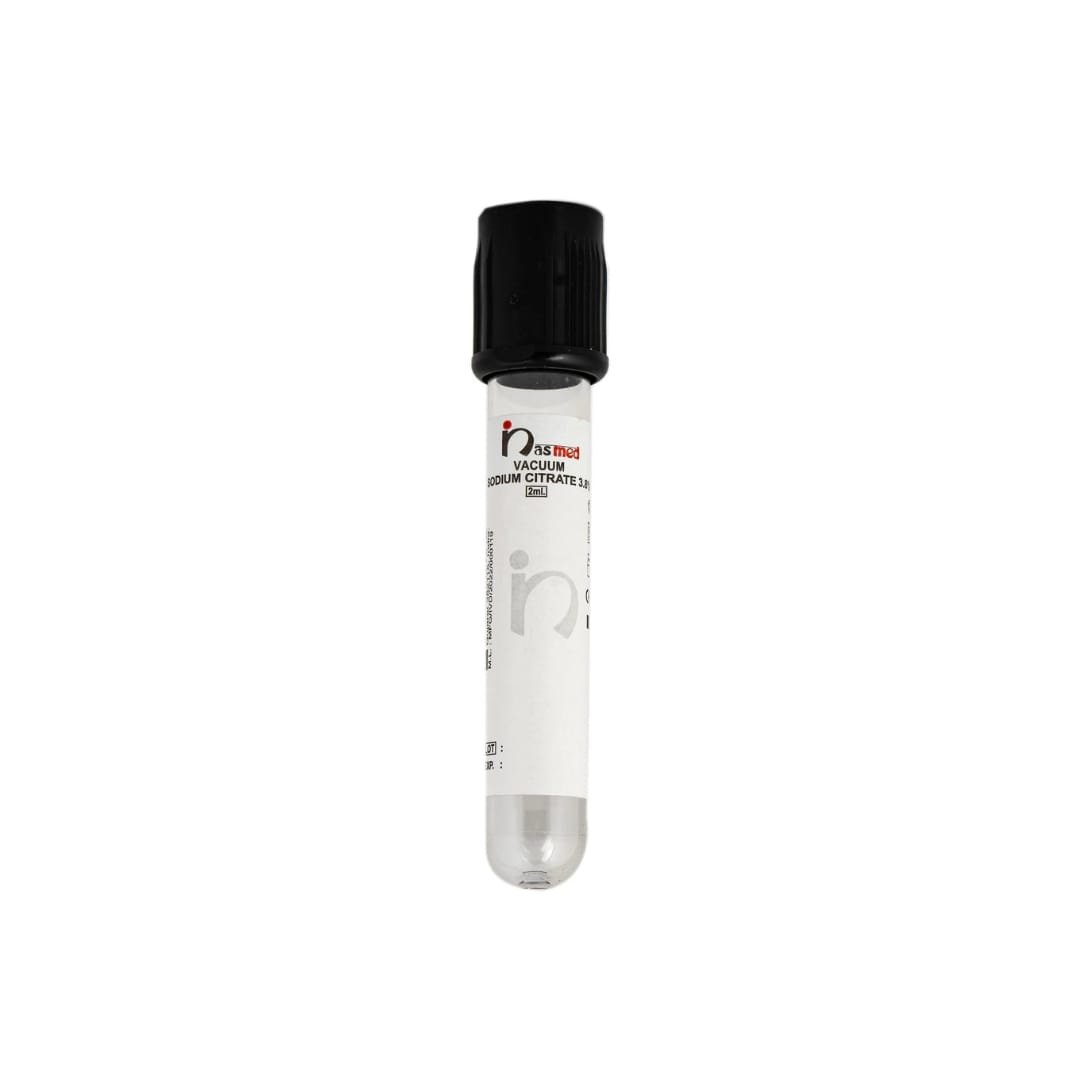
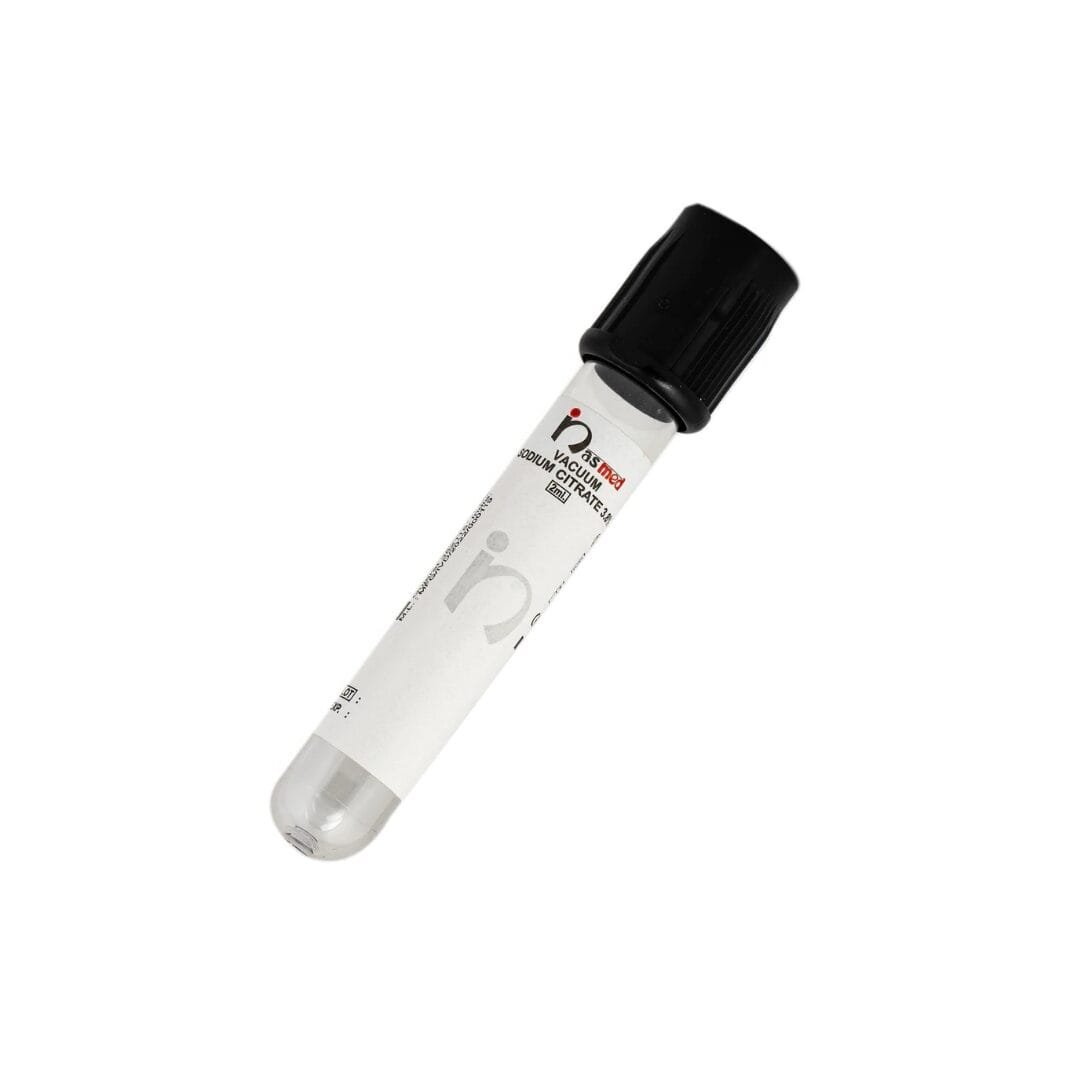
Sodium Citrate 3.8% Blood Collection Tube | Coagulation & ESR Vacuum Tubes
A Sodium Citrate 3.8% Blood Collection Tube is a vacuum-based blood collection device used primarily for coagulation studies such as Prothrombin Time (PT), International Normalised Ratio (INR), Activated Partial Thromboplastin Time (APTT), and the Erythrocyte Sedimentation Rate (ESR) test. Identified by its light blue cap, this tube contains a buffered 3.8% (0.129 mol/L) tri-sodium citrate solution that binds calcium ions in blood, temporarily preventing clot formation so that laboratories can measure how blood clots under controlled conditions.
At Nasmed Diagnostic, every Sodium Citrate 3.8% Blood Collection Tube is manufactured under strict quality protocols to ensure a consistent 9:1 blood-to-additive ratio, accurate vacuum draw, and reliable results — batch after batch. Whether you run a diagnostic lab, hospital pathology department, or a blood collection centre, this tube is a dependable choice for hemostasis testing.
What Is a Sodium Citrate 3.8% Blood Collection Tube?
The Sodium Citrate 3.8% tube is a pre-evacuated (vacuum) glass or PET tube pre-filled with a measured quantity of tri-sodium citrate anticoagulant. When blood is drawn into the tube, the citrate ions chelate (bind) free calcium in the plasma. Since calcium is essential for the coagulation cascade, this reversible binding stops the clotting process without permanently damaging clotting factors — which is critical, because the lab needs those factors intact to measure how fast the blood would clot once calcium is added back during testing.
This tube is different from a Sodium Citrate 3.2% tube mainly in its citrate concentration, which affects the additive-to-blood ratio slightly and can influence PT/INR results in certain patient groups (e.g., high hematocrit or those on anticoagulant therapy).
Key Features & Specifications
| Specification | Details |
|---|---|
| Additive | Tri-Sodium Citrate, 3.8% (0.129 mol/L) |
| Cap Colour | Light Blue |
| Blood-to-Additive Ratio | 9:1 |
| Tube Material | Medical-grade Glass / PET (shatter-resistant) |
| Draw Type | Vacuum (evacuated) technology |
| Common Volumes | 1.8 mL, 2 mL, 2.7 mL, 3 mL (custom sizes available) |
| Primary Use | Coagulation studies (PT, INR, APTT) & ESR |
| Sterility | Sterile, single-use, non-pyrogenic |
| Storage | Store at room temperature, away from direct sunlight |
| Shelf Life | As per batch expiry printed on label |
How Does It Work? (Principle)
- Blood is drawn directly into the tube using the vacuum pressure inside it.
- The tube must be filled exactly to the marked fill line — this maintains the precise 9:1 blood-to-citrate ratio, which is essential for test accuracy.
- Immediately after collection, the tube should be gently inverted 3–4 times to mix the additive with the blood without causing hemolysis.
- The sodium citrate binds calcium ions, halting the coagulation cascade at the point of collection.
- In the lab, the sample is centrifuged to separate platelet-poor plasma, which is then used for coagulation analysers (PT/INR/APTT) or, in the case of ESR, read directly in a Westergren tube.
Why the fill line matters: An under-filled or over-filled Sodium Citrate tube changes the blood-to-citrate ratio, which can produce falsely prolonged or shortened clotting results — a major source of pre-analytical error in laboratories.
Clinical Applications & Uses
- Prothrombin Time (PT) & INR – used to monitor patients on warfarin/anticoagulant therapy
- Activated Partial Thromboplastin Time (APTT) – used to detect bleeding disorders and monitor heparin therapy
- Erythrocyte Sedimentation Rate (ESR) – used as a general marker of inflammation
- Fibrinogen assays and other special coagulation tests
- Pre-surgical coagulation screening in hospitals and surgical centres
- Research and academic laboratory use
Sodium Citrate 3.8% vs Other Blood Collection Tubes – Comparison Table
Choosing the correct tube additive is critical for accurate diagnostic results. Here’s how the Sodium Citrate 3.8% tube compares with other commonly used anticoagulant tubes available at Nasmed Diagnostic:
| Parameter | Sodium Citrate 3.8% (This Product) | Sodium Citrate 3.2% | Sodium Heparin | Sodium Fluoride |
|---|---|---|---|---|
| Cap Colour | Light Blue | Light Blue | Dark Green | Grey |
| Anticoagulant | Tri-sodium citrate 3.8% | Tri-sodium citrate 3.2% | Heparin (sodium salt) | Sodium fluoride + oxalate/EDTA |
| Mechanism | Binds calcium ions | Binds calcium ions | Activates antithrombin III | Inhibits glycolysis enzymes |
| Primary Use | Coagulation studies, ESR | Coagulation studies (PT/INR/APTT) | Plasma chemistry, blood gases, chromosome studies | Blood glucose, lactate testing |
| Blood:Additive Ratio | 9:1 | 9:1 | N/A (spray-coated) | N/A (spray-coated) |
| Sample Type Produced | Citrated plasma | Citrated plasma | Heparinised plasma | Glucose-stable whole blood/plasma |
| Best For | Hemostasis / clotting tests | Hemostasis / clotting tests | Rapid biochemistry, STAT tests | Diabetes screening, glucose monitoring |
Explore our complete tube range on the Our Products page.
Why Choose Nasmed Diagnostic for Blood Collection Tubes?
- Consistent Quality: Every batch is quality-checked for vacuum accuracy, additive concentration, and sterility before dispatch.
- Precision Manufacturing: Fill-line accuracy is maintained to avoid the 9:1 ratio errors that commonly cause pre-analytical test failures.
- Reliable Bulk Supply: We support diagnostic labs, hospitals, and distributors across India with consistent stock availability.
- Wide Product Range: From Sodium Citrate to Sodium Heparin and Sodium Fluoride tubes, Nasmed Diagnostic manufactures a complete portfolio of blood collection consumables — browse the full range on our Our Products page.
- Experienced Team: Backed by years of experience in IVD (in-vitro diagnostics) manufacturing and quality compliance.
As per international pre-analytical standards, incorrect order of draw or incorrect fill volume in citrate tubes is one of the leading causes of specimen rejection in coagulation testing — which is why using a properly manufactured, fill-line-accurate tube like Nasmed’s Sodium Citrate 3.8% tube matters for lab accuracy. For further reading on laboratory blood test standards, you can refer to the U.S. National Library of Medicine (NIH) resource on laboratory testing: MedlinePlus – Erythrocyte Sedimentation Rate (ESR) Test.
Frequently Asked Questions (FAQs)
Q1. What is a Sodium Citrate 3.8% Blood Collection Tube used for?
- It is mainly used for coagulation tests such as PT, INR, and APTT, as well as the ESR (Erythrocyte Sedimentation Rate) test. The tube’s light blue cap identifies it in the lab.
Q2. What is the difference between Sodium Citrate 3.2% and 3.8% tubes?
- Both tubes work on the same principle of binding calcium to prevent clotting, but they differ slightly in citrate concentration. Most modern CLSI guidelines recommend 3.2% for routine coagulation testing, while 3.8% concentration tubes remain in use for ESR and specific regional/lab protocols. Your lab’s SOP will specify which one to use.
Q3. Why must the tube be filled exactly to the marked line?
- The 9:1 blood-to-citrate ratio is essential for accurate results. Underfilling increases the relative citrate concentration and can falsely prolong clotting times, while overfilling can do the opposite.
Q4. How many times should a citrate tube be inverted after collection?
- Standard practice is to gently invert the tube 3–4 times immediately after collection to mix the additive thoroughly, without shaking vigorously, which can cause hemolysis and affect results.
Q5. Can Sodium Citrate tubes be used for routine blood sugar or CBC tests?
- No. Sodium Citrate tubes are specifically for coagulation and ESR testing. For blood glucose, a Sodium Fluoride tube is used, and for CBC, an EDTA tube is required.
Q6. Where can I buy Sodium Citrate 3.8% Blood Collection Tubes in bulk?
- Nasmed Diagnostic supplies Sodium Citrate 3.8% Blood Collection Tubes in bulk to diagnostic labs, hospitals, and distributors. You can browse our full range on the Our Products page or Contact Us for pricing and availability.
Q7. Is Nasmed Diagnostic’s Sodium Citrate tube suitable for NABL-accredited labs?
- Yes, our tubes are manufactured under strict quality control processes suitable for use in NABL-accredited and quality-conscious diagnostic laboratories. For product certifications or documentation, please get in touch with our team.
Need Bulk Supply or Custom Specifications?
Nasmed Diagnostic is a trusted manufacturer of blood collection tubes and IVD consumables serving diagnostic laboratories, hospitals, and distributors across India. For pricing, bulk orders, private labelling, or product documentation, Contact Us today, or visit nasmeddiagnostic.com to explore our full product range.