

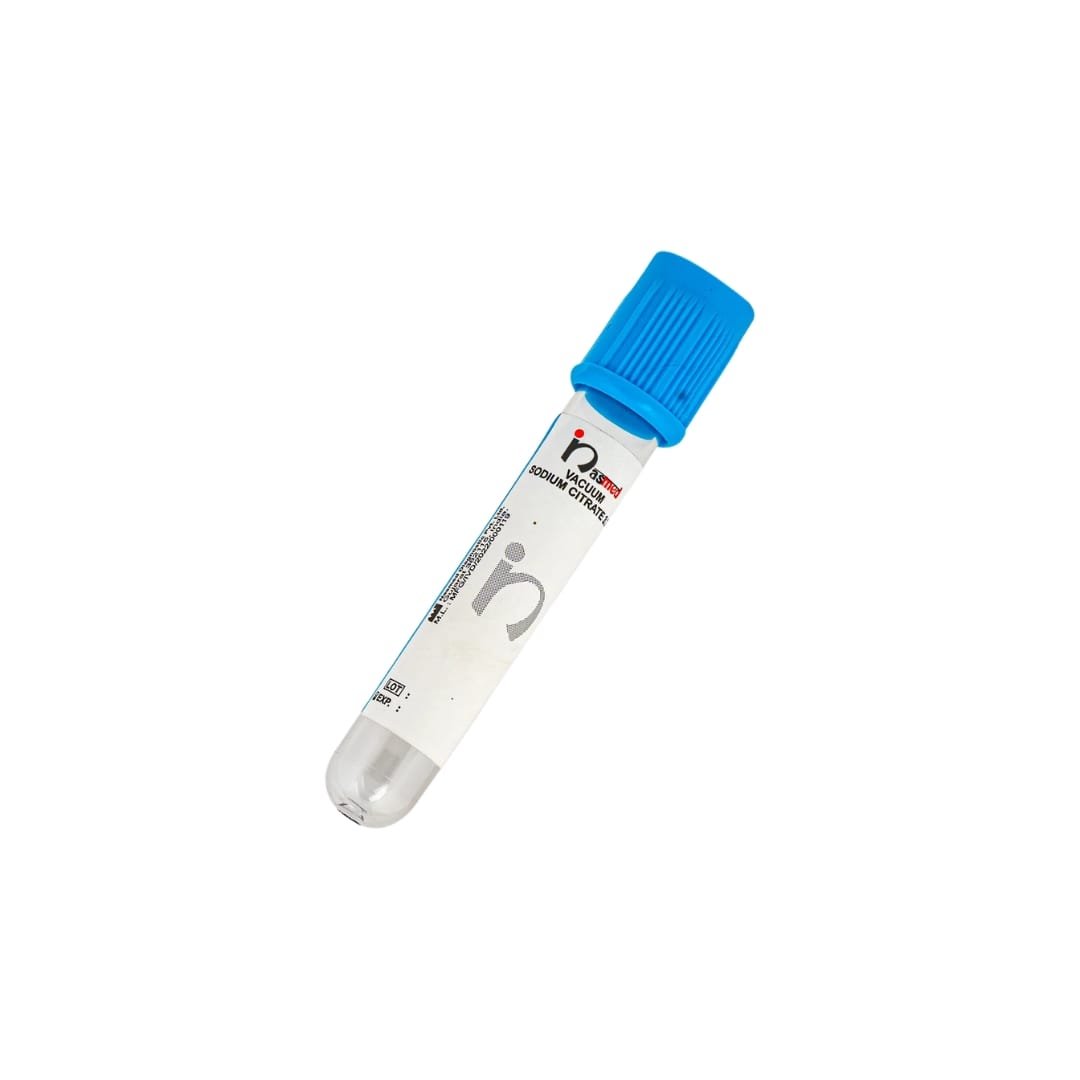
Looking for a reliable coagulation blood collection tube that gives your lab consistent, accurate results every time? The Sodium Citrate 3.2% Blood Collection Tube from Nasmed Diagnostics is specifically designed for coagulation studies such as PT (Prothrombin Time) and APTT (Activated Partial Thromboplastin Time). Identified by its distinctive light-blue top, this tube uses a precise 3.2% sodium citrate solution to bind calcium ions and prevent clotting, preserving the coagulation factors in the blood sample until it reaches the laboratory.
Whether you run a diagnostic lab, hospital pathology department, or blood bank, this tube ensures sample integrity, reduces pre-analytical errors, and supports reliable diagnostic outcomes. Explore our full catalogue of blood collection tubes on the Nasmed Diagnostics products page, or contact our team for bulk orders and pricing.
What Is a Sodium Citrate 3.2% Blood Collection Tube?
A Sodium Citrate 3.2% Blood Collection Tube is a vacuum or non-vacuum tube pre-filled with a 3.2% (0.109 mol/L) buffered sodium citrate solution. This anticoagulant works by chelating (binding) calcium ions in the blood, which interrupts the coagulation cascade and keeps the sample liquid without destroying the clotting factors themselves. This makes the tube uniquely suited for coagulation testing, unlike EDTA or heparin tubes, which are used for hematology or biochemistry tests respectively.
The standard draw ratio for these tubes is 9 parts blood to 1 part sodium citrate, a ratio that must be maintained precisely — underfilling or overfilling the tube can directly affect PT/APTT results and lead to inaccurate diagnosis.
Key Features & Specifications
| Specification | Details |
|---|---|
| Anticoagulant | Buffered Sodium Citrate |
| Concentration | 3.2% (0.109 mol/L) |
| Cap Colour | Light Blue |
| Blood-to-Additive Ratio | 9:1 |
| Tube Type | Vacuum / Non-Vacuum options |
| Primary Use | Coagulation studies (PT, APTT, INR, Fibrinogen) |
| Material | Medical-grade PET/Glass |
| Sterility | Sterile, single-use, individually sealed |
| Suitable For | Hospitals, diagnostic labs, blood banks, pathology centres |
How Does Sodium Citrate Prevent Blood Clotting?
Sodium citrate prevents coagulation by binding free calcium ions in the blood plasma. Since calcium is an essential cofactor in multiple steps of the clotting cascade, removing it stops the blood from clotting inside the tube — while keeping the clotting factors intact and measurable. This is precisely why sodium citrate tubes, and not other anticoagulant tubes, are the correct choice whenever a coagulation profile is ordered.
Clinical Applications
Sodium Citrate 3.2% tubes are routinely used for:
- Prothrombin Time (PT) and INR testing, commonly used to monitor patients on anticoagulant therapy (e.g., warfarin)
- Activated Partial Thromboplastin Time (APTT) testing
- Fibrinogen level assessment
- D-Dimer testing for clotting disorders
- Pre-surgical coagulation screening
- Coagulation factor assays in specialised hematology labs
Sodium Citrate 3.2% vs Sodium Citrate 3.8%: What’s the Difference?
Both concentrations are used for coagulation testing, but they are not interchangeable, and choosing the right one matters for accurate results.
| Parameter | Sodium Citrate 3.2% | Sodium Citrate 3.8% |
|---|---|---|
| Molar Concentration | 0.109 mol/L | 0.129 mol/L |
| Global Standard | Recommended by CLSI/WHO for routine coagulation testing | Older concentration, now used less frequently |
| Common Use | Standard PT/APTT testing in most modern labs | Used in select legacy protocols and specific regional labs |
| Result Consistency | More standardised across international guidelines | Can show variability if reference ranges aren’t adjusted |
| Availability | Widely stocked, industry preferred | Available for specific institutional requirements |
Need the 3.8% variant instead? View the Sodium Citrate 3.8% Blood Collection Tube from Nasmed Diagnostics.
Sodium Citrate Tube vs Other Blood Collection Tubes
Choosing the correct tube additive is critical since each anticoagulant serves a different diagnostic purpose.
| Tube Type | Anticoagulant | Primary Use | Cap Colour |
|---|---|---|---|
| Sodium Citrate 3.2% | Sodium Citrate | Coagulation studies (PT, APTT) | Light Blue |
| Lithium Heparin Tube | Lithium Heparin | Plasma biochemistry, electrolytes | Green |
| Sodium Fluoride Tube | Sodium Fluoride / Potassium Oxalate | Glucose & lactate estimation | Grey |
Using the wrong tube for the wrong test is one of the most common pre-analytical errors in laboratories, so always match the tube additive to the test requested.
Why Choose Nasmed Diagnostics?
- Consistent quality — every batch is manufactured under strict quality control for accurate anticoagulant ratios
- Wide product range — from coagulation to hematology and biochemistry tubes, explore the complete range on our products page
- Trusted by labs across India — supplying hospitals, diagnostic centres, and pathology labs
- Reliable supply chain — bulk and institutional orders fulfilled on time
- Dedicated support — get in touch with our team for product queries, samples, or bulk pricing
Visit nasmed diagnostic to explore our complete diagnostic consumables range.
Correct Blood Collection Procedure for Coagulation Tubes
To ensure accurate coagulation results, healthcare professionals should follow standard phlebotomy protocols — correct order of draw, complete tube filling to the marked line, and immediate gentle inversion (3–4 times) to mix the sample with the anticoagulant without causing hemolysis. For detailed, globally recognised procedural standards, refer to the WHO Guidelines on Drawing Blood: Best Practices in Phlebotomy, hosted by the U.S. National Library of Medicine (NIH).
Frequently Asked Questions (FAQs)
Q1. What is a Sodium Citrate 3.2% Blood Collection Tube used for?
- It is primarily used for coagulation studies such as PT, APTT, INR, fibrinogen, and D-Dimer testing.
Q2. Why is the cap of a Sodium Citrate tube light blue?
- The light-blue cap is an internationally recognised color code that helps phlebotomists and lab technicians instantly identify the tube as a coagulation-specific tube.
Q3. What is the correct blood-to-anticoagulant ratio for this tube?
- The standard ratio is 9 parts blood to 1 part sodium citrate. Incorrect filling can significantly affect test accuracy.
Q4. Can Sodium Citrate 3.2% and 3.8% tubes be used interchangeably?
- No. They have different molar concentrations, and most modern laboratory guidelines (CLSI/WHO) recommend 3.2% as the standard for routine coagulation testing.
Q5. Why is proper tube filling important in coagulation testing?
- Underfilling or overfilling changes the blood-to-citrate ratio, which can lead to falsely prolonged or shortened PT/APTT results.
Q6. Is the Sodium Citrate tube suitable for glucose testing?
- No. Glucose testing requires a Sodium Fluoride tube. Using the wrong tube type can lead to inaccurate results.
Q7. Where can I buy Sodium Citrate 3.2% Blood Collection Tubes in bulk?
- You can order directly from Nasmed Diagnostics or contact our sales team for institutional and bulk pricing.
Order Sodium Citrate 3.2% Blood Collection Tubes Today
Ensure accurate coagulation testing in your lab with Nasmed Diagnostics’ Sodium Citrate 3.2% Blood Collection Tubes. Browse our full product range or contact us today for pricing, samples, and bulk order assistance.