
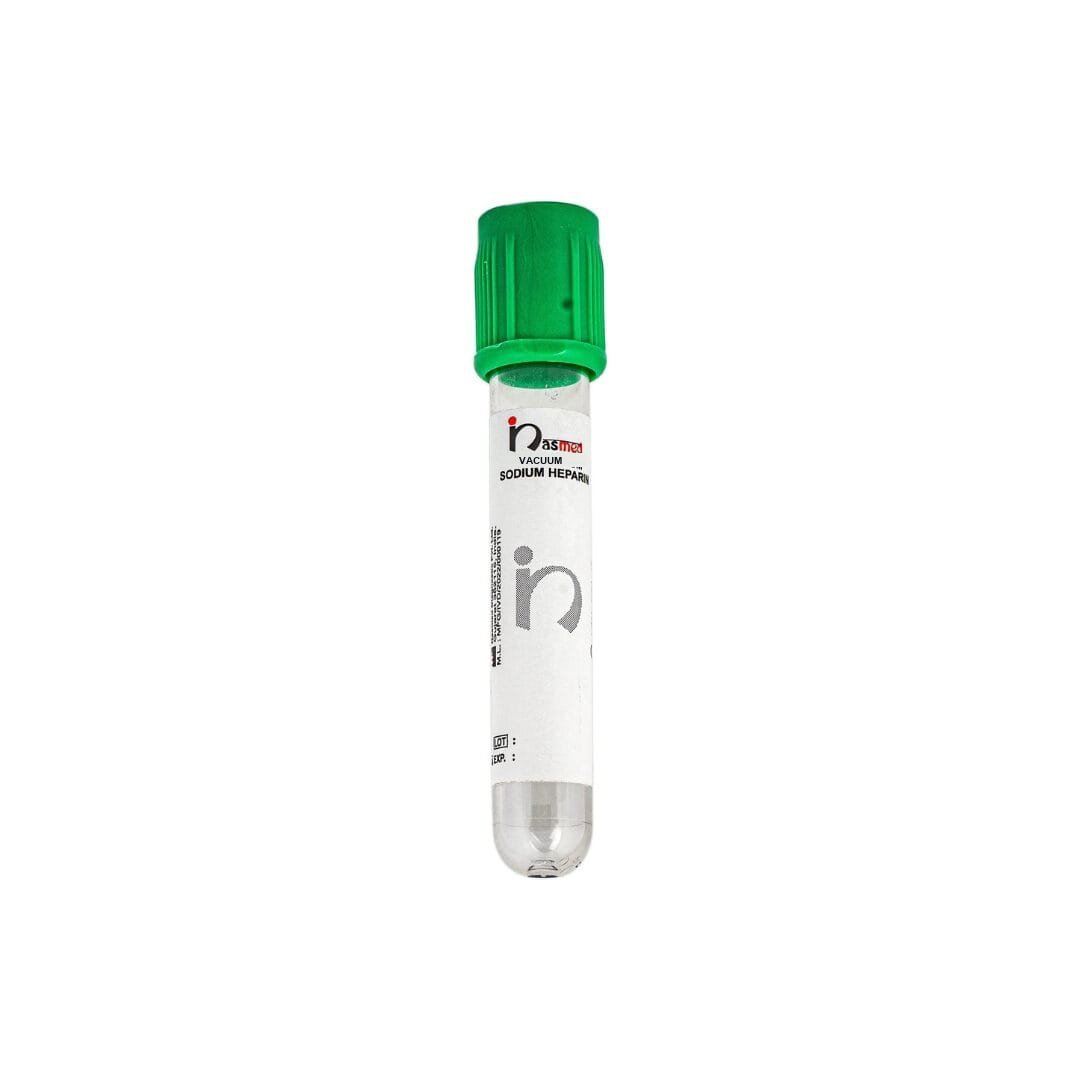
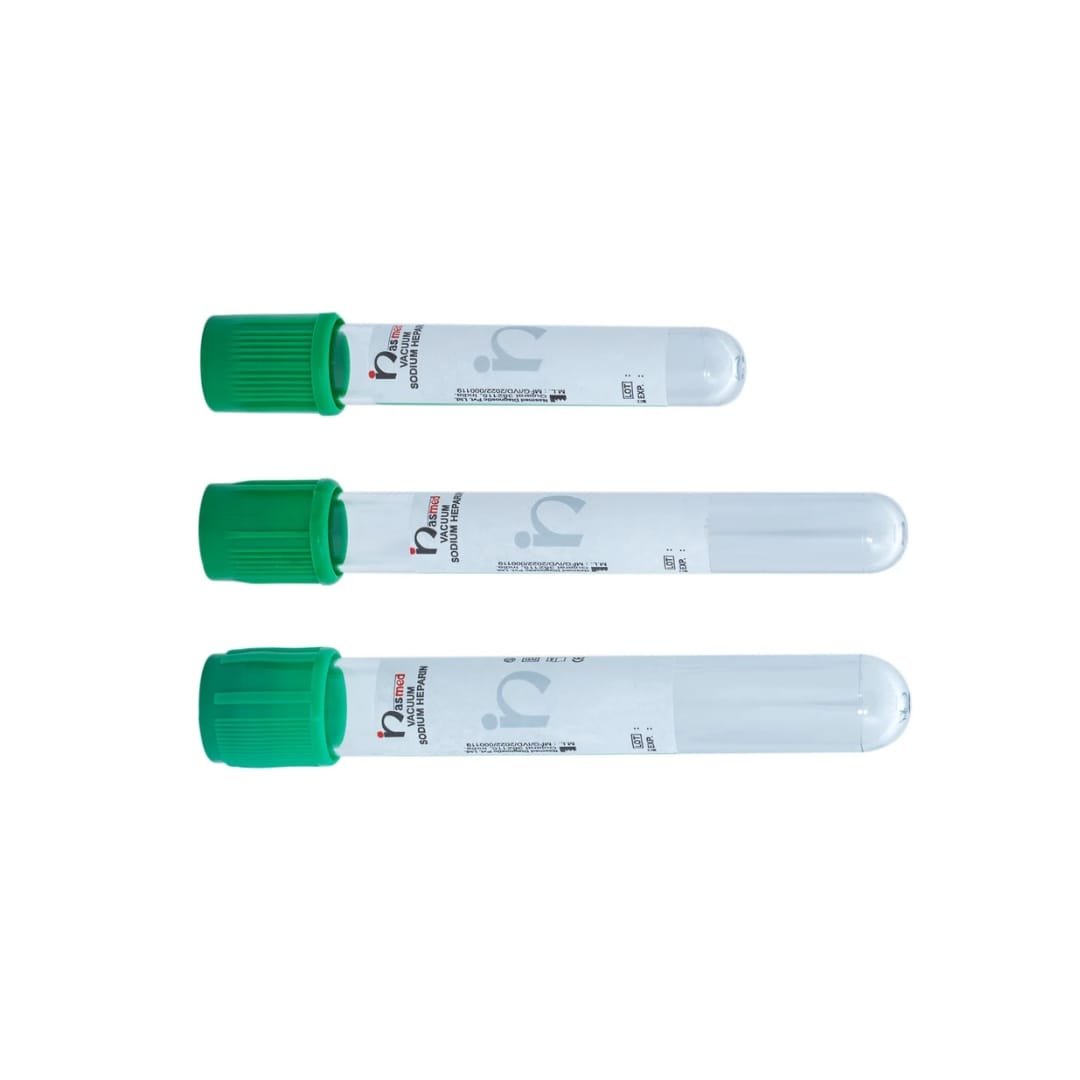
A Sodium Heparin Blood Collection Tube (commonly called a “green top tube”) is a vacuum blood collection tube pre-coated with sodium heparin, an anticoagulant that stops blood from clotting so labs can separate and test plasma instead of serum. It is the tube of choice for tests that need fast turnaround, such as ammonia, blood gases, electrolytes, and several stat chemistry panels, because plasma can be obtained by centrifugation within minutes, without waiting for clot formation.
Nasmed Diagnostic manufactures and supplies sodium heparin tubes that meet clinical laboratory standards for anticoagulant fill volume, draw draw-fill ratio, and vacuum consistency — built for hospitals, pathology labs, and diagnostic centres that cannot afford sample rejection.
What Is a Sodium Heparin Blood Collection Tube?
A sodium heparin tube is a sterile, vacuum-sealed glass or plastic tube with a green rubber stopper, internally coated with sodium heparin salt. When blood enters the tube, heparin binds to antithrombin III in the plasma, which inactivates thrombin and clotting factor Xa. Because clotting is blocked at the source, the blood stays in its liquid (whole blood/plasma) state, and the sample can be spun down to separate plasma from blood cells almost immediately after collection.
This is different from a clot activator tube, which is designed to encourage clotting so serum can be extracted after the clot forms — a process that naturally takes longer.
Why Sodium Heparin Instead of Other Anticoagulants?
- No interference with most chemistry assays — sodium heparin does not distort electrolyte, enzyme, or metabolic panel results the way EDTA or citrate can.
- Faster processing — no clotting wait time, which matters for STAT and emergency lab requests.
- Preferred for specific tests — ammonia, blood gas analysis, chromosome/karyotype studies, and certain hormone assays typically require heparinized plasma.
Key Features of Nasmed Diagnostic’s Sodium Heparin Tube
- Precise Sodium Heparin Coating – Uniform internal spray-coating ensures consistent anticoagulant activity across every tube in the batch, minimising the risk of micro-clots.
- Accurate Vacuum Draw – Factory-calibrated vacuum pulls the exact blood volume printed on the label, maintaining the correct blood-to-anticoagulant ratio.
- Color-Coded Green Stopper – Meets international (ISO 6710) color-coding conventions so lab staff and phlebotomists can identify the tube instantly and avoid sample mix-ups.
- Medical-Grade PET/Glass Construction – Shatter-resistant, non-reactive material that protects sample integrity during transport and centrifugation.
- Clear Volume Graduation – Printed fill-line markings support correct draw volume for accurate lab results.
- Sterile, Single-Use, Latex-Free – Manufactured and packed under controlled conditions to prevent contamination.
Technical Specifications
| Specification | Details |
|---|---|
| Additive | Sodium Heparin |
| Stopper Colour | Green |
| Tube Material | Medical-grade PET / Borosilicate Glass |
| Draw Volumes Available | 2 ml, 3 ml, 4 ml, 5 ml, 6 ml |
| Sample Type Obtained | Heparinised Plasma / Whole Blood |
| Sterility | Sterile, Single-Use |
| Shelf Life | As per manufacturing batch (printed on label) |
| Storage Condition | Store at 4°C–25°C, away from direct sunlight |
| Compliance | Manufactured under GMP-controlled facility |
(Exact volumes and pack sizes may vary — please check the live product listing or contact our team for current availability.)
Common Clinical Applications
Sodium heparin plasma tubes are widely used for:
- Blood gas analysis and pH studies
- Ammonia level testing
- Electrolyte panels (Sodium, Potassium, Chloride)
- Liver and kidney function tests requiring rapid turnaround
- Chromosomal/cytogenetic analysis
- Certain hormone and trace-element assays
- Emergency/STAT chemistry testing in hospital labs
Sodium Heparin vs. Other Blood Collection Tubes – Comparison Table
Choosing the right tube depends entirely on the test being ordered. Here’s how sodium heparin tubes compare with the other additive tubes available from NAS Med Diagnostic:
| Tube Type | Additive | Stopper Colour | Sample Obtained | Best Used For |
|---|---|---|---|---|
| Sodium Heparin Tube | Sodium Heparin | Green | Plasma | STAT chemistry, blood gases, ammonia, electrolytes |
| Clot Activator Tube | Clot Activator (Silica particles) | Red | Serum | Routine serology, hormone assays, general chemistry |
| Gel Clot Activator Tube | Clot Activator + Separator Gel | Yellow/Gold | Serum (gel-separated) | Biochemistry, immunoassays, tests needing clean serum separation |
| Sodium Fluoride Tube | Sodium Fluoride + Oxalate/EDTA | Grey | Plasma (glucose-stable) | Blood glucose, lactate testing |
In short: if the requisition asks for plasma without waiting for a clot, choose sodium heparin. If it calls for serum, a clot activator or gel tube is the correct choice. If the test is glucose or lactate, sodium fluoride is the standard.
How to Use and Store Sodium Heparin Tubes?
- Confirm patient identity and test requisition before draw.
- Follow the recommended order of draw to prevent cross-contamination between additives.
- Fill the tube to the marked volume line — under-filling or over-filling changes the blood-to-heparin ratio and can affect results.
- Invert the tube gently 8–10 times immediately after draw to mix the additive with blood (do not shake).
- Centrifuge as per your lab’s SOP to separate plasma.
- Store unused tubes at room temperature, away from direct heat and sunlight, and use before the printed expiry date.
For standardized, evidence-based phlebotomy and specimen-handling practices, laboratories can refer to the WHO Guidelines on Drawing Blood: Best Practices in Phlebotomy, hosted on the official U.S. government CDC archive: CDC Stacks – WHO Guidelines on Drawing Blood.
Why Choose Nasmed Diagnostic?
NAS Med Diagnostic has been supplying blood collection consumables to hospitals, pathology labs, and diagnostic centres with a focus on consistency, compliance, and reliability. Our sodium heparin tubes are manufactured under controlled quality processes, batch-tested for vacuum accuracy and additive coating, and packed to prevent contamination during transit.
We understand that in a diagnostic lab, a single faulty tube can mean a rejected sample, a delayed report, and a re-draw for the patient. That’s why our quality checks focus on the two things that matter most in a heparin tube: correct anticoagulant dosing and accurate draw volume — batch after batch.
Explore our complete catalogue of blood collection tubes and lab consumables on our Products page, or learn more about our company and manufacturing standards at nasmed diagnostic.
Looking to Order in Bulk?
We supply sodium heparin tubes in bulk packs for hospitals, diagnostic chains, and distributors, with customised packaging and volume-based pricing. Browse our full range on the Our Products page, or get in touch with our team for a quotation, sample request, or distributorship enquiry.
Visit nasmed diagnostic to learn more about our full range of diagnostic and lab consumable products.
Frequently Asked Questions (FAQs)
Q1. What does the green top on a blood collection tube mean?
- A green stopper indicates the tube contains sodium or lithium heparin, an anticoagulant used to obtain plasma samples for tests that require quick processing, such as blood gases, ammonia, and electrolyte panels.
Q2. What is the difference between sodium heparin and lithium heparin tubes?
- Both prevent clotting the same way, but sodium heparin can slightly elevate sodium ion readings, while lithium heparin can slightly elevate lithium readings. Labs choose the anticoagulant based on which electrolyte is being tested to avoid interference.
Q3. Can sodium heparin tubes be used for a Complete Blood Count (CBC)?
- No. CBC testing requires EDTA (lavender top) tubes, which better preserve cell morphology. Sodium heparin tubes are not recommended for routine haematology counts due to potential cell clumping and staining artifacts.
Q4. Why is the blood-to-additive ratio important in heparin tubes?
- Under-filling a heparin tube leaves too much heparin relative to blood volume, which can dilute the sample and skew certain chemistry results. This is why filling to the marked line and following correct draw technique matters.
Q5. How should sodium heparin tubes be stored before use?
- Store unopened tubes at room temperature (typically 4°C–25°C), away from direct sunlight and excessive heat, and use them before the expiry date printed on the tube label.
Q6. Where can I buy sodium heparin blood collection tubes in bulk for my lab?
- You can order sodium heparin tubes directly from NAS Med Diagnostic. Check current pack sizes and volumes on our Products page or contact us for bulk pricing and delivery timelines.
Need Help Choosing the Right Tube?
If you’re unsure which blood collection tube fits your test panel — sodium heparin, clot activator, gel separator, or sodium fluoride — our team can help you match the right consumable to your lab’s requirements. Contact Nasmed Diagnostic today for product guidance, samples, or a bulk quote.