
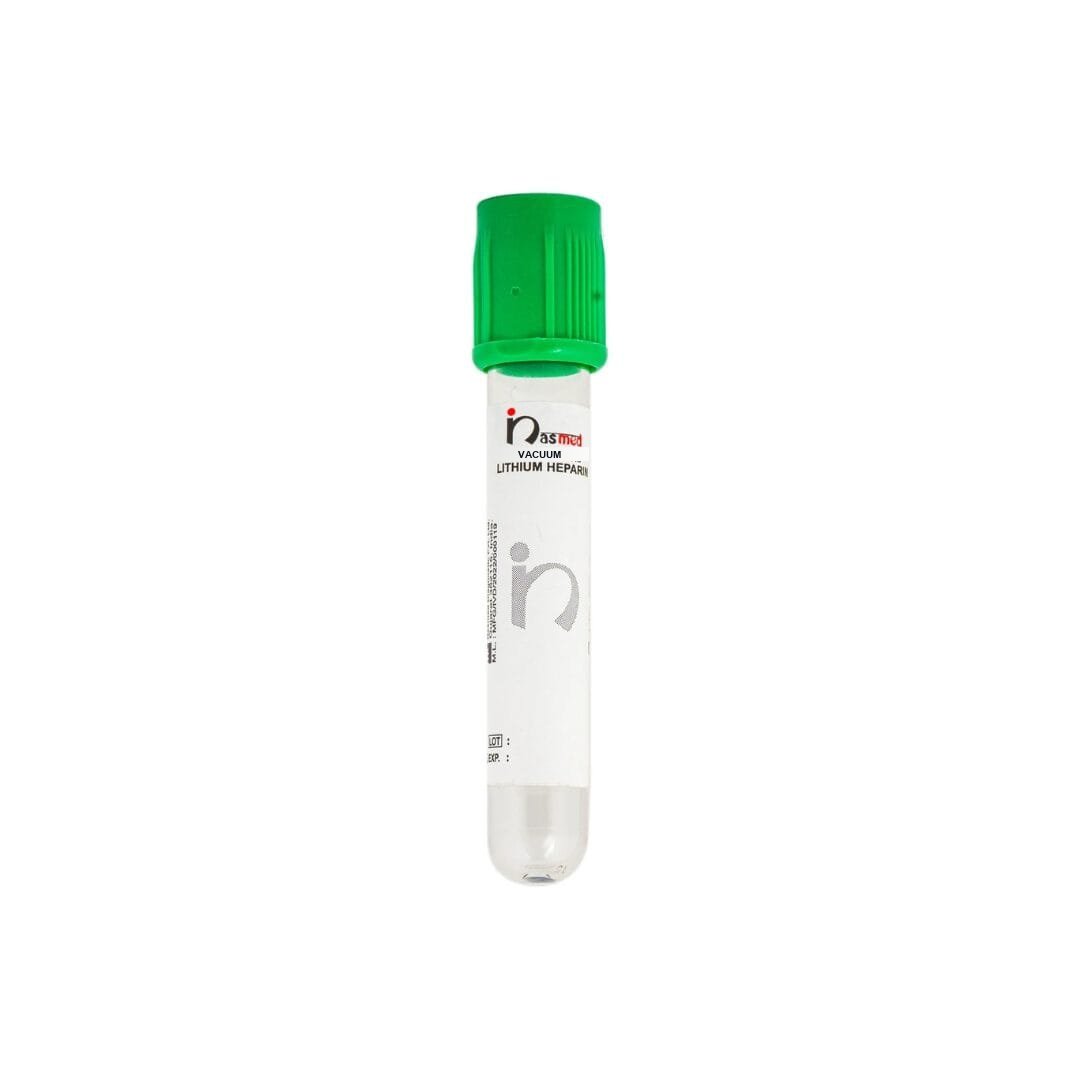
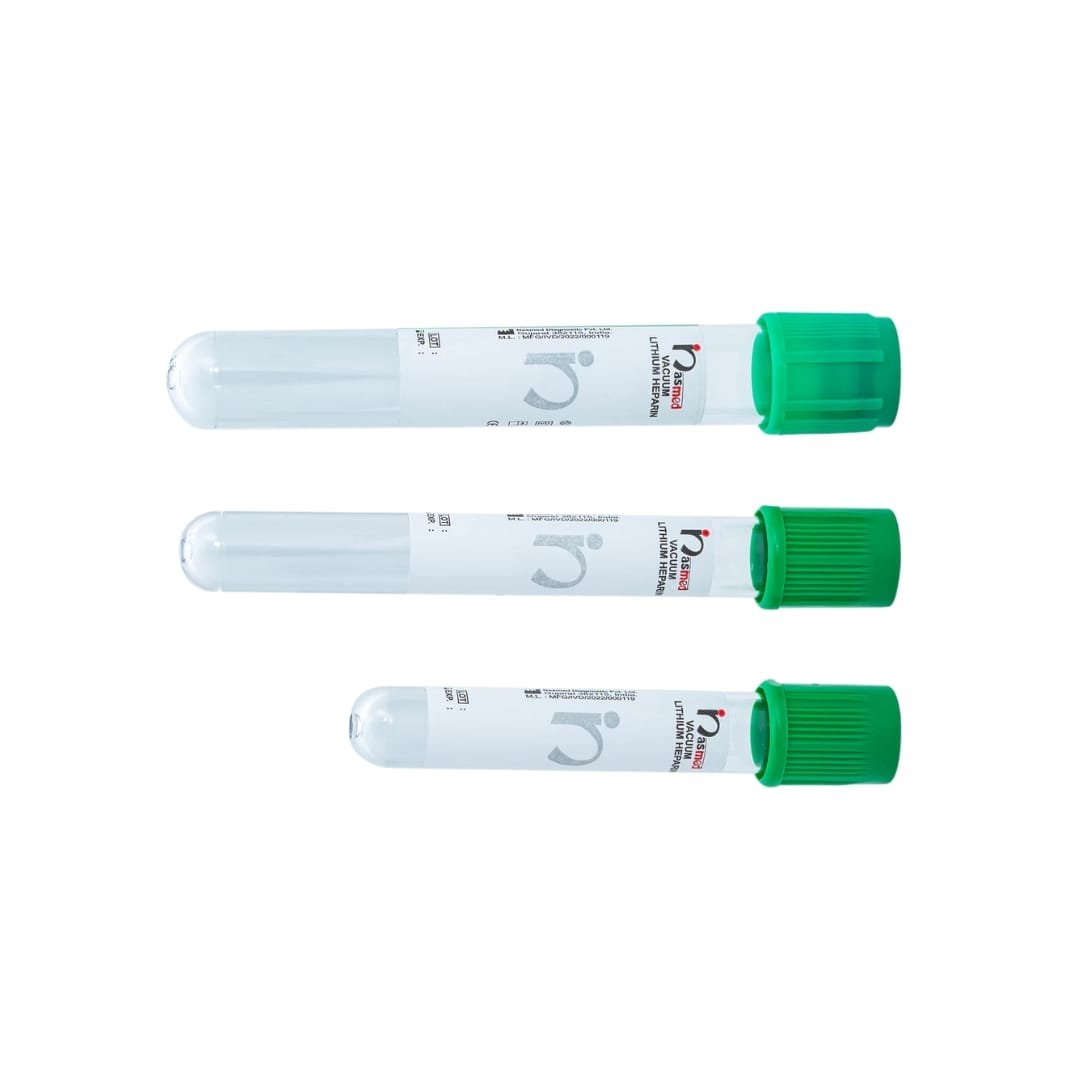
Accurate diagnosis begins with a correctly collected blood sample. The Nasmed Lithium Heparin Blood Collection Tube is engineered to deliver clot-free, high-quality plasma samples for biochemistry, electrolyte, and emergency testing — helping laboratories and hospitals get faster, more reliable results with every draw.
What Is a Lithium Heparin Blood Collection Tube?
A Lithium Heparin blood collection tube is a green-top vacuum tube coated internally with lithium heparin, an anticoagulant that prevents blood from clotting without altering its chemical composition. Unlike EDTA, heparin does not chelate calcium or other ions, which makes it the preferred choice for tests where mineral and electrolyte accuracy matters — such as liver function tests (LFT), kidney function tests (KFT), and blood gas analysis.
Key Features of Nasmed Lithium Heparin Tubes
- Lithium Heparin Coating – Uniformly sprayed for consistent, rapid anticoagulation across the full sample volume
- Vacuum-Draw Technology – Ensures a precise, pre-measured blood volume with minimal hemolysis risk
- Medical-Grade PET Material – Shatter-resistant, safer than glass for handling and transport
- Color-Coded Green Cap – Meets international tube color-coding standards for instant identification
- Sterile & Non-Toxic – Manufactured in a controlled, contamination-free environment
- Clear Graduation Marks – For accurate fill-volume verification
Technical Specifications
| Parameter | Specification |
|---|---|
| Additive | Lithium Heparin (spray-coated) |
| Cap Color | Green |
| Tube Material | Medical-grade PET (unbreakable) |
| Draw Type | Vacuum (evacuated) |
| Sample Type Yielded | Heparinized Plasma / Whole Blood |
| Common Volumes | 2 ml, 3 ml, 4 ml, 5 ml |
| Shelf Life | Up to 24 months from manufacturing |
| Sterility | Sterile, single-use, disposable |
| Packaging | 100 tubes per box |
How Does Lithium Heparin Work as an Anticoagulant?
Heparin works by activating antithrombin III, which neutralizes thrombin and blocks the clotting cascade at multiple points. Because it prevents clot formation without binding calcium the way EDTA or citrate does, samples collected in lithium heparin tubes remain chemically closer to native blood — making them ideal for electrolyte panels, ammonia testing, and situations requiring rapid stat results.
Comparison Table: Lithium Heparin vs Other Anticoagulant Tubes
| Tube Type | Anticoagulant | Cap Color | Best Used For |
|---|---|---|---|
| Lithium Heparin Tube | Lithium Heparin | Green | LFT, KFT, electrolytes, stat biochemistry |
| K3 EDTA Tube | EDTA | Lavender/Purple | CBC, hematology, blood grouping |
| Sodium Citrate 3.2% Tube | Sodium Citrate (3.2%) | Light Blue | Coagulation studies, PT/INR, APTT |
| Sodium Citrate 3.8% Tube | Sodium Citrate (3.8%) | Light Blue | ESR, older coagulation protocols |
Choosing the right tube directly affects test accuracy — using the wrong anticoagulant can distort results or make a sample unusable. Browse our complete range on the Nasmed Diagnostic Our Products page to find the right tube for every test type.
Applications & Clinical Uses
- Liver Function Tests (LFT)
- Kidney/Renal Function Tests (KFT)
- Electrolyte panels (Sodium, Potassium, Chloride)
- Ammonia level testing
- Blood gas and pH analysis
- Emergency/stat biochemistry testing where rapid plasma separation is needed
Correct Blood Collection Procedure (Order of Draw)
- Confirm patient identity and label the tube before draw.
- Perform venipuncture using standard aseptic technique.
- Allow the vacuum to draw the exact required blood volume.
- Gently invert the tube 8–10 times immediately after collection to mix the anticoagulant — never shake.
- Centrifuge as per your lab protocol to separate plasma.
- Store and transport at the recommended temperature to preserve sample integrity.
These steps align with internationally recognized best practices for safe and accurate specimen collection, as outlined in the WHO Guidelines on Drawing Blood: Best Practices in Phlebotomy hosted by the U.S. National Institutes of Health (NIH).
Why Choose Nasmed Diagnostic?
Nasmed Diagnostic manufactures blood collection tubes under strict quality protocols to ensure every batch delivers consistent, lab-accurate results. From sterile packaging to controlled vacuum calibration, each tube is built for reliability that hospitals and diagnostic centers can trust. Visit Nasmed Diagnostic to learn more about our manufacturing standards, or explore our full catalog on the Our Products page.
Frequently Asked Questions
Q1. What is a Lithium Heparin blood collection tube used for?
- It is primarily used for biochemistry tests such as liver function, kidney function, and electrolyte panels, where plasma free of calcium-binding interference is required.
Q2. What color is a Lithium Heparin tube?
- Lithium Heparin tubes have a green cap, the internationally recognized color code for heparinized plasma tubes.
Q3. Can you use Lithium Heparin tubes for hematology tests such as CBC?
- No. CBC and hematology panels require EDTA tubes (lavender cap), as heparin can interfere with cell morphology and staining.
Q4. How many times should you invert a heparin tube after blood collection?
- Gently invert the tube 8–10 times immediately after the draw to mix the anticoagulant evenly with the blood.
Q5. What is the shelf life of Nasmed Lithium Heparin tubes?
- Nasmed Lithium Heparin tubes have a shelf life of up to 24 months from the date of manufacturing when stored as per label instructions.
Q6. Where can I buy Lithium Heparin blood collection tubes in bulk for my lab or hospital?
- You can order directly through Nasmed Diagnostic’s product page or contact our team for bulk pricing and B2B supply.