
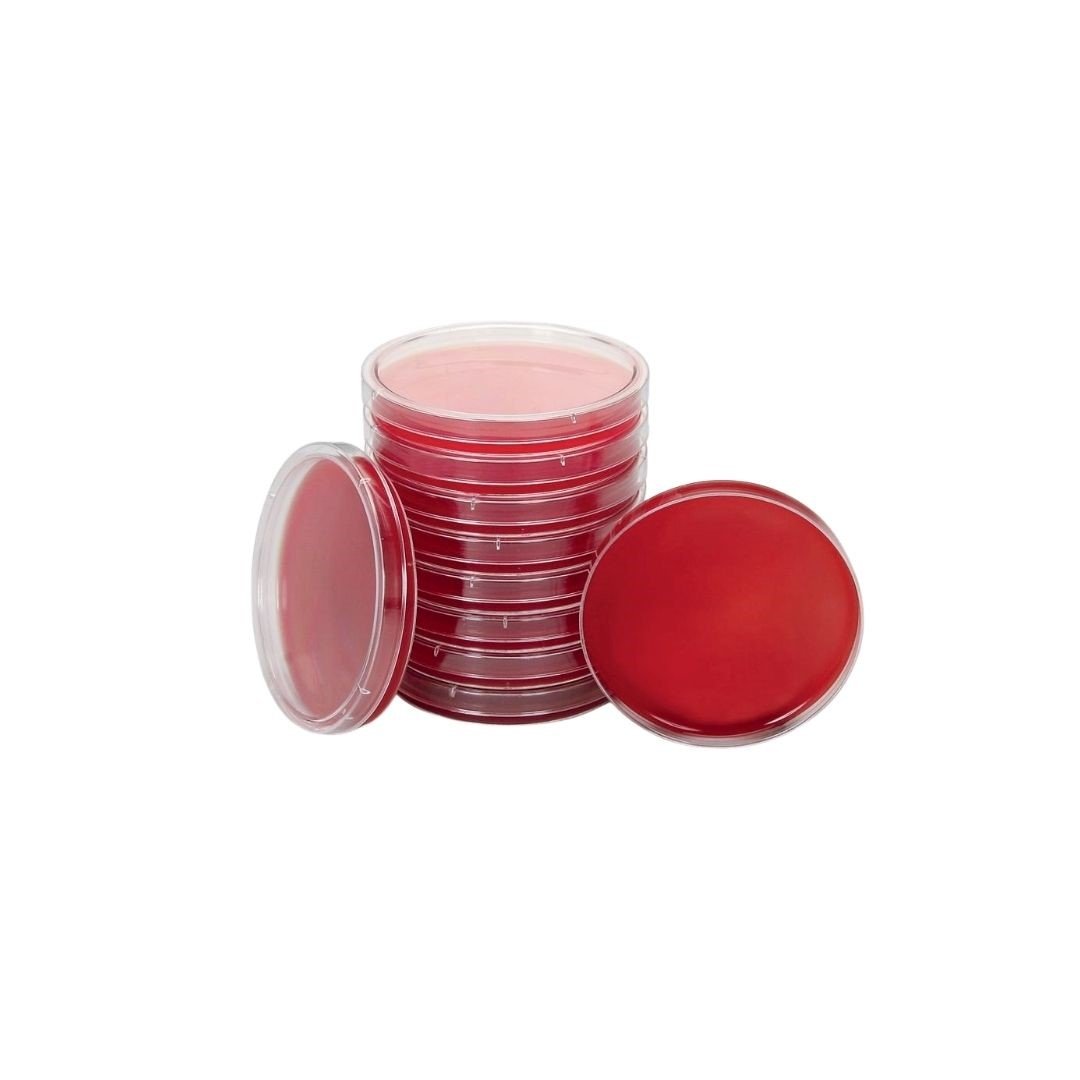
Blood Agar Plates – Ready-to-Use 5% Sheep Blood Culture Media
Nasmed Diagnostic’s Blood Agar Plates are ready-to-use, enriched microbiological culture media prepared with a Tryptic Soy Agar (TSA) base and 5% defibrinated sheep blood. Manufactured under controlled GMP conditions, these plates are designed for the isolation, cultivation, and differentiation of fastidious and non-fastidious microorganisms, and for the visual detection of hemolytic reactions (alpha, beta, and gamma hemolysis) in clinical and research laboratories.
Every batch is quality-checked for sterility, pH stability, and growth-promotion performance before dispatch, so your laboratory receives consistent, contamination-free plates every time.
A Blood Agar Plate is an enriched, non-selective culture medium containing 5% sheep blood in a Tryptic Soy Agar base, used mainly to grow fastidious bacteria (like Streptococcus and Staphylococcus species) and to identify them based on their hemolysis pattern on the plate.
What Is a Blood Agar Plate?
A Blood Agar Plate (BAP) is one of the most widely used general-purpose and differential culture media in clinical microbiology. It combines a nutrient-rich agar base with mammalian blood (commonly sheep blood) to support the growth of bacteria that do not grow well on ordinary nutrient media, such as Streptococcus pneumoniae, Streptococcus pyogenes, and various Staphylococcus species.
Because red blood cells in the medium react differently depending on the bacterial species present, Blood Agar also works as a differential medium — helping microbiologists visually classify bacteria by their hemolytic pattern:
- Beta (β) hemolysis – complete lysis of red blood cells, seen as a clear zone around the colony
- Alpha (α) hemolysis – partial/greenish discoloration around the colony
- Gamma (γ) hemolysis – no lysis, no visible change around the colony
Composition of Nasmed Blood Agar Plates
| Ingredient | Approximate Quantity (g/litre) |
|---|---|
| Tryptone / Casein digest | 15.0 g |
| Soya peptone | 5.0 g |
| Sodium chloride | 5.0 g |
| Agar | 15.0 g |
| Sheep blood (defibrinated) | 5% v/v |
| Final pH (at 25°C) | 7.3 ± 0.2 |
Formulation may be adjusted batch-to-batch to meet quality-control performance standards.
Key Applications & Uses
- Isolation and cultivation of fastidious and non-fastidious bacteria, yeasts, and fungi
- Detection and differentiation of hemolytic activity in Streptococcus and Staphylococcus species
- Primary culture of clinical specimens — throat swabs, sputum, wound swabs, blood, urine, and genital swabs
- Antibiotic susceptibility testing (disc diffusion method) in combination with other selective media
- Teaching and research applications in microbiology laboratories and colleges
- Quality control and environmental monitoring in pharmaceutical and food-testing labs
Why Choose Nasmed Blood Agar Plates?
- Ready-to-use — pre-poured, pre-sterilized plates; no in-house media preparation needed
- Consistent quality — every batch tested for sterility, pH, and growth promotion before dispatch
- Optically clear polystyrene plates for distortion-free colony viewing
- Leak-proof, hygienically sealed packaging to prevent contamination and moisture loss during transit
- Cold-chain maintained delivery to preserve blood cell integrity and media performance
- GMP-compliant manufacturing with documented batch traceability
Blood Agar Plates vs. Other Culture Media — Comparison Table
| Feature | Blood Agar Plates | Chocolate Agar Plates | CLED Agar Plates |
|---|---|---|---|
| Base medium | Tryptic Soy Agar + 5% sheep blood | Blood agar heated to lyse RBCs (“chocolate” colour) | Cystine–Lactose–Electrolyte-Deficient Agar |
| Medium type | Enriched, differential (hemolysis) | Enriched, non-selective | Non-inhibitory, differential |
| Primary use | Isolation of fastidious organisms; hemolysis pattern testing | Growth of Haemophilus and Neisseria species | Urine culture; discourages swarming of Proteus |
| Best suited for | Throat, wound, sputum, blood cultures | Respiratory and genital specimens | Urinary tract infection (UTI) screening |
| Hemolysis detection | Yes | No | No |
| Typical incubation | 24–48 hrs at 35–37°C, 5–10% CO₂ | 24–48 hrs at 35–37°C, 5–10% CO₂ | 18–24 hrs at 35–37°C |
View the full range on our Agar Plates category page.
Technical Specifications
| Parameter | Details |
|---|---|
| Plate size | 90 mm / 100 mm (standard); custom sizes available on request |
| Packaging | Sleeves of 10/20 plates, sealed in moisture-resistant bags |
| Storage condition | 2°C – 8°C, away from direct light |
| Shelf life | As per batch expiry printed on pack (typically 4–6 weeks from manufacture) |
| Appearance | Opaque, cherry-red coloured medium |
| Regulatory status | Manufactured for professional/laboratory diagnostic use only |
How to Use & Store Blood Agar Plates?
- Remove plates from cold storage and allow them to reach room temperature before inoculation (this prevents condensation from affecting colony growth).
- Streak the specimen onto the plate surface using a sterile inoculation loop.
- Incubate at 35–37°C for 18–24 hours (up to 48 hours for slow-growing organisms), preferably in 5–10% CO₂ for optimal recovery of fastidious species.
- Examine colonies for growth pattern, pigmentation, and type of hemolysis.
- Store unused plates refrigerated at 2–8°C, and always check the expiry date before use.
Quality, Compliance & Safety
Nasmed Diagnostic manufactures culture media under a controlled quality-management process, with each batch checked for sterility and growth-promotion performance before it leaves the facility. Our media preparation and testing approach aligns with the standard bacteriology practices published by the Indian Council of Medical Research (ICMR) — the apex government body for biomedical research in India — in its official Bacteriology Standard Operating Procedures manual.
📄 Reference: ICMR – Bacteriology SOP Manual, AMR Surveillance & Research Network (Government of India)
Frequently Asked Questions
Q1. What is a Blood Agar Plate used for?
- A Blood Agar Plate is used to grow and identify bacteria that don’t grow easily on plain nutrient media, and to observe their hemolytic (blood-cell-breakdown) pattern, which helps microbiologists identify organisms such as Streptococcus and Staphylococcus species.
Q2. What is the composition of Blood Agar?
- It is typically made of a Tryptic Soy Agar base enriched with 5% defibrinated sheep blood, along with peptones, sodium chloride, and agar as the solidifying agent, at a final pH of around 7.3–7.4.
Q3. How long can Blood Agar Plates be stored?
- When stored refrigerated at 2–8°C and protected from light, Blood Agar Plates generally remain usable until the expiry date printed on the pack — typically 4–6 weeks from the date of manufacture.
Q4. What is the difference between Blood Agar and Chocolate Agar?
Q5. What does beta hemolysis on a Blood Agar Plate indicate?
- Beta hemolysis appears as a clear, transparent zone around a colony, indicating complete destruction of red blood cells — commonly associated with organisms such as Streptococcus pyogenes.
Q6. Can Laboratories Use Blood Agar Plates for Antibiotic Susceptibility Testing?
Q7. Can Laboratories Use Nasmed Blood Agar Plates Directly?
- Yes, they come pre-poured, pre-sterilized, and quality-tested, allowing laboratories to inoculate specimens directly without preparing media in-house.
Q8. Where can I buy Blood Agar Plates in bulk for my lab?
- You can order Nasmed Blood Agar Plates directly through our product page or explore our full product range. For bulk/institutional pricing, please contact our team.
Order Blood Agar Plates from Nasmed Diagnostic
Looking for reliable, ready-to-use Blood Agar Plates for your laboratory? Explore our complete product catalogue or get in touch with our team for bulk orders, technical data sheets, and pricing.