
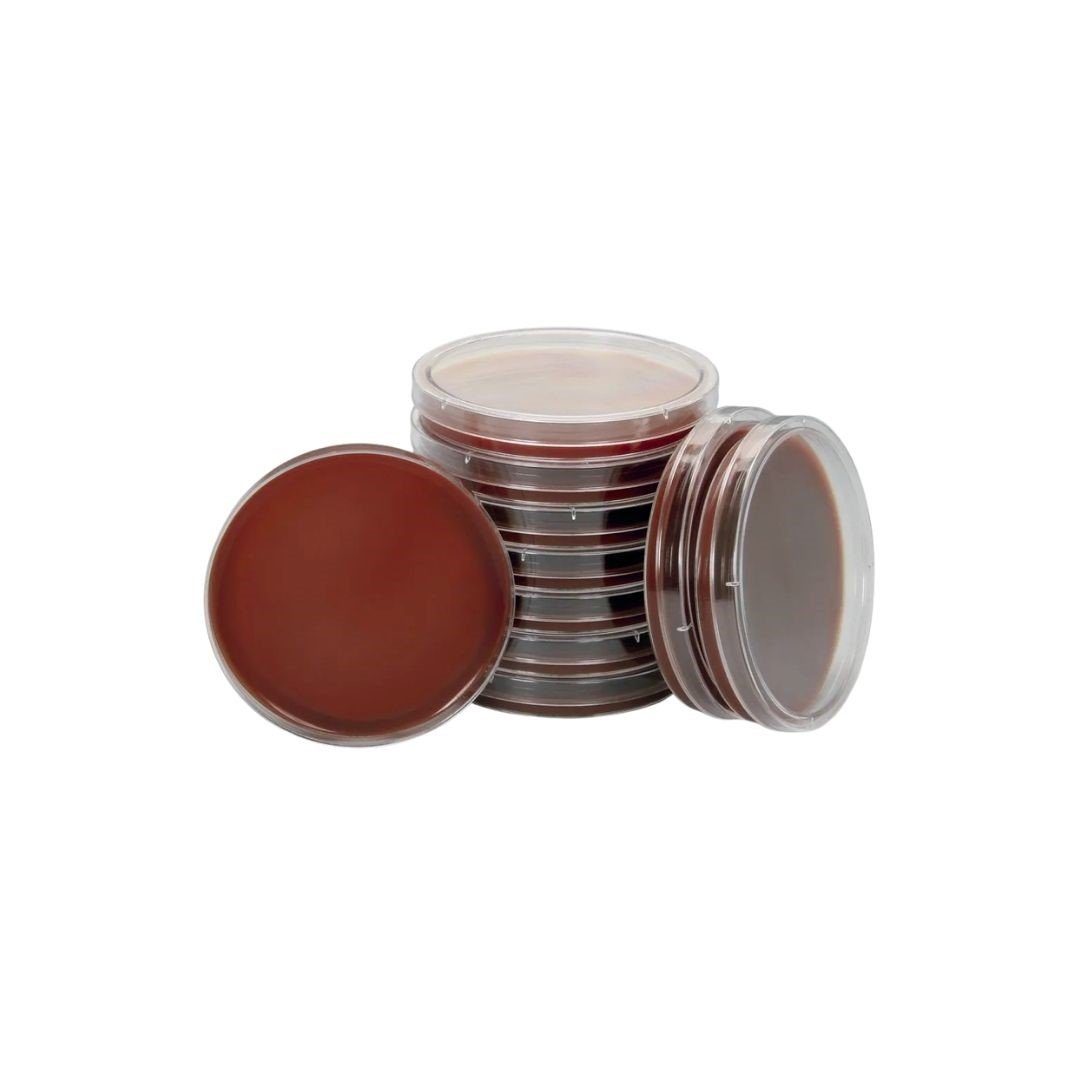
Chocolate Agar Plates – Enriched Culture Media for Fastidious Organisms
If your laboratory struggles to recover slow-growing, nutritionally demanding pathogens like Haemophilus influenzae or Neisseria gonorrhoeae from clinical specimens, the problem is usually the growth medium — not the technique. Chocolate Agar Plates from Nasmed Diagnostic are formulated specifically to solve this: they supply the heat-lysed blood factors (X and V factors) these fastidious bacteria need to grow reliably, giving your lab consistent, contamination-free isolation on the first attempt. Manufactured under strict quality control and used daily by diagnostic and hospital microbiology labs, these ready-to-use plates are a dependable choice for respiratory, genital, and CSF culture workflows.
What Are Chocolate Agar Plates?
Chocolate Agar is an enriched, non-selective culture medium made by heating blood agar until the red blood cells lyse, turning the medium a chocolate-brown colour. This heating process releases two essential nutrients — hemin (X factor) and NAD (V factor) — directly into the agar, which fastidious organisms cannot synthesize on their own. Without this step, these bacteria simply fail to grow on standard media such as Blood Agar or MacConkey Agar.
It is the medium of choice for cultivating:
- Haemophilus influenzae and Haemophilus parainfluenzae
- Neisseria gonorrhoeae and Neisseria meningitidis
- Other fastidious respiratory and oropharyngeal pathogens
Composition / Formulation
| Ingredient | Approx. Quantity (g/L) |
|---|---|
| GC Agar Base / Special Peptone | 15–20 g |
| Dextrose (Glucose) | 0.5–1.5 g |
| Sodium Chloride | 5 g |
| Disodium Phosphate | 4–5 g |
| Agar | 15 g |
| Sterile Lysed Blood (Hemoglobin) | 1% (added post-sterilization at 80°C) |
| Vitamin/Growth Enrichment Supplement | As per formulation |
| Final pH (at 25°C) | 7.3 ± 0.2 |
Formulation may be adjusted and standardized to meet performance parameters.
Key Features & Benefits
- Ready-to-use sterile plates – no in-house preparation delays
- Optically clear polystyrene base for distortion-free colony reading
- Breathable sleeve packaging to prevent condensation and moisture build-up
- Consistent pH and hemoglobin content for batch-to-batch reliability
- Stackable design with raised rings to prevent sliding during storage and transport
- Manufactured under quality systems aligned with ISO standards for medical device/media manufacturing
Clinical & Diagnostic Applications
Chocolate Agar Plates are routinely used for:
- Primary isolation of respiratory pathogens — recovery of H. influenzae and H. parainfluenzae from sputum, nasopharyngeal, and BAL specimens
- Isolation of pathogenic Neisseria species — from urogenital, pharyngeal, and cerebrospinal fluid samples
- Recovery of X and V factor–dependent organisms requiring hemin and NAD
- CO2-enriched culture workflows — enhanced recovery when incubated in 5–10% CO2
- Processing of mixed clinical specimens where a non-selective enriched medium increases pathogen yield
How to Use Chocolate Agar Plates?
- Bring the plate to room temperature before use; check for cracks, contamination, or excess moisture.
- Streak the specimen for isolation using a sterile loop or directly roll the swab onto the agar surface.
- Incubate at 35–37°C in a 5–10% CO2 atmosphere (3–7% CO2 specifically for Neisseria species) for 24–48 hours.
- Examine for characteristic colony growth; subculture within 18–24 hours for optimal results.
- Discard plates showing contamination or no growth after the recommended incubation period.
Chocolate Agar vs Blood Agar vs CLED Agar — Comparison Table
| Parameter | Chocolate Agar Plates | Blood Agar Plates | CLED Agar Plates |
|---|---|---|---|
| Type of Medium | Enriched, non-selective | Enriched, non-selective, differential | Differential, non-inhibitory |
| Key Ingredient | Heat-lysed blood (X & V factors) | Intact sheep/horse blood (5–10%) | Lactose, cystine, electrolytes |
| Primary Use | Fastidious organisms (Haemophilus, Neisseria) | General bacteriology, hemolysis pattern study | Urine culture, prevents Proteus swarming |
| Best For | Respiratory, genital, CSF specimens | Wound, throat, blood culture specimens | Urinary tract infection diagnosis |
| Incubation Atmosphere | 5–10% CO2 | Ambient air or CO2 | Ambient air |
| Hemolysis Visible? | No (blood is lysed) | Yes (alpha/beta/gamma) | Not applicable |
Storage, Shelf Life & Quality Assurance
- Storage temperature: 2–8°C, away from direct light
- Shelf life: Typically valid as per the batch expiry printed on the pack; always check the label before use
- Each batch undergoes quality control testing against standard control organisms (e.g., H. influenzae ATCC 10211, N. gonorrhoeae ATCC 43069) to confirm growth performance before dispatch
- Manufactured in compliance with ISO-certified quality management systems
For laboratory-level guidance on recommended culture media by specimen type, refer to the CDC’s clinical microbiology culture media reference.
Why Choose NAS Med Diagnostic Chocolate Agar Plates?
With years of hands-on manufacturing experience in microbiological culture media, Nasmed Diagnostic focuses on batch consistency, strict quality checks, and reliable supply for hospital and diagnostic laboratories across India. Every plate is designed to reduce culture failures and give microbiologists confidence in their results — not just another agar plate, but a dependable diagnostic tool. Explore our complete range on the Our Products page, or browse all variants under our Agar Plates category.
Frequently Asked Questions
Q1. What is Chocolate Agar used for?
- Chocolate Agar is used to isolate fastidious bacteria — mainly Haemophilus and Neisseria species — that cannot grow on standard media because they require hemin (X factor) and NAD (V factor) released from heat-lysed blood.
Q2. Why is it called “Chocolate” Agar if it contains no chocolate?
- The name comes from its chocolate-brown appearance, caused by heating blood agar until red blood cells lyse — not from any chocolate ingredient.
Q3. What is the difference between Chocolate Agar and Blood Agar?
- Blood Agar contains intact red blood cells and shows hemolysis patterns, while Chocolate Agar uses lysed blood, releasing growth factors needed by fastidious organisms that Blood Agar cannot support as effectively.
Q4. What incubation conditions does Chocolate Agar require?
- Most labs incubate Chocolate Agar at 35–37°C in a 5–10% CO2-enriched atmosphere for 24–48 hours for optimal recovery of fastidious organisms.
Q5. How should Chocolate Agar Plates be stored?
- Store sealed plates at 2–8°C and use them before the expiry date printed on the packaging to ensure medium performance.
Q6. Where can I buy quality Chocolate Agar Plates in India?
- You can order ISO-compliant, ready-to-use Chocolate Agar Plates directly from Nasmed Diagnostic. For bulk orders or queries, contact our team.