
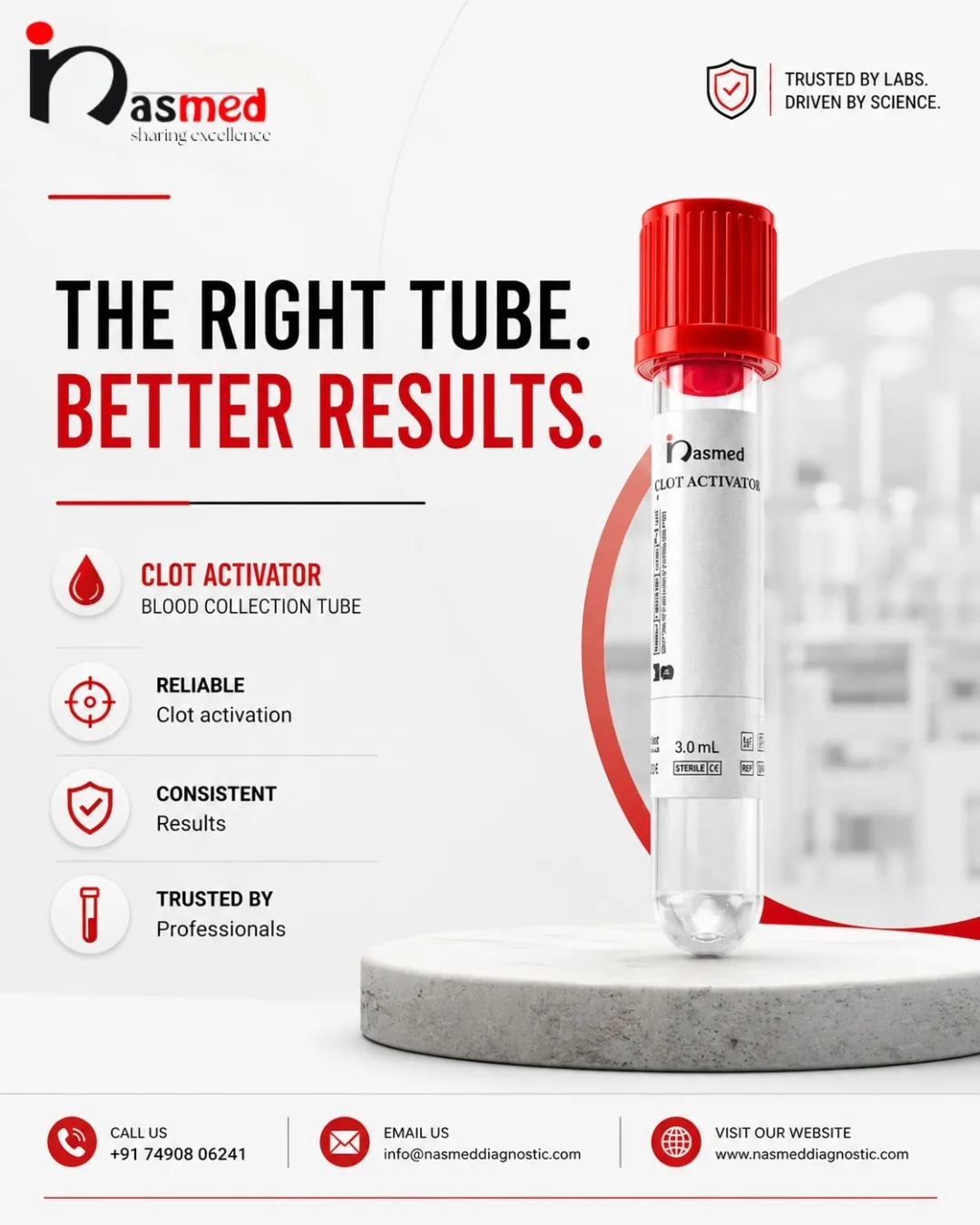
What is a Clot Activator ?
How Does a Clot Activator Work?
process after collection, helping blood form a stable clot more efficiently. This allows laboratories to obtain clear serum for accurate diagnostic testing with less waiting time. Understanding What is a Clot Activator helps laboratories select the right tube for serum-based investigations. Nasmed Diagnostics Pvt. Ltd. provides quality clot activator blood collection tubes designed for consistent clot formation, efficient serum separation, and reliable sample handling, supporting smoother laboratory workflows and dependable diagnostic results.
What Is a Clot Activator? A Practical Guide for Indian Labs and Hospitals
A clot activator is a coating applied to the inner wall of a blood collection tube. It speeds up natural blood clotting and helps laboratories obtain serum faster.
Common clot activators include silica, thrombin, and ellagic acid. They can reduce clotting time from around 20–30 minutes to approximately 5–15 minutes, depending on the tube and sample.
This faster clot formation supports efficient serum separation for biochemistry, serology, and immunoassay testing. Diagnostic tubes suppliers India use clot activator technology to provide consistent and reliable serum samples for routine laboratory workflows.
| Clot Activator Type | How It Works | Typical Clot Time | Common Use |
|---|---|---|---|
| Silica Particles | Activates the intrinsic clotting pathway on contact | 10–15 minutes | Routine biochemistry and serology tubes |
| Thrombin | Directly converts fibrinogen to fibrin | 3–5 minutes | STAT or emergency testing tubes |
| Ellagic Acid | Triggers rapid intrinsic pathway activation | 5–10 minutes | Rapid serum separator (gel) tubes |
A mid-sized diagnostic chain in Ahmedabad, referred to as “Client A,” faced inconsistent serum clarity in about 6–8% of samples. The issue affected samples processed through its biochemistry analyser. The lab traced the problem to inconsistent clot activator coating in its previous supplier’s tubes.
Client A switched to Nasmed Diagnostics’ clot activator tubes. Within two months, the lab reported fewer repeat-draw requests. Staff also noticed more consistent clotting times across different shifts. The quality manager found this consistency helpful for planning staff schedules.
These improvements can save valuable time and reduce costs. This matters even more for laboratories that process hundreds of samples every day. Diagnostic centres in Kolkata and Vadodara have also shown interest in similar product consistency.
As of 2026, Nasmed Diagnostics has expanded its clot activator tube range. The range now includes additional micro-volume formats. These tubes support more precise blood collection for paediatric and geriatric patients.
Why Choose Nasmed Diagnostics for Clot Activator Tubes
Nasmed Diagnostics manufactures clot activator and gel-based serum separator tubes in a CDSCO-certified, ISO 7 clean room facility in Gandhinagar, Gujarat, where coating consistency is checked at every production batch. This matters because uneven clot activator coating is one of the most common — and least discussed — causes of hemolysis and delayed serum separation in Indian diagnostic labs.
Most quality complaints we hear from lab managers in Mumbai, Pune, or Hyderabad are not about the tube material itself but about inconsistent clotting time from batch to batch. A tube that clots in 8 minutes today and 18 minutes tomorrow throws off entire testing schedules in a busy path lab. As per CDSCO guidelines for in-vitro diagnostic devices, coating uniformity and material biocompatibility are core evaluation parameters, and this is exactly where consistent clean-room manufacturing makes a measurable difference.
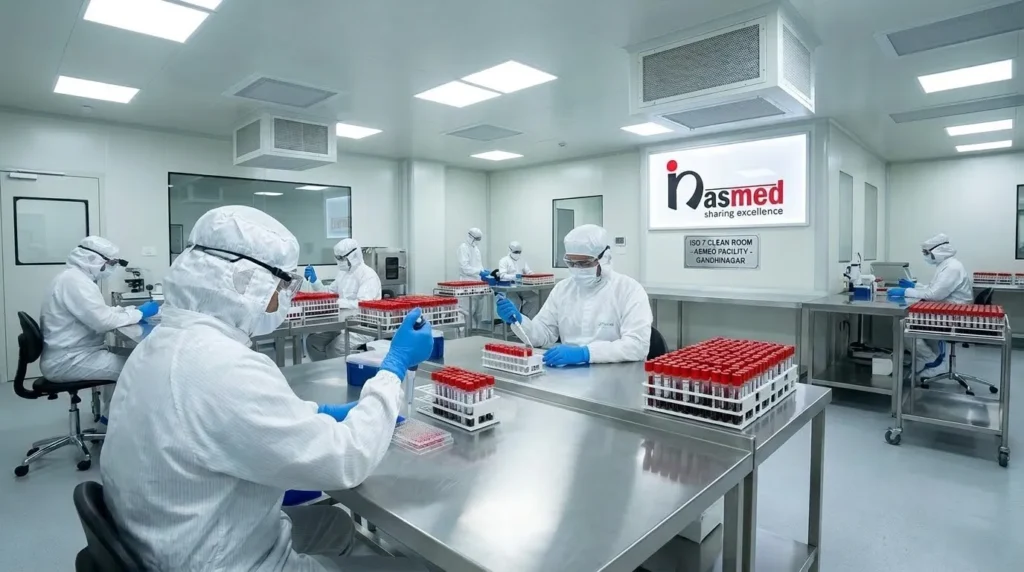
A vacuum blood collection tube is a pre-evacuated tube that draws a fixed blood volume automatically once the needle enters the tube, and when combined with a properly applied clot activator, it gives predictable serum yield without operator-dependent variation. This is especially useful for high-volume NABL-accredited labs in Chennai and Bangalore running hundreds of biochemistry samples daily.
Our Clot Activator Tube Manufacturing Capabilities
Here’s how Nasmed Diagnostics approaches clot activator tube production: every batch goes through controlled spray-coating, followed by internal quality checks for clot time, particle count, and vacuum retention before packaging.
The manufacturing line covers a full range — plain clot activator tubes, gel lithium heparin tubes for plasma separation, gold-top gel serum separator tubes, micro paediatric tubes for neonatal and low-volume draws, and specialised cell-free DNA tubes used in prenatal and oncology testing. Each tube category needs a different internal coating chemistry, and getting this wrong directly affects test accuracy, so formulation control is not optional — it is the core of the manufacturing process.
Non-vacuum tubes are manufactured on a separate line to prevent cross-contamination of coating chemicals, which is a small operational detail that many smaller regional suppliers skip due to space or cost constraints. In an ISO 7 clean room, particle counts are maintained at Class 10,000 levels, which is a recognised benchmark for contamination-controlled manufacturing of medical disposables in India.
For quick reference, the table below shows how cap colour maps to additive type and test use — a detail phlebotomy staff in every Indian lab rely on daily for correct sample handling.
| Cap Colour | Additive | Sample Type | Common Test Use |
|---|---|---|---|
| Red | Clot activator (silica) | Serum | Biochemistry, serology |
| Gold / Yellow | Clot activator + separator gel | Serum | Hormone panels, immunoassays |
| Green | Lithium heparin | Plasma | STAT chemistry, electrolytes |
| Lavender / Purple | EDTA | Whole blood | CBC, haematology |
| Light Blue | Sodium citrate | Plasma | Coagulation studies (PT/INR) |
Navigating Regulatory Compliance and CDSCO Certification
Yes, clot activator tubes fall under CDSCO‘s regulatory scope for in-vitro diagnostic devices, and compliant manufacturers must demonstrate documented quality processes, material traceability, and batch-level testing records.
For hospital procurement teams in Delhi, Jaipur, and Chandigarh, this compliance layer is not a formality — it is what protects a lab from liability if a testing discrepancy is ever traced back to a faulty consumable. International material guidelines, including biocompatibility expectations aligned with ISO 6710 for single-use blood collection tubes, are also referenced during formulation and validation of clot activator coatings.
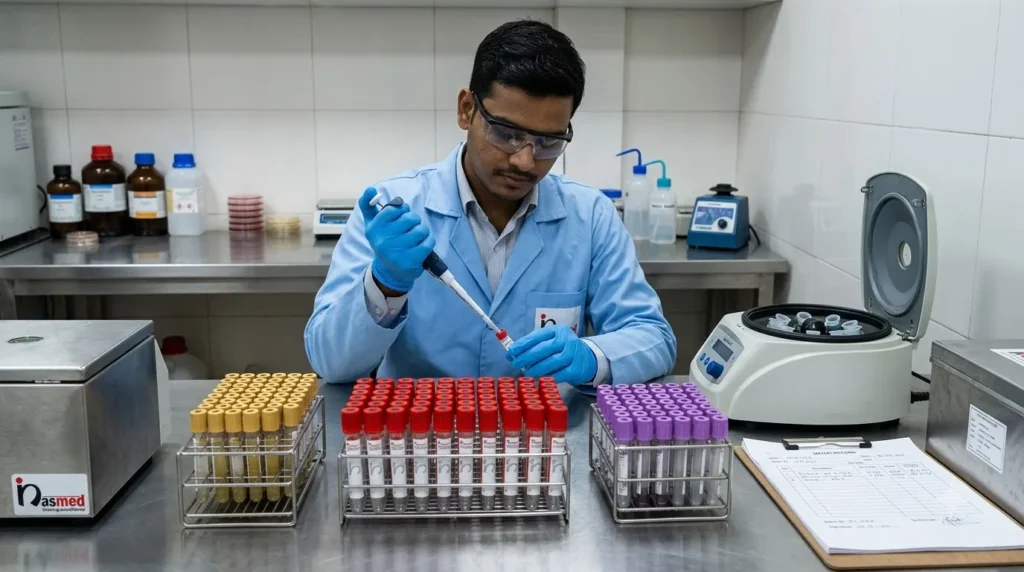
CDSCO-certified tubes carry documented evidence of raw material sourcing and sterility validation, which becomes especially relevant for government tenders and NABL-accredited lab empanelment processes, where documentation gaps can disqualify an otherwise capable supplier.
Local Suppliers vs Nasmed Diagnostics: A Practical Comparison
Choosing between a regional trader and a certified manufacturer usually comes down to consistency, documentation, and after-sales support — three areas where the difference shows up only after a few months of use, not on day one.
| Parameter | Local/Regional Suppliers | Nasmed Diagnostics |
|---|---|---|
| CDSCO Certification | Often unverifiable or third-party sourced | Direct CDSCO-certified manufacturing |
| Clean Room Standard | Rarely disclosed | ISO 7, Class 10,000 clean room |
| Batch-to-Batch Consistency | Variable, limited QC data | Documented QC per batch |
| Custom Formulation Support | Limited | Available for hospitals and labs |
| Pricing Transparency | Negotiation-dependent | Structured, quote-based pricing |
In short, the table shows that the main gap between regional suppliers and a certified manufacturer is documentation and consistency, not raw material cost — which is usually the deciding factor for hospitals renewing annual consumable contracts.
Step-by-Step Process: How We Deliver Clot Activator Tubes
Here’s how Nasmed Diagnostics moves an order from enquiry to delivery for hospitals and labs across India:
- Requirement discussion — We confirm the required volume, tube type (vacuum or non-vacuum), and custom labelling requirements. Smaller labs in Surat or Indore can discuss their requirements through a quick WhatsApp consultation.
- Formulation and coating — Our team selects the appropriate clot activator concentration according to the tube size and intended test panel. We then apply the formulation uniformly to support consistent clot formation.
- Clean room assembly — Our team performs stoppering, vacuum sealing, and labelling inside our ISO 7 clean room facility. This controlled environment helps maintain product quality and minimize contamination risks.
- Batch quality testing — Our quality team checks clotting performance, vacuum draw accuracy, and tube appearance for every batch. We record the test results before approving the batch for release.
- Packaging and dispatch — We use tamper-evident packaging to protect the tubes during transportation. Our logistics team coordinates pan-India delivery, including shipments to diagnostic centres in tier-2 cities.
Real Client Case Study
A mid-sized diagnostic chain in Ahmedabad, referred to as “Client A,” faced inconsistent serum clarity in about 6–8% of samples. The issue affected samples processed through its biochemistry analyser. The lab traced the problem to inconsistent clot activator coating in its previous supplier’s tubes.
Client A switched to Nasmed Diagnostics’ clot activator tubes. Within two months, the lab reported fewer repeat-draw requests. Staff also noticed more consistent clotting times across different shifts. The quality manager found this consistency helpful for planning staff schedules.
These improvements can save valuable time and reduce costs. This matters even more for laboratories that process hundreds of samples every day. Diagnostic centres in Kolkata and Vadodara have also shown interest in similar product consistency.
As of 2026, Nasmed Diagnostics has expanded its clot activator tube range. The range now includes additional micro-volume formats. These tubes support more precise blood collection for paediatric and geriatric patients.
Frequently Asked Questions
Q.What is a clot activator used for in blood collection tubes?
- A clot activator is used to speed up blood coagulation inside the tube, cutting clotting time from roughly 20–30 minutes down to 5–15 minutes. This helps serum separate faster during centrifugation, which directly improves testing turnaround time for biochemistry, serology, and hormone panels in busy Indian labs.
Q.How to use clot activator tubes correctly for accurate results?
- Invert the tube gently 5–6 times immediately after draw to mix the additive with blood, avoid shaking it hard, and let it stand for the recommended clot time before centrifuging. Skipping the inversion step is one of the most common reasons for micro-clots and inaccurate biochemistry results in Indian labs.
Q.Why use gel-based clot activator tubes instead of plain red-top tubes?
- Gel clot activator tubes are used when sample stability during transport matters, since the gel barrier physically separates serum from the clot after spinning. This is particularly useful for labs in Chennai or Kolkata that send samples to a central reference lab and need the serum to stay stable for longer.
Q.Clot activator tube ka use kaise karein sample collection ke time?
- Blood draw ke turant baad tube ko 5-6 baar halke se invert karo taaki additive blood ke saath achhe se mix ho jaaye. Zyada zor se hilana nahi hai, aur centrifuge karne se pehle tube ko recommended clot time (5-15 minute) ke liye stand karne dena chahiye.
Q.Clot activator tube kyun use karna chahiye normal plain tube ke bajaye?
- Plain glass tube me natural clotting me 20-30 minute lag sakte hain, jabki clot activator wale tube me yahi process 5-15 minute me ho jaata hai. Isse lab ka turnaround time kam hota hai aur high-volume biochemistry testing me sample processing zyada predictable rehta hai.
Q.Are Nasmed Diagnostics clot activator tubes CDSCO certified, and how can I order in bulk?
- Yes, Nasmed Diagnostics manufactures its clot activator tubes in a CDSCO-certified, ISO 7 clean room facility with documented batch-level quality checks. Labs and hospitals can request a free product consultation or the Blood Collection Tubes Cost Guide by contacting Nasmed Diagnostics via phone, WhatsApp, or the website contact form.
Ready to simplify your lab’s disposables sourcing? Reach the Nasmed Diagnostics team directly at +91 79908 01393, or message on WhatsApp at +91 74908 06241 / info@nasmeddiagnostic.com for a Free Product Consultation, the Blood Collection Tubes Cost Guide, or a same-week quote.Contact Us