
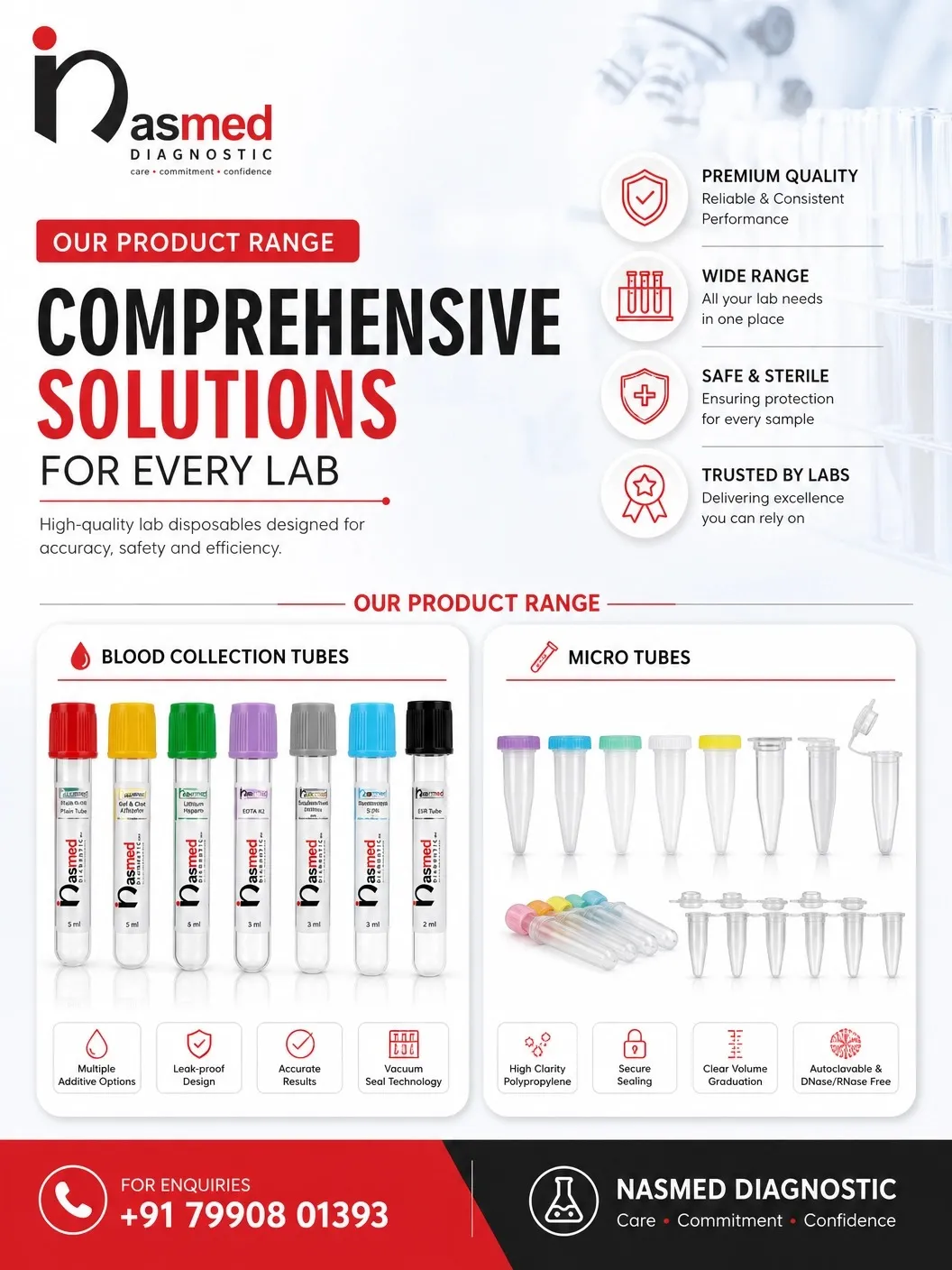
How Blood Collection Tubes Ensure Accuracy
Why Are Blood Collection Tubes Important for Accurate Test Results?
Blood collection tubes are important because they preserve sample quality, prevent contamination, and maintain the correct blood-to-additive ratio. Understanding how blood collection tubes ensure accuracy helps laboratories achieve reliable diagnostic results and reduce testing errors. Nasmed Diagnostic manufactures premium blood collection tubes designed for consistent sample integrity, dependable performance, and accurate clinical testing across hospitals, diagnostic laboratories, and healthcare facilities.
How Blood Collection Tubes Ensure Accuracy: A Manufacturing Perspective
Accurate diagnostic results begin long before a sample reaches the analyzer — they begin with the tube itself. After spending over a decade and a half inside clean rooms and quality labs across Gujarat, I can tell you that the single biggest silent contributor to inaccurate lab reports isn’t always the testing equipment. It’s often the blood collection tube: its additive ratio, its vacuum consistency, its material purity. Hospitals in Mumbai, Delhi, and Bangalore invest lakhs in analyzers, yet a poorly manufactured tube can still throw off haemolysis rates, clotting times, or plasma separation quality. This article walks through exactly how tube design, material science, and manufacturing discipline work together to protect sample integrity — and why procurement heads across India are paying closer attention to their tube suppliers.
Why Choose Nasmed Diagnostics for How Blood Collection Tubes Ensure Accuracy
Nasmed Diagnostics manufactures its entire range inside an ISO 7 clean room facility (Class 10,000), which directly affects tube accuracy — fewer airborne particles during filling means fewer chances of sample contamination later. The company is CDSCO certified, and its facility in Gandhinagar, Gujarat, is led by Directors Kush Patel and Suril Shah, alongside a technical team that understands the practical realities of Indian lab workflows — power fluctuations, transport delays, temperature variance during monsoon season in cities like Chennai or Kolkata. Here’s how Nasmed Diagnostics approaches accuracy: every batch of sterile blood collection tubes goes through additive-ratio verification, vacuum-draw testing, and stopper-seal inspection before dispatch. This isn’t a marketing claim — it’s a documented quality process that hospitals and diagnostic chains have come to rely on for diagnostic lab disposables procurement.
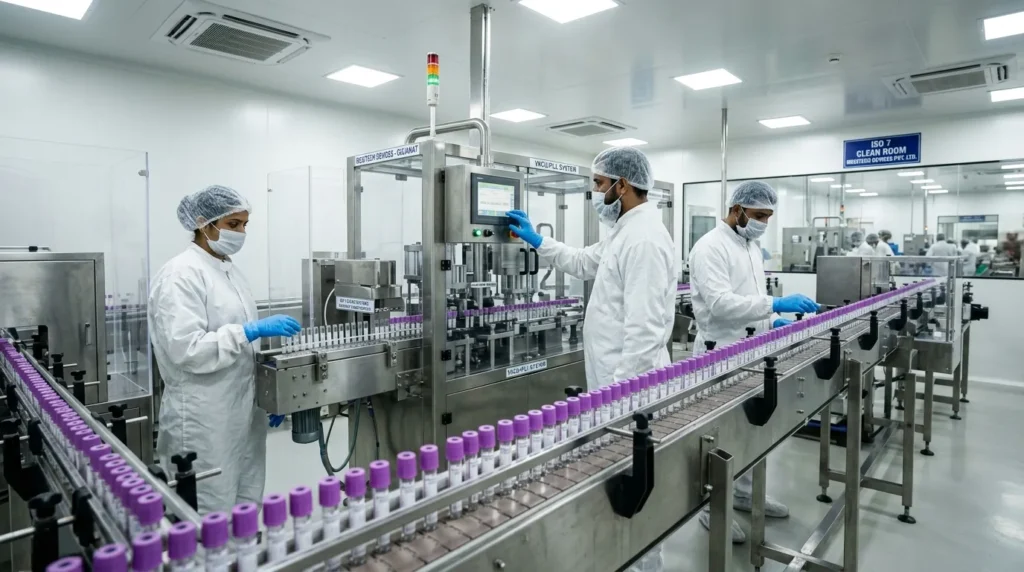
Our How Blood Collection Tubes Ensure Accuracy Manufacturing Capabilities
Tube accuracy comes down to four manufacturing variables: additive precision, vacuum consistency, material compatibility, and stopper integrity.
Vacuum and Non-Vacuum Tube Precision
Vacuum blood collection tubes rely on a calibrated internal vacuum. This vacuum draws a precise blood-to-additive ratio. If the vacuum is inconsistent — a common issue with unregulated regional suppliers — the blood-to-anticoagulant ratio shifts. This distorts coagulation and haematology results. Nasmed Diagnostics tests vacuum draw at multiple points during production, not just at final QC. This approach catches drift early.
Non-vacuum blood collection tubes serve a different but equally important purpose. They work particularly well in paediatric and geriatric collections, where controlled, manual draw reduces vein trauma. Micro paediatric tubes need even tighter tolerances because sample volumes are so small. Even a 5% additive error can compromise a child’s CBC result. Paediatric hospitals in Jaipur and Chandigarh stay particularly cautious about this.
Coagulation and Glucose Testing Tubes
For coagulation studies, Sodium Citrate Blood Collection Tubes require an exact 9:1 blood-to-citrate ratio. Deviation here is one of the most common causes of rejected PT/INR samples in Indian labs. For glucose testing, Sodium Fluoride Blood Collection Tubes inhibit glycolysis. This keeps glucose values from drifting downward before the sample is processed. It matters enormously for diabetes screening camps run across Pune and Indore.
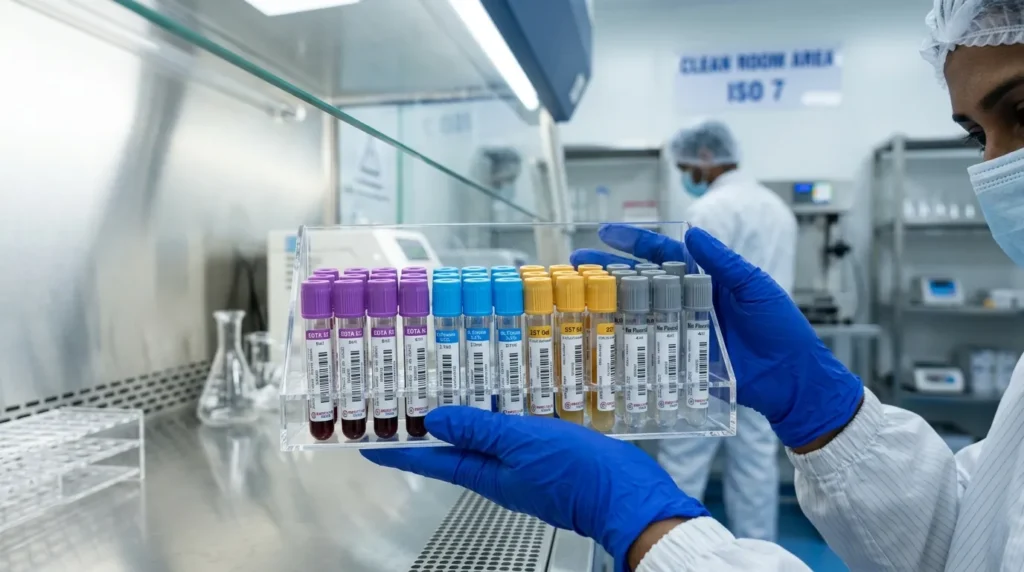
Gel, Clot Activator, and Cell-Free DNA Tubes
Gel lithium heparin tubes, including the Gel Lithium Heparin – Blood Collection Tube and the standalone Lithium Heparin Blood Collection Tubes, use a separator gel with a precisely calibrated density. This gel sits between plasma and cellular components after centrifugation. If the gel’s specific gravity is off, plasma contamination occurs. This affects biochemistry panels.
Similarly, the Clot Activator – Blood Collection Tube and Gel + Clot Activator – Blood Collection Tube rely on activator coating uniformity. This uniformity ensures clotting completes within the expected window. Inconsistent coating leads to fibrin strands interfering with automated analyzers — a complaint we hear often from labs in Surat and Vadodara.
Beyond tubes, cell-free DNA tubes are increasingly used for NIPT and oncology liquid biopsy work. They require stabilizing reagents that preserve DNA integrity for days during transport. This matters most for labs sending samples from tier-2 cities to centralized testing hubs in Hyderabad or Ahmedabad.
Contact UsNavigating Regulatory Compliance & CDSCO Certification
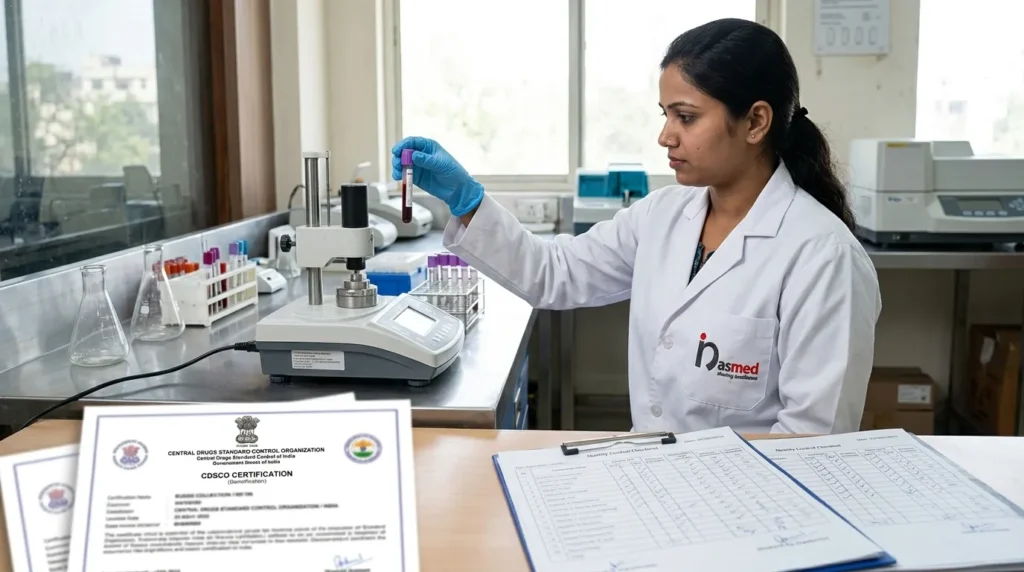
The best starting point for any procurement head evaluating tube suppliers is regulatory documentation. CDSCO certification confirms that manufacturing follows India’s medical device quality framework, while alignment with international material guidelines (such as ISO 6710 for single-use blood collection tubes) ensures material compatibility, sterility validation, and additive accuracy are independently verifiable rather than self-declared. Nasmed Diagnostics maintains CDSCO certification alongside ISO 7 clean room manufacturing, giving hospital procurement teams documentation they can present during NABL audits or institutional tenders. This matters practically — a lab in Delhi or Kolkata undergoing NABL accreditation renewal often needs traceable supplier certificates, not just a product invoice.
Local Suppliers vs Nasmed Diagnostics
| Parameter | Typical Local/Regional Supplier | Nasmed Diagnostics |
|---|---|---|
| Manufacturing Environment | Standard workshop conditions | ISO 7 Clean Room (Class 10,000) |
| Regulatory Certification | Varies, often undocumented | CDSCO Certified |
| Vacuum/Additive QC | Batch-level sampling only | Multi-stage in-process testing |
| Custom Diagnostic Solutions | Limited customization | Available on request |
| Product Range | Narrow, single-category focus | Vacuum, non-vacuum, micro, CFD, urine containers |
Step-by-Step Process – How We Deliver How Blood Collection Tubes Ensure Accuracy
Here’s how Nasmed Diagnostics moves a tube from raw material to dispatch:
- Raw material screening — We inspect medical-grade PET/glass and rubber stoppers for compatibility before production begins.
- Clean room moulding and additive dosing — Our technicians dispense precise anticoagulant/activator quantities under controlled ISO 7 conditions.
- Vacuum calibration — We check each production run for consistent draw volume.
- Sealing and stopper integrity testing — This step prevents leakage and maintains vacuum shelf life.
- Sterilization and lot-based QC sampling — Our quality team tests samples from every lot before granting approval.
- Labelling and packaging — We print batch numbers and expiry dates on every unit for full traceability.
- Dispatch — We deliver tubes to hospitals, labs, and diagnostic centers across India, including bulk orders for chains in Chennai and Mumbai.
Real Client Case Study
A mid-sized diagnostic chain operating across three centers in Ahmedabad had been facing recurring PT/INR rejections — nearly 8% of coagulation samples were being flagged for insufficient fill volume. After switching their sodium citrate tube supplier to Nasmed Diagnostics, their lab manager (we’ll call him Mr. R.S., since client identity remains confidential) reported the rejection rate dropped to under 2% within two months, attributing it to more consistent vacuum draw and clearer fill-line markings. This is a mini example of what proper additive-to-blood ratio manufacturing looks like in practice — it’s not glamorous, but it directly reduces re-draws, patient discomfort, and reporting delays.
In a more detailed account, a multi-specialty hospital lab in Pune had switched suppliers twice in eighteen months due to inconsistent gel separation quality in their biochemistry tubes — plasma samples were showing cellular contamination in nearly 6% of centrifuged tubes. Their procurement team requested custom diagnostic solutions from Nasmed Diagnostics, including tube-fill volume adjustments suited to their automated analyzer’s minimum sample requirements. After a trial batch of gel lithium heparin tubes and clot activator tubes was implemented, the lab’s internal QC log showed contamination-flagged samples dropping to under 1% over a three-month tracking period, and reporting turnaround improved because fewer samples required recollection. The hospital’s quality officer noted that having CDSCO documentation on file also simplified their NABL surveillance audit that year.
Frequently Asked Questions
Q1: Vacuum blood collection tubes manual draw se zyada accurate kyun hote hain?
- Vacuum tubes ek fixed, pre-calibrated draw volume maintain karte hain, jisse har sample me blood-to-additive ratio consistent rehta hai — manual draw me jo variability aati hai, wo yahan kam ho jaati hai.
Q2: Why do sodium citrate tubes need an exact fill volume?
- Coagulation testing depends on a precise 9:1 blood-to-citrate ratio; underfilled tubes distort PT/INR results and are commonly rejected during lab QC.
Q3: Kya Nasmed Diagnostics ke tubes CDSCO certified hain?
- Ji haan, Nasmed Diagnostics CDSCO certification ke saath manufacture karta hai, aur production Gandhinagar, Gujarat ke ISO 7 clean room facility ke andar hoti hai.
Q4: What’s the difference between gel and non-gel tubes for biochemistry testing?
- Gel tubes use a density-calibrated separator that isolates plasma or serum after centrifugation, reducing manual handling and contamination risk compared to non-gel tubes.
Q5: Kya diagnostic labs custom tube specifications request kar sakte hain?
- Ji haan, Nasmed Diagnostics custom diagnostic solutions offer karta hai, jisme fill-volume adjustments aur lab equipment ke hisaab se packaging formats bhi include hain.
Q6: How do micro paediatric tubes maintain accuracy with small sample volumes?
- They’re manufactured with tighter vacuum and additive tolerances since even small measurement errors have a proportionally larger impact on small-volume paediatric samples.
Sample integrity isn’t a small detail — it’s the foundation every diagnostic report is built on. If you’re a lab manager, hospital procurement head, or diagnostic center owner evaluating your current tube supplier, it’s worth asking the harder questions about batch consistency and certification. Reach Nasmed Diagnostics at +91 79908 01393, WhatsApp us at +91 74908 06241, or email info@nasmeddiagnostic.com for a Free Product Consultation or to download our Blood Collection Tubes Cost Guide.
Contact Us