
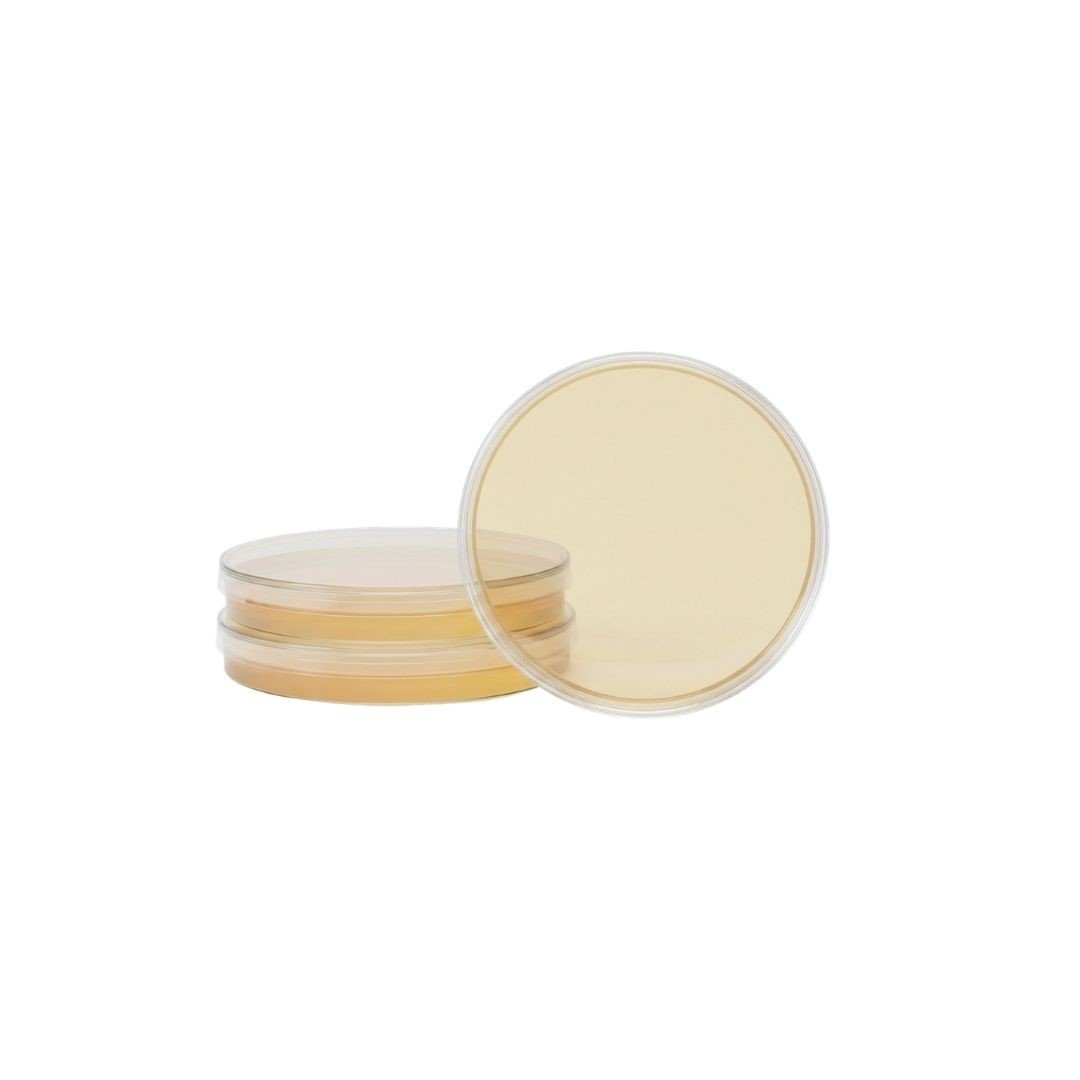
Mueller Hinton Agar Plates – Ready-to-Use Media for Antimicrobial Susceptibility Testing
Mueller Hinton Agar (MHA) Plates are the internationally recognized, non-selective culture medium used for antimicrobial susceptibility testing (AST) by the Kirby-Bauer disk diffusion method. Manufactured under strict quality control at Nasmed Diagnostic, these ready-to-pour plates conform to CLSI and EUCAST guidelines and are trusted by diagnostic laboratories, hospitals, and research institutions across India for accurate, reproducible zone-of-inhibition results.
What Is Mueller Hinton Agar?
Mueller Hinton Agar is a non-selective, non-differential growth medium developed by John Howard Mueller and Jane Hinton. It supports the growth of most non-fastidious, rapidly growing aerobic and facultative anaerobic bacteria, making it the gold-standard medium for disk diffusion antibiotic sensitivity testing worldwide.
Its unique formulation — particularly the presence of starch — absorbs toxic metabolic by-products released during bacterial growth, ensuring antibiotics diffuse evenly and inhibition zones remain reliable and reproducible.
Composition of Mueller Hinton Agar
| Ingredient | Approx. Quantity (per litre) | Function |
|---|---|---|
| Beef/HM Infusion | 300 g equivalent extract | Source of nitrogen, vitamins & carbon |
| Acid Hydrolysate of Casein | 17.5 g | Supplies amino acids for growth |
| Starch | 1.5 g | Absorbs bacterial toxins, aids diffusion |
| Agar | 17 g | Solidifying agent |
| Distilled Water | 1000 ml | Base medium |
| Final pH | 7.3 ± 0.1 at 25°C | Optimal for antibiotic activity |
Key Features of Nasmed Diagnostic’s Mueller Hinton Agar Plates
- Ready-to-use, pre-poured, and sterility-tested plates
- Uniform 4 mm agar depth for standardized disk diffusion results
- Formulated to conform to CLSI (Clinical and Laboratory Standards Institute) and EUCAST recommendations
- Smooth, bubble-free, and evenly poured surface for accurate zone measurement
- Suitable for both manual and automated disk-dispensing systems
- Available in standard 90mm/100mm and 150mm plate formats
- Proper batch-wise quality control using ATCC reference strains
Applications and Uses
Mueller Hinton Agar Plates are used across clinical, pharmaceutical, and research microbiology for:
- Kirby-Bauer Disk Diffusion Testing – Determining antibiotic susceptibility (Sensitive/Intermediate/Resistant) of clinical bacterial isolates.
- Minimum Inhibitory Concentration (MIC) by Gradient Strips – Used with E-test/gradient diffusion strips.
- Quality Control of Antibiotic Discs – Routine QC using standard strains such as E. coli ATCC 25922, S. aureus ATCC 25923, and P. aeruginosa ATCC 27853.
- Cultivation of Non-Fastidious Organisms – General-purpose growth of aerobic clinical and environmental isolates.
- AST of Fastidious Organisms – With 5% sheep blood supplementation, used for Streptococcus species and similar organisms.
How to Use and Store Mueller Hinton Agar Plates?
- Storage: Store at 2–8°C, away from direct light, until the expiry date mentioned on the pack.
- Before Use: Bring plates to room temperature and ensure the agar surface is dry before inoculation.
- Inoculation: Swab a standardized 0.5 McFarland bacterial suspension evenly across the plate surface.
- Disk Application: Apply antimicrobial discs within 15 minutes of inoculation, ensuring proper spacing.
- Incubation: Incubate aerobically at 35–37°C for 16–18 hours as per CLSI protocol.
- Reading Results: Measure zone diameters and interpret using current CLSI/EUCAST breakpoint tables.
Mueller Hinton Agar vs Other Common Agar Media – Comparison Table
| Parameter | Mueller Hinton Agar | MacConkey Agar | Nutrient Agar |
|---|---|---|---|
| Nature of Medium | Non-selective, non-differential | Selective & differential | Non-selective, general purpose |
| Primary Use | Antimicrobial susceptibility testing (Kirby-Bauer) | Isolation of Gram-negative enteric bacteria | Routine cultivation & maintenance of cultures |
| Key Ingredient | Starch (absorbs toxins) | Bile salts, crystal violet, lactose | Peptone & beef extract |
| Differentiates Lactose Fermenters? | No | Yes (pink vs pale colonies) | No |
| Ideal For | Zone of inhibition testing | Detecting E. coli, Salmonella, Shigella | Stock culture maintenance & general growth |
| CLSI/EUCAST Recommended? | Yes | Not applicable for AST | Not applicable for AST |
Explore our full range of Agar Plates and other diagnostic culture media products.
Why Choose Nasmed Diagnostic?
- Experience & Expertise: Years of specialization in manufacturing reliable, laboratory-grade culture media.
- Consistent Quality: Every batch undergoes strict quality control using standard ATCC reference strains before dispatch.
- Trusted by Laboratories: Supplied to diagnostic labs, hospitals, and microbiology research centers.
- Pan-India Availability: Reliable supply chain and timely delivery.
- Customer Support: Our technical team is available to help you choose the right media for your lab’s requirements — Contact Us for bulk orders, technical queries, or product samples.
Explore our complete range of products at nasmed diagnostic or browse all available media on our Our Products page.
Frequently Asked Questions (FAQs)
1. What is Mueller Hinton Agar used for?
- Mueller Hinton Agar is primarily used for antimicrobial susceptibility testing (antibiotic sensitivity testing) using the Kirby-Bauer disk diffusion method, as recommended by CLSI and EUCAST.
2. Why is starch added to Mueller Hinton Agar?
- Starch absorbs toxic metabolic by-products released by bacteria during growth, which prevents interference with antibiotic diffusion and ensures accurate, reproducible zone-of-inhibition readings.
3. What is the ideal depth of Mueller Hinton Agar in a plate?
- For accurate disk diffusion results, the agar depth should be approximately 4 mm, as recommended by CLSI guidelines.
4. Can Mueller Hinton Agar be used for all bacteria?
- It is best suited for non-fastidious, rapidly growing aerobic bacteria. For fastidious organisms like Streptococcus species, Mueller Hinton Agar supplemented with 5% sheep blood is used.
5. What is the shelf life of Mueller Hinton Agar Plates?
- When stored properly at 2–8°C, Mueller Hinton Agar Plates typically remain stable until the expiry date printed on the packaging. Always check the batch details before use.
6. What is the difference between Mueller Hinton Agar and MacConkey Agar?
- Mueller Hinton Agar is a non-selective medium used mainly for antibiotic susceptibility testing, while MacConkey Agar is a selective and differential medium used to isolate and identify Gram-negative enteric bacteria.
7. How do I order Mueller Hinton Agar Plates in bulk for my lab?
- You can browse our full product range on the Our Products page or directly Contact Us for bulk pricing and delivery details.
Reference: As per NIH/NCBI Bookshelf – Antimicrobial Susceptibility Testing, standardized disk diffusion methods using Mueller Hinton Agar remain the most widely accepted approach for guiding clinical antibiotic therapy decisions globally.