
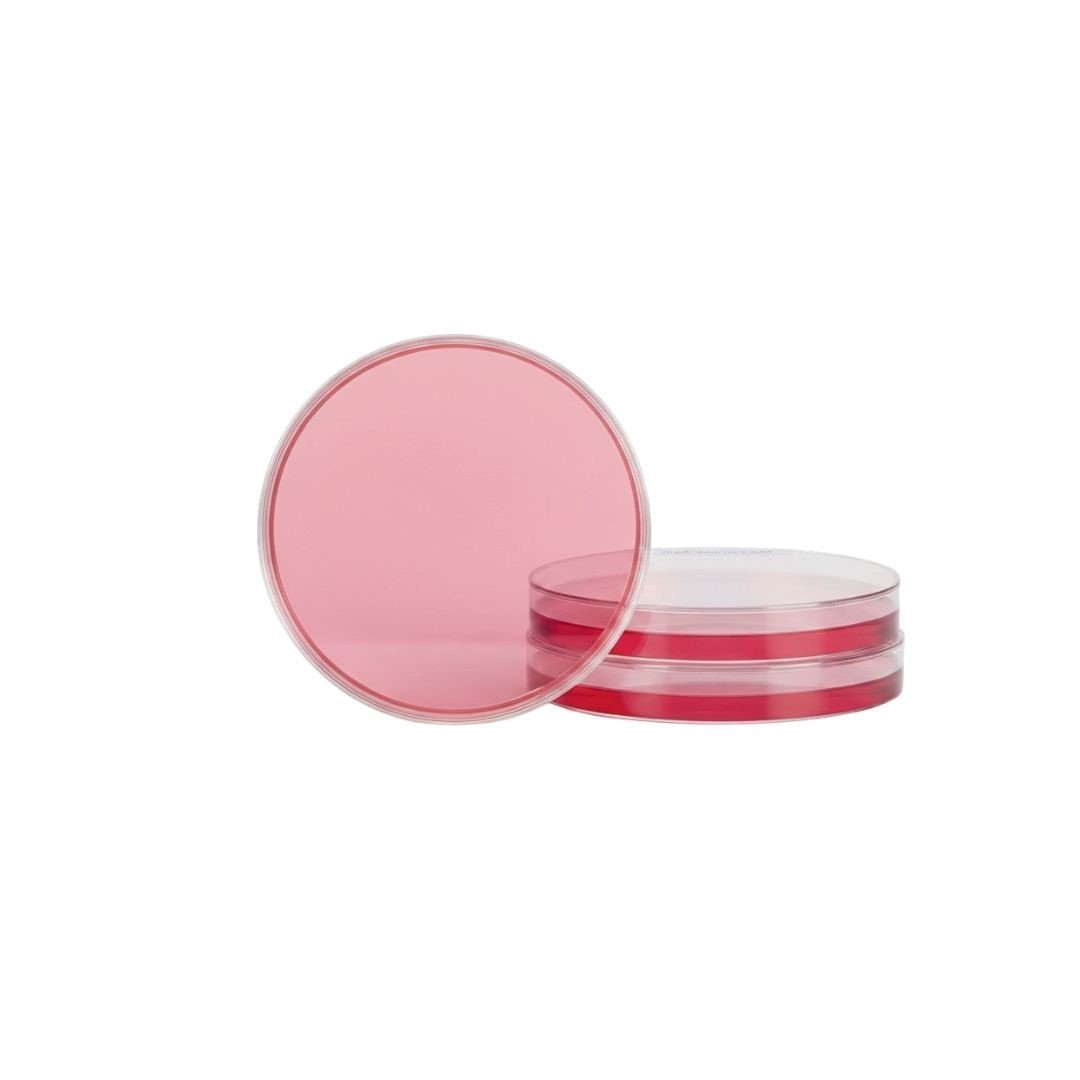
MacConkey Agar Plates – Ready-to-Use Selective & Differential Culture Media
MacConkey Agar Plates are ready-to-use, sterile culture media used in microbiology laboratories to selectively isolate gram-negative bacteria — particularly Enterobacteriaceae such as E. coli, Salmonella, and Shigella — while differentiating lactose-fermenting from non-lactose-fermenting organisms based on colony colour change.
What Is MacConkey Agar?
MacConkey Agar is a selective and differential growth medium first developed for isolating enteric gram-negative bacilli from clinical, food, water, and pharmaceutical samples. Bile salts and crystal violet dye in the formula suppress the growth of gram-positive organisms, allowing gram-negative bacteria to grow freely. Lactose in the medium then acts as the differentiating factor: organisms that ferment lactose produce acid, turning their colonies pink to red, while non-lactose fermenters remain pale or colourless.
This dual selective-differential action makes MacConkey Agar one of the most widely used media in diagnostic, food safety, water testing, and pharmaceutical quality-control laboratories.
Composition of MacConkey Agar (per litre)
| Ingredient | Quantity (g/L) |
|---|---|
| Peptone / Gelatin digest | 17.0 |
| Proteose peptone | 3.0 |
| Lactose | 10.0 |
| Bile salts | 1.5 |
| Sodium chloride | 5.0 |
| Neutral red | 0.03 |
| Crystal violet | 0.001 |
| Agar | 13.5–15.0 |
| Final pH (at 25°C) | 7.1 ± 0.2 |
Formula may vary slightly by manufacturer batch standardisation.
Key Features & Specifications
| Specification | Details |
|---|---|
| Plate Type | Ready-to-use, pre-poured, sterile |
| Plate Diameter | Standard 90 mm (also available in other sizes on request) |
| Appearance | Clear to slightly opalescent, pinkish-red medium |
| Sterility | Gamma-sterilised / autoclave-sterilised, quality-checked per batch |
| Storage Temperature | 2°C – 8°C, away from direct light |
| Shelf Life | As per batch expiry printed on pack (typically several weeks under refrigeration) |
| Packaging | Sleeved in breathable, moisture-resistant packs |
| Use | For in vitro diagnostic and laboratory use only |
Applications & Uses of MacConkey Agar Plates
MacConkey Agar Plates are used across multiple sectors of microbiological testing:
- Clinical Microbiology – Isolating gram-negative pathogens from urine, stool, wound, and blood culture samples.
- Enterobacteriaceae Screening – Detecting E. coli, Klebsiella, Proteus, Salmonella, and Shigella species.
- Food Microbiology – Testing food samples for coliform and enteric pathogen contamination.
- Water Testing – Screening drinking water and wastewater for coliform bacteria.
- Pharmaceutical QC – Microbial limit testing of non-sterile pharmaceutical products as per USP/EP/JP guidelines.
- Teaching & Research Labs – Demonstrating lactose fermentation and gram-negative selectivity in academic settings.
How MacConkey Agar Works?
- Selection – Bile salts and crystal violet inhibit gram-positive bacteria, allowing only gram-negative organisms to grow.
- Differentiation – Lactose-fermenting bacteria produce acid, which reacts with the neutral red indicator, turning colonies pink/red.
- Non-fermenters – Bacteria unable to ferment lactose (e.g., Salmonella, Shigella) appear pale, translucent, or colourless.
This colour-based readout allows lab technicians to make a fast, presumptive identification before confirmatory biochemical testing.
How to Use MacConkey Agar Plates: Step-by-Step?
- Remove the plate from cold storage and let it reach room temperature before opening.
- Ensure the agar surface is dry; do not use plates with visible condensation.
- Aseptically streak or spread the test inoculum (approx. 50–100 CFU) onto the surface using a sterile loop.
- Incubate at 35–37°C for 18–24 hours under aerobic conditions.
- Observe colony colour: pink/red colonies indicate lactose fermenters; pale/colourless colonies indicate non-fermenters.
- Confirm presumptive results with biochemical or serological tests as needed.
MacConkey Agar vs Other Agar Plates: Comparison Table
| Parameter | MacConkey Agar Plates | CLED Agar Plates | Mueller Hinton Agar Plates |
|---|---|---|---|
| Primary Purpose | Selective isolation & differentiation of gram-negative bacteria | Cystine-lactose-electrolyte-deficient medium for urine culture, prevents Proteus swarming | Antibiotic susceptibility testing (AST / zone of inhibition) |
| Selectivity | Selective for gram-negative organisms | Non-selective, supports most urinary pathogens | Non-selective, standardised for AST only |
| Differentiation Basis | Lactose fermentation (colour change) | Lactose fermentation (colour change) | Not differential — used for inhibition zone measurement |
| Typical Sample Type | Stool, urine, food, water, pharma samples | Urine samples | Pure bacterial/fungal isolates |
| Common Use Case | Detecting E. coli, Salmonella, Shigella | Quantitative urine culture & colony counting | Determining antibiotic sensitivity/resistance |
Explore our full range of Agar Plates to find the right medium for your lab’s testing panel.
Why Choose Nasmed Diagnostic MacConkey Agar Plates?
- Consistent Quality – Every batch is quality-checked for sterility, pH accuracy, and growth performance before dispatch.
- Ready-to-Use Convenience – No preparation time; plates arrive sterile and ready for inoculation.
- Reliable Cold-Chain Packaging – Packaged to preserve moisture balance and medium integrity in transit.
- Trusted by Diagnostic Labs – Supplied to clinical, pathology, and food-testing laboratories that require dependable, reproducible results.
- Backed by Technical Support – Our team can help you choose the right pack size and media type for your workflow.
Browse our complete catalogue of diagnostic consumables on our products page, or visit Nasmed Diagnostic to learn more about our manufacturing standards.
Storage & Shelf Life
Store MacConkey Agar Plates at 2°C–8°C in an upright position, away from direct sunlight and heat sources. Do not freeze. Avoid using plates that show excess moisture, cracking, or discolouration. Always check the batch expiry date printed on the pack before use, and use the medium within its validated shelf life to ensure reliable growth performance.
Frequently Asked Questions
Q1. What is MacConkey Agar used for?
- MacConkey Agar is used to selectively isolate gram-negative bacteria, especially Enterobacteriaceae, and to differentiate lactose-fermenting organisms from non-fermenters based on colony colour.
Q2. Why do MacConkey Agar plates turn pink?
- The pink/red colour appears when lactose-fermenting bacteria produce acid, which reacts with the neutral red pH indicator in the medium, signalling a positive lactose fermentation result.
Q3. Can gram-positive bacteria grow on MacConkey Agar?
- No. Bile salts and crystal violet in the formula inhibit most gram-positive bacteria, making the medium selective for gram-negative organisms only.
Q4. What is the ideal incubation temperature for MacConkey Agar?
- Plates are typically incubated at 35–37°C for 18–24 hours under aerobic conditions for optimal colony growth.
Q5. How should MacConkey Agar plates be stored?
- Store refrigerated at 2°C–8°C, protected from light and moisture, and use within the batch expiry date for best performance.
Q6. Is MacConkey Agar suitable for water and food testing?
- Yes. Along with clinical diagnostics, MacConkey Agar is widely used for detecting coliforms in water samples and enteric pathogens in food testing, in line with standard laboratory testing protocols.
Reference
Method and composition cross-checked against the U.S. FDA’s Bacteriological Analytical Manual (BAM), Media M91: MacConkey Agar — fda.gov.
Need Bulk Quantities or a Custom Quote?
Our team can help with pricing, pack sizes, and delivery timelines for your lab. Contact Us today, or explore more diagnostic media on our Website.