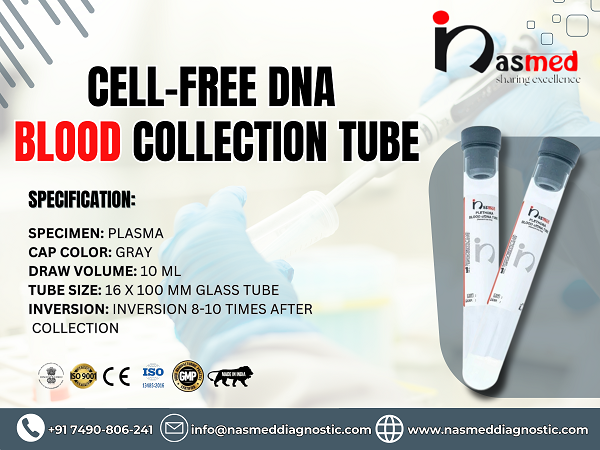
Advantages of Using Cell-Free DNA Blood Collection Tubes in Oncology Diagnostics: Nasmed Diagnostic
Modern testing methods and analysis have advanced considerably in the last ten years. Medical facilities and testing centres throughout India, the United States, and the United Kingdom now handle greater volumes of tests, a broader range of assay types, and increasing demand for faster turnaround and consistently reliable results. The advantages of Cell-Free DNA Blood Collection Tubes have become particularly pertinent in this evolving setting, aiding precision in sophisticated molecular diagnostics.
In standard lab procedures, precise specimen acquisition remains the foundation for every trustworthy diagnostic outcome. Notwithstanding progress in automation and sophisticated analysers, test results are still directly impacted by the efficacy with which a blood sample is drawn, stabilised, moved, and processed. Blood Collection Tubes continue to play a crucial role across hospitals, pathology networks, and reference facilities globally. Among these, Cell-Free DNA Blood Collection Tubes are increasingly incorporated into testing procedures where preserving minute circulating DNA fragments is vital for accurate subsequent molecular evaluation.
Evolving Requirements of Contemporary Testing & Healthcare Facilities
Diagnostic and hospital labs are functioning in an environment with greater demands than ever before. Some genuine challenges observed across healthcare systems include:
- Surging test volumes: Facilities in metropolitan areas manage substantial outpatient and inpatient sample loads daily.
- Quicker results: Clinicians anticipate prompt reports to inform treatment decisions.
- Global quality benchmarks: Many facilities adhere to internationally accepted quality standards through certifications or membership associations.
- Export and compliance pressures: Labs and suppliers serving global sectors face heightened scrutiny regarding the quality, packaging, and traceability of their supplies.
In hospital and pathology settings, purchasing departments are challenged to procure supplies that are consistent, reliable, and compatible with existing machinery. Blood Collection Tubes, often viewed as necessities, can become a hidden source of pre-analytical errors if quality varies across manufacturing lots or suppliers.
What Constitutes a Cell-Free DNA Blood Collection Tube?
A Cell-Free DNA Blood Collection Tube is engineered to support the gathering and stabilisation of blood specimens when cell-free DNA assessment is part of the lab process. In practical lab scenarios, this tube operates similarly to other conventional blood collection tubes during vein puncture, marking, shipment, and separation.
Seasoned lab personnel recognise that events occurring between the blood draw and sample handling directly affect test validity. In routine procedures, these tubes help mitigate changes in the specimen that may arise from delayed processing, temperature fluctuations, or the duration of transport between collection sites and leading laboratories.
Rather than being solely a “specialized research item,” these tubes are increasingly integrated into routine diagnostic workflows at reference centres and hospital systems that perform advanced molecular assessments.
Why Are Blood Collection Tubes Crucial for Accurate Blood Specimen Collection?
Accurate blood specimen collection commences with the correct tube. Blood Collection Tubes directly contribute to:
- Upholding specimen integrity from collection through analysis
- Minimising contamination risks during handling and transit
- Promoting uniformity in test outcomes across various collection points
In diagnostics intended for export quality, uniformity across different tube batches is especially important. A tube that performs differently from one delivery to the next can introduce variation in assay results, affecting confidence in outcomes across partner facilities in regions such as Southeast Asia and parts of Europe.
The Function of Blood Collection Tubes in Trustworthy Test Results
Selecting the wrong tube or encountering inconsistent tube quality can influence:
- Assay accuracy: Imbalances in additives or variations in tube composition may alter specimen behaviour.
- Re-testing frequency: Subpar specimen quality often results in rejection and the need for new samples.
- Patient confidence: Stoppages due to specimen issues can diminish trust in laboratory services.
In day-to-day diagnostic lab activities, pre-analytical errors remain a leading cause of needing repeat sampling. A simple mismatch between testing requirements and the tube type can lead to unnecessary redraws, added workload for phlebotomists, and patient inconvenience.
Considerations for Safety, Sterility & Patient Well-being
Blood Collection Tubes utilised in medical settings must ensure safe handling for both patients and medical staff. Primary concerns include:
- Sterilisation methods: Tubes should be produced under controlled conditions to reduce contamination risks.
- Ingress-proof design: Secure caps help prevent exposure during transit.
- User protection: Tubes must be compatible with standard phlebotomy apparatus to decrease handling errors.
In hospital and pathology lab settings, safe supplies reduce occupational exposure risks and help ensure compliance with internal safety mandates.
Compatibility with Modern Diagnostic Apparatus
Contemporary laboratories depend on automation to manage heavy workloads. Blood Collection Tubes should integrate seamlessly with:
- Automated analyzers
- Centrifuges are used for separating plasma
- Specimen tracking and transport systems
In large testing networks and referral labs across areas such as the Middle East and North America, compatibility challenges can disrupt workflows. Tubes that don’t fit racks, barcode readers, or centrifuge holders cause avoidable operational delays.
Manufacturing Quality, Reagents, & Tube Uniformity
Consistency in manufacturing is not solely about appearance; it directly affects how a tube performs in actual lab conditions. Dependable manufacturers control:
- Tube dimensions and material thickness
- Stability of the vacuum level
- Precision of the additives
Common agents used in blood collection tubes include EDTA, gelling agents, heparin, and fluoride-containing additives. Each agent serves a distinct diagnostic function. Non-uniformity in additive composition can affect specimen stability and test performance.
Seasoned lab professionals know that even slight changes in additive concentration can alter specimen characteristics during separation or storage.
Considerations for Storage, Remaining Effective Life, & Shipping
Blood Collection Tubes must maintain stability throughout storage and shipment. This is especially vital for:
- Climatic factors in India: Elevated temperatures and dampness can compromise packaging integrity.
- Shipments abroad: Lengthy transit durations to markets in Africa or Southeast Asia necessitate robust packaging.
- Centralised depots: Distributors frequently hold tubes for longer periods before dissemination.
Clear marking of shelf life and storage requirements helps quality assurance teams maintain usable inventory and minimise waste.
Economic Viability for Labs & Care Providers
Cost-effectiveness in diagnostics extends beyond the initial purchase price. Enduring operational value derives from:
- Reduced rejection of specimens
- Fewer repeated sample collections
- Steady quality of supply
In routine diagnostic lab functions, minimising rejected sample results in smoother workflows, better utilisation of staff time, and an improved patient experience. Purchasing teams often assess supplies based on their impact on the overall cost of ownership rather than just the per-unit price.
Adherence to Regulations, Norms, & Export Readiness
Laboratories and distributors serving international sectors face expectations concerning:
- Global acceptance of their supplies
- Buyer assessments and necessary paperwork
- Standards set by hospital procurement bodies
Export readiness involves more than just regulatory documentation. It also encompasses uniform labelling, packaging, batch traceability, and documented quality checks. Purchasers in areas like the Gulf and parts of Europe increasingly evaluate manufacturers on these operational facets before onboarding new vendors.
Incorporation into Hospital & Lab Processes
In hospital outpatient collections, diagnostic facilities, and pathology networks, blood collection tubes must fit seamlessly into established procedures. This involves:
- Ease of use for phlebotomists
- Clear marking and identification
- Compatibility with LIS and sample tracking systems
When necessary supplies harmonise well with workflow design, labs experience fewer handling errors and a smoother flow of specimens from collection to reporting.
Practices for Education, Handling, & Disposal
Appropriate instruction and handling techniques are vital to maximise the benefit of high-quality supplies. Laboratories generally concentrate on:
- Straightforward, repeatable training modules for new personnel
- Secure disposal methods aligned with rules for biological waste
- Regular reviews to pinpoint gaps in handling procedures
In hospital and pathology lab settings, awareness of correct disposal lessens environmental hazards and supports adherence to local waste management directives.
Why is Selecting the Appropriate Manufacturer Important?
Selecting the right manufacturer is a key strategic decision for labs and distributors serving multiple regions. Essential elements to consider include:
- The manufacturer’s experience in creating diagnostic supplies
- Quality assurance systems that guarantee consistency across production runs
- Understanding of international shipping logistics and required documentation
- Sufficient production capacity to support expanding test volumes
In international supply chains, inconsistent supply or quality can disrupt service delivery across entire testing networks.
About Nasmed Diagnostic Pvt Ltd
Nasmed Diagnostic Pvt Ltd is an Indian producer of diagnostic supplies for both domestic and overseas markets. With a history of serving testing centres and healthcare distributors across Asia, Africa, and other territories, the company focuses on manufacturing uniformity, quality oversight, and the practical utility of blood collection merchandise.
Further details about their product lines and manufacturing standards can be viewed at 👉 https://www.nasmeddiagnostic.com/
Conclusion:
Blood Collection Tubes remain one of the most overlooked yet critical components of the diagnostic process. From sample integrity and workflow efficiency to patient experience and laboratory reliability, the quality of tubes directly affects outcomes across the diagnostic value chain.
For laboratories, hospitals, and distributors serving diverse healthcare systems, thoughtful selection of consumables such as the Cell-Free DNA Blood Collection Tube supports consistent diagnostics, safer handling practices, and smoother integration into modern laboratory operations.
A careful, quality-focused approach to sourcing blood collection consumables helps build long-term reliability in both patient care and diagnostic service delivery.
Key Takeaways
- Diagnostic Accuracy: Reliable tubes support consistent test results
- Sample Safety & Sterility: Quality manufacturing reduces contamination risks
- Workflow Efficiency: Compatibility with automation improves lab operations
- Cost Control for Labs: Fewer re-tests and rejections lower operational burden
- Growing Global Demand: International diagnostics require export-ready consumables
FAQS
1. How does the choice of blood collection tube affect sample accuracy?
- Tube material and additive consistency influence how blood behaves after collection. Inconsistent tubes can lead to pre-analytical variation, which affects test reliability.
2. Can blood collection tubes be stored in warm climates without quality loss?
- Properly packaged tubes with clear storage guidelines are designed to tolerate routine storage conditions, but exposure to excessive heat or humidity should be avoided.
3. Are Cell-Free DNA Blood Collection Tubes compatible with automated lab systems?
- Most tubes used in clinical diagnostics are designed to fit standard racks, centrifuges, and analysers used in modern laboratories. Compatibility should always be verified during validation.
4. What are common lab mistakes related to blood collection tubes?
- Using the wrong tube for a test, improper storage, and delayed processing are common pre-analytical errors seen in daily diagnostic lab operations.
5. Do export markets require special documentation for blood collection tubes?
- International buyers often expect documentation related to manufacturing quality, batch traceability, and packaging standards as part of procurement evaluations.
#BloodCollectionTube #DiagnosticConsumables #PathologyLab #MedicalDiagnostics #NasmedDiagnostic #IVDProducts #HealthcareManufactufacturing #GlobalDiagnostics #SodiumFluorideBloodCollectionTubes