
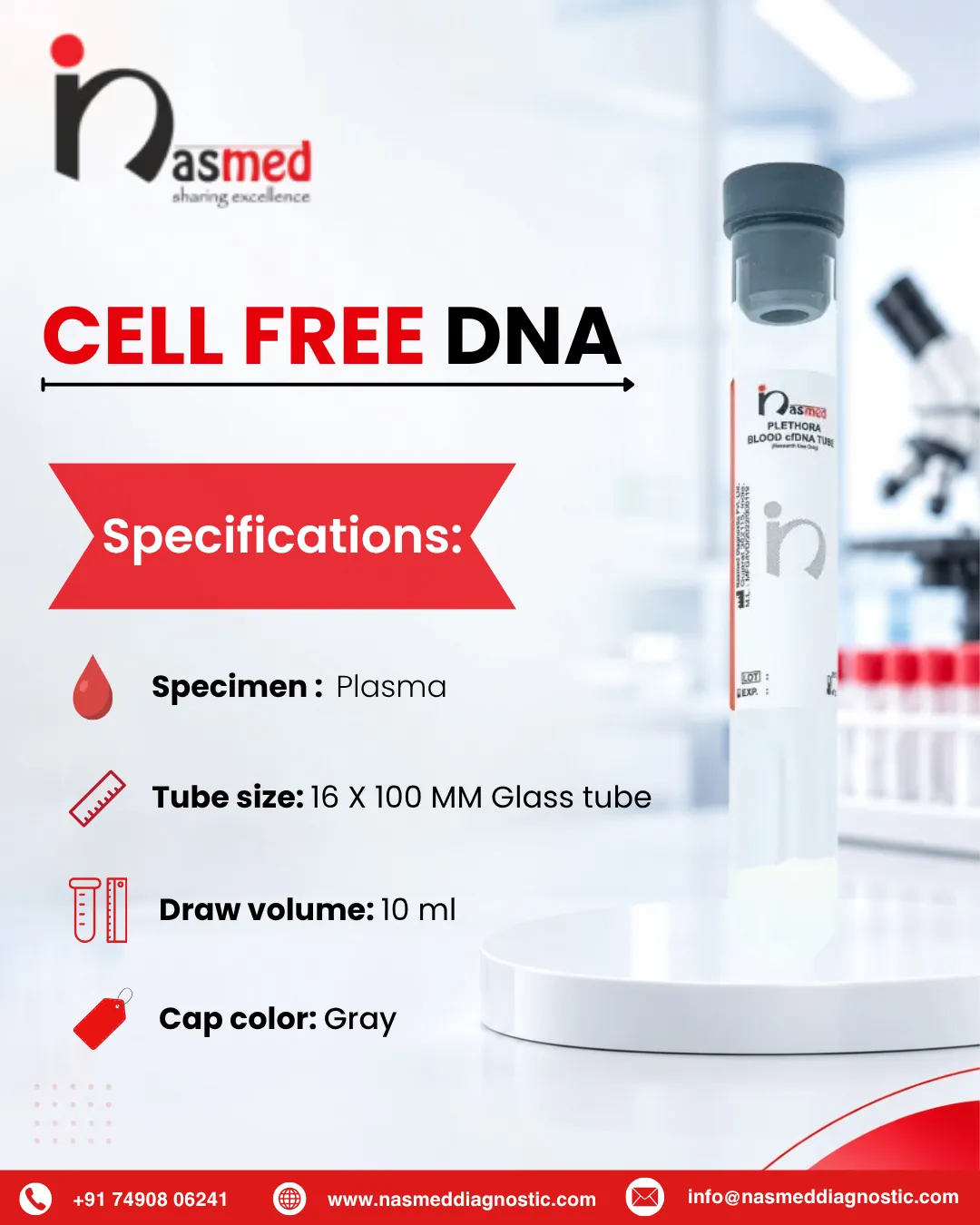
Cell Free DNA Blood Collection Tubes for Accurate Molecular Testing
Cell free DNA tubes protect the tiny DNA fragments floating in your blood plasma from the moment of collection until they reach the lab. These fragments carry valuable information about pregnancy, cancer and organ health. They are also fragile and easy to lose to poor handling.
A standard tube cannot protect them for long. A specialised tube can. This guide explains how these tubes work, where they are used, how to handle them, and what to check before you buy.
What Are Cell Free DNA Blood Collection Tubes?
Cell free DNA blood collection tubes are evacuated tubes filled with a preservative. They keep circulating cell-free DNA (cfDNA) stable in whole blood during transport and storage.
cfDNA is made of short DNA fragments released into the bloodstream when cells die. Its concentration is very low in a healthy adult. During pregnancy, some of it comes from the placenta. Tumour cells also shed fragments into the blood, and this fraction is called circulating tumour DNA (ctDNA).
A regular tube gives poor results for this work. Its white blood cells start to break down within hours and release their own DNA. That extra genomic DNA dilutes the signal you actually want to measure.
How Do Cell Free DNA Tubes Work?
The preservative inside the tube does two jobs at once.
- It stabilises nucleated blood cells. The cells stay intact, so they do not leak genomic DNA into the plasma.
- It slows DNA-degrading enzymes. The natural cfDNA fragments stay whole until extraction.
Blood is drawn straight into the tube and mixed by gentle inversion. The preservative starts working immediately. The sample can then travel at room temperature for several days, depending on the tube. Nasmed’s own article on cell free DNA tubes and personalised medicine covers the science behind this in more depth.
At the lab, technicians separate the plasma and extract the cfDNA for sequencing or PCR.
Benefits of Cell Free DNA Blood Collection Tubes
Good preservation changes what a lab can offer. Here is what you gain.
- Cleaner results. Less genomic DNA contamination means a clearer cfDNA signal.
- Longer transport window. Samples from distant collection centres stay usable.
- Fewer redraws. Patients avoid repeat needle pricks, and labs avoid delays.
- Easier logistics. Processing does not have to happen within a couple of hours.
- Consistent quality. Batch-to-batch reliability supports reproducible assays.
Cell Free DNA Tubes for Non-Invasive Prenatal Testing
Non-invasive prenatal testing (NIPT) screens for chromosomal conditions such as Down syndrome using only a maternal blood sample. The test looks at fetal DNA fragments circulating in the mother’s plasma, usually from about the tenth week of pregnancy.
Fetal DNA makes up only a small share of the total cfDNA. If maternal white cells burst in transit, that share drops further and the test may fail or need a redraw.
Stabilised tubes prevent this. They make it practical for clinics in smaller towns to collect samples and send them to a central laboratory.
Contact UsApplications of Cell Free DNA Tubes in Molecular Testing
The same tubes support several areas of testing. The table below summarises the main ones.
| Application | What the test looks for | Why stabilisation matters |
|---|---|---|
| Non-invasive prenatal testing | Fetal chromosomal abnormalities | Keeps the small fetal fraction detectable |
| Liquid biopsy (oncology) | Tumour mutations in ctDNA | Prevents dilution of rare tumour fragments |
| Treatment monitoring | Changes in ctDNA over time | Gives comparable results across visits |
| Transplant monitoring | Donor-derived cfDNA levels | Reduces false signals from lysed cells |
| Research and epigenetics | Methylation and fragment patterns | Preserves native fragment profiles |
Liquid biopsy is growing fastest. It supports early screening and preventive care by detecting disease signals through a simple blood draw instead of an invasive procedure.
Cell Free DNA Tube Handling, Stability and Storage
Even the best preservative cannot rescue a poorly handled sample. These steps protect your results.
- Check the expiry date and the tube’s fill volume before use.
- Fill to the marked draw volume. Underfilling changes the blood-to-preservative ratio.
- Invert gently 8 to 10 times straight after collection. Never shake the tube.
- Label clearly with patient details and the collection time.
- Keep the tube at room temperature. Do not refrigerate or freeze whole blood.
- Ship within the stability window stated by the manufacturer. Many tubes protect cfDNA for roughly 7 to 14 days.
- Process in two spins. Labs commonly use a slow spin to separate plasma, then a faster spin to remove residual cells.
- Freeze the plasma at −80 °C if extraction will not happen immediately.
Always follow the manufacturer’s instructions for use, as tube chemistry varies. Avoid haemolysis by using a suitable needle and a smooth draw.
How to Choose the Right Cell Free DNA Blood Collection Tube
Not every tube suits every workflow. Compare a stabilised tube with a standard one first.
| Feature | Cell free DNA tube | Standard EDTA tube |
|---|---|---|
| Preservative | Stabilises cells and blocks DNA breakdown | Anticoagulant only |
| Plasma processing window | Several days at room temperature | Usually within a few hours |
| Genomic DNA contamination | Low | Rises as cells lyse |
| Best suited for | NIPT, liquid biopsy, transplant tests | Routine haematology such as CBC |
| Transport from remote sites | Practical | Difficult without cold chain |
Then check these points before ordering:
- Stability claim. Match the tube’s window to your longest transit time.
- Assay compatibility. Confirm the preservative works with your extraction kit and platform.
- Draw volume. Pick a size that gives enough plasma for your test.
- Manufacturing quality. Look for a controlled, clean-room facility and regulatory approval.
- Supplier support. You need reliable stock, batch documentation and technical help. See how reliable manufacturers of cell-free DNA blood collection tubes are evaluated.
Quality benchmarks matter in the wider lab chain too. An ISO 9001-certified diagnostic centre with its own pathology laboratory shows how documented quality systems support dependable results.
Why Choose Us For Blood Collections Tubes?
Nasmed Diagnostics Pvt. Ltd. manufactures blood collection tubes at Survey No 282 (Old Block No 213 Paiki), Nandoli, Gandhinagar, Gujarat 382115. The company is led by Directors Kush Patel and Suril Shah, with a team of skilled technicians and quality experts.
- CDSCO certified and manufactured in an ISO 7 clean room (Class 10,000) for contamination-free production.
- Full range: vacuum, non-vacuum, micro/paediatric, cell-free DNA and gel lithium heparin tubes, plus urine containers and custom lab disposables.
- International material guidelines followed, with affordable pricing and responsive support.
- Trusted by hospitals, clinics and laboratories across India.
Read how our tubes support precision diagnostic testing, or contact us for samples and bulk quotes.
Call: +91 79908 01393 | Email: info@nasmeddiagnostic.com
FAQs
Q.What are cell free DNA blood collection tubes?
- They are blood tubes containing a preservative that stabilises blood cells and protects cfDNA from degradation. This keeps the sample suitable for molecular testing after transport.
Q.How do cell free DNA tubes work?
- The preservative stops white blood cells from lysing and slows DNA-degrading enzymes. Genomic DNA stays inside the cells, and cfDNA stays intact in the plasma.
Q.Are cell free DNA blood collection tubes used for prenatal testing?
- Yes. Non-invasive prenatal tests rely on fetal DNA fragments in maternal plasma. Stabilised tubes keep that small fraction detectable and reduce failed samples.
Q.How to collect blood for cell free DNA testing?
- Fill the tube to its marked volume and invert it gently 8 to 10 times. Label it and keep it at room temperature. Send it to the lab within the stated stability window.
Q.What is the stability and storage period for these tubes?
- Stability depends on the product, but many tubes preserve cfDNA for about 7 to 14 days at room temperature. Store unused tubes as directed and check expiry dates. Do not freeze whole blood.
Q.What are the benefits of cell free DNA blood collection tubes?
- They give cleaner results, allow longer transport times, reduce redraws and support consistent quality across batches and sites.
Q.Can a standard EDTA tube replace a cfDNA tube?
- Only if plasma is separated within a few hours. For longer transport, a stabilised tube gives far more reliable cfDNA results.