
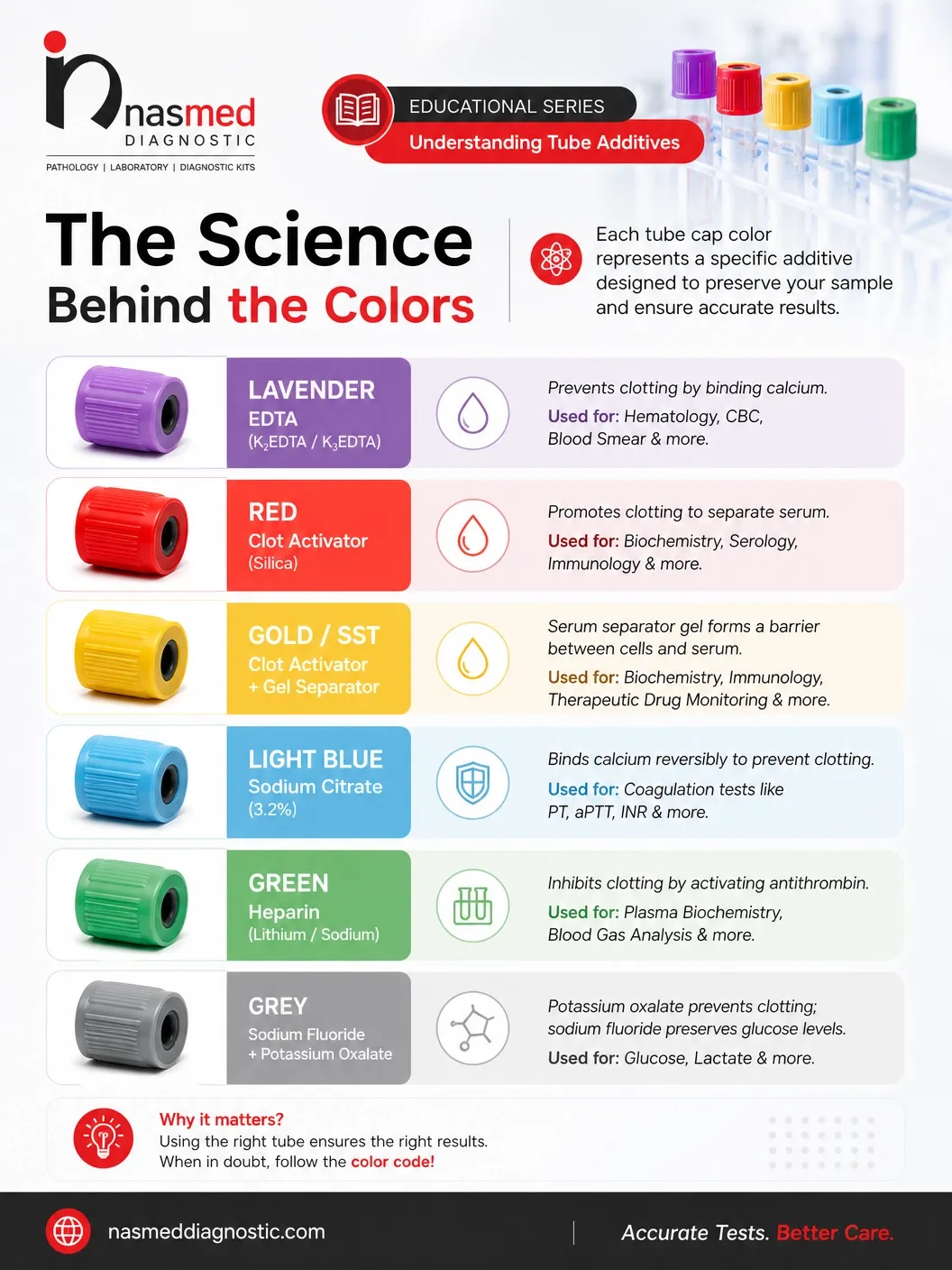
Laboratory Blood Collection Tube Color Guide
Laboratory Blood Collection Tube Color Guide: What Every Lab Manager in India Must Know
Walk into any diagnostic laboratory in Mumbai, Hyderabad, or Ahmedabad, and you will notice the same rainbow of stoppers lined up beside a phlebotomist’s tray — red, lavender, green, blue, grey, yellow. These aren’t decorative choices. Each cap colour on a blood collection tube carries a specific clinical meaning, an additive chemistry, and a defined testing purpose. Getting that colour wrong — even once — can result in a haemolysed sample, a clotting artefact, or an entirely unusable draw that needs to be repeated on an already anxious patient. For lab managers, procurement heads, and quality officers across India, understanding the tube colour system is as fundamental as calibrating an analyser. This guide explains each colour, its additive, its use, and what to demand from your tube supplier to ensure sample integrity from the very first draw.
Why Choose Nasmed Diagnostics for Your Blood Collection Tube Requirements?
There are dozens of suppliers claiming to offer diagnostic lab disposables in India, but the gap between a quality-compliant manufacturer and a price-first trader becomes painfully visible when sample rejections start climbing. Nasmed Diagnostics Pvt. Ltd., based in Gandhinagar, Gujarat, was built precisely to close that gap.
The company is led by directors Kush Patel and Suril Shah, who have assembled a team of skilled technicians and quality experts working inside a state-of-the-art ISO 7 clean room facility (Class 10,000). Every tube — from standard vacuum tubes to specialised cell-free DNA tubes — is manufactured under contamination-controlled conditions that most smaller regional suppliers simply cannot match. Add CDSCO certification to this, and you have a partner whose products satisfy the Central Drugs Standard Control Organisation’s standards for in-vitro diagnostic devices.
Hospitals in Delhi, diagnostic chains in Bangalore, and independent path labs in Surat and Jaipur have placed repeat orders with Nasmed Diagnostics — not because of aggressive discounting, but because consistent tube performance translates directly into fewer rejection slips and better patient outcomes. That reputation is built sample by sample, tube by tube.
Learn more about our vacuum blood collection tubes product range to understand specifications before ordering.
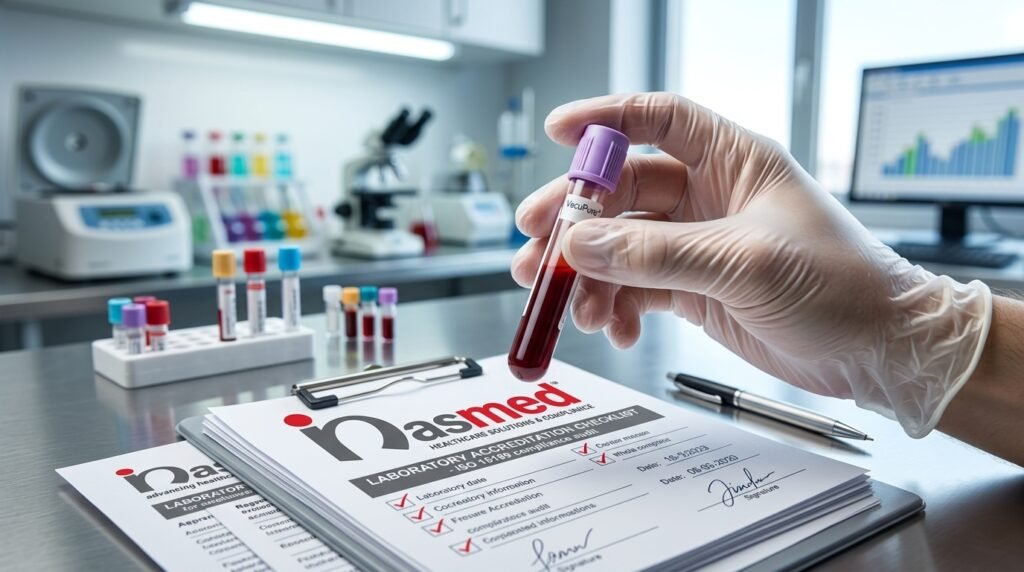
Our Laboratory Blood Collection Tube Color Guide Manufacturing Capabilities
Understanding the colour system is one thing — being able to reliably manufacture tubes across every colour and additive type at commercial scale is another. Here is where Nasmed Diagnostics distinguishes itself as a credible vacuum blood collection tubes manufacturer in Gandhinagar.
The product range covers the full clinical spectrum. Vacuum blood collection tubes are available in all standard sizes and draw volumes, manufactured with precisely calibrated vacuum levels to ensure accurate fill. Non-vacuum blood collection tubes are supplied for settings where passive collection is preferred, particularly in paediatric wards and smaller clinic setups in Chandigarh, Indore, and Vadodara where budget-conscious procurement requires flexibility.
The gel lithium heparin tubes — among the most clinically versatile products in the range — undergo rigorous gel viscosity and separation index testing before dispatch. Plasma chemistry results depend heavily on the gel separator performing consistently after centrifugation, and Nasmed Diagnostics‘ process controls are designed with that clinical reality in mind.
For tertiary hospitals and mother-child care centres, micro paediatric tubes are available with low-draw volumes (0.25 mL to 1.0 mL), minimising blood volume stress in neonates and infants. And for oncology centres and genetic testing labs in Chennai, Pune, and Kolkata, cell-free DNA tubes with proprietary preservative formulations are supplied to support liquid biopsy workflows and NIPT programs.
The facility also manufactures urine containers and a broader range of custom diagnostic lab disposables, making it possible for procurement teams to consolidate their entire consumable sourcing under one CDSCO-certified roof.
Explore our micro paediatric blood collection tubes designed for neonatal and infant phlebotomy.
Quick Reference: Blood Collection Tube Color Guide
| Cap Colour | Additive / Anticoagulant | Primary Use / Tests | Notes for Lab Managers |
|---|---|---|---|
| Red | None (plain) or Clot Activator | Serum biochemistry, serology, immunology | Allow 30 min clotting before centrifugation |
| Gold / SST | Clot activator + gel separator | Serum chemistry panels, hormone assays | Gel must have consistent viscosity; check supplier QC |
| Lavender / Purple | EDTA (K2 or K3) | CBC, haematology, ESR, blood grouping | Mix 8–10 times by inversion; prevents clot formation |
| Green | Lithium Heparin or Sodium Heparin | Plasma chemistry, LFT, KFT, electrolytes | Gel lithium heparin variant preferred for urgent panels |
| Blue | Sodium Citrate (3.2%) | Coagulation: PT, APTT, D-Dimer, fibrinogen | Fill to exact volume mark; underfill alters citrate:blood ratio |
| Grey | Sodium Fluoride + Potassium Oxalate | Glucose, lactate, alcohol levels | Sodium fluoride inhibits glycolysis; draw last if multiple tubes |
| Yellow | SPS or ACD | Blood cultures, HLA typing, DNA banking | First in order of draw to prevent contamination |
| Pink | EDTA | Blood banking, cross-matching, transfusion | Typically labelled with patient ID by bedside staff |
| Dark Navy / Black | Sodium Citrate (buffered) | Westergren ESR, specific coagulation profiles | Used when dilution factor matters; follow lab SOP |
| Pearlescent / White | Preservative (Cell-Free DNA) | Liquid biopsy, NIPT, circulating tumour DNA | Store at 4–25°C; stabilises cfDNA for up to 14 days |
Navigating Regulatory Compliance and CDSCO Certification for Blood Collection Tubes
In 2017, the Government of India brought blood collection tubes under the regulatory ambit of the Drugs and Cosmetics Act through the Medical Devices Rules. This meant that manufacturers had to seek CDSCO certification and comply with Schedule M III for medical device manufacturing — including sterility requirements, biocompatibility testing, and labelling standards. The intent was sound: to eliminate the flood of non-compliant, domestically assembled tubes that had caused sample integrity issues across labs in Hyderabad and Delhi in the preceding years.
What this change did, practically, is raise the bar for entry. Manufacturers without controlled production environments, validated additive processes, or audited quality management systems were effectively sidelined. Nasmed Diagnostics was built in alignment with these standards from day one. The ISO 7 clean room environment controls particulate matter at Class 10,000 levels — meaning fewer than 10,000 particles ≥0.5 microns per cubic foot — which is the accepted standard for sterile diagnostic product manufacturing.
Lab managers and procurement teams evaluating suppliers should always request a copy of the manufacturer’s CDSCO registration certificate and their clean room qualification report. These are not bureaucratic formalities — they are clinical safeguards. International material guidelines, including those from the Clinical and Laboratory Standards Institute (CLSI) and ISO 6710 for single-use blood collection containers, further specify tube dimensions, vacuum tolerance, and additive performance standards that any credible manufacturer should demonstrate compliance with.
Internal link: Read our detailed post on CDSCO compliance requirements for blood collection tubes in India to stay updated on regulatory obligations.
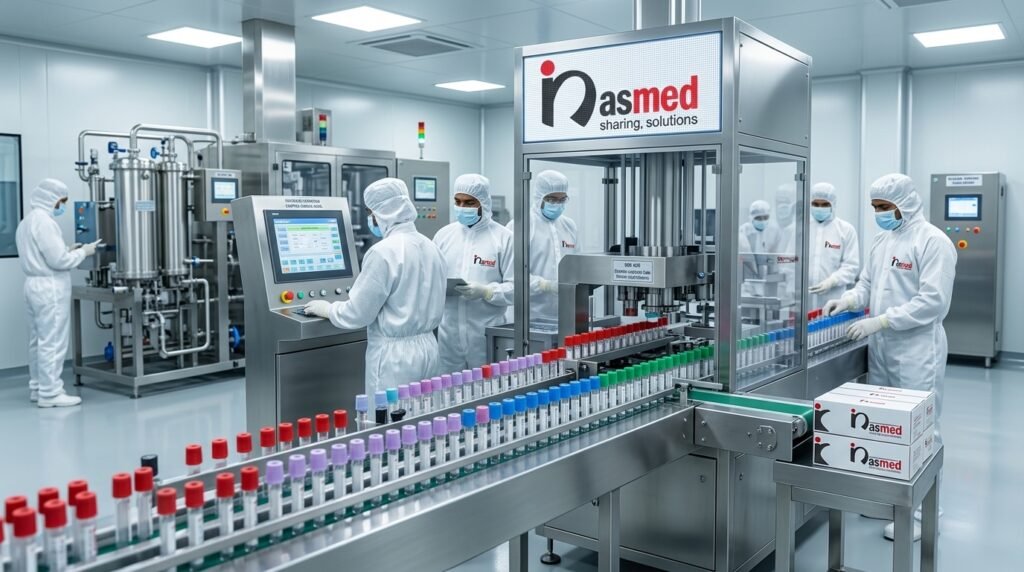
Local Suppliers vs Nasmed Diagnostics – An Honest Comparison
When a procurement officer in Ahmedabad or Kolkata evaluates tube suppliers, price is usually the first filter. But experienced lab managers know that the real cost of a tube isn’t just the unit price — it’s the rejection rate, the repeat-draw rate, and the downstream test errors that trace back to compromised sample quality. Here is a practical comparison.
| Parameter | Typical Local / Unbranded Supplier | Nasmed Diagnostics Pvt. Ltd. |
|---|---|---|
| Manufacturing Environment | Open or semi-controlled facility; no clean room certification | ISO 7 Clean Room (Class 10,000), validated and audited |
| Regulatory Status | Often unregistered or operating under old exemptions | CDSCO certified under Medical Devices Rules 2017 |
| Additive Consistency | Variable lot-to-lot additive concentration | Batch-tested additive performance with QC documentation |
| Vacuum Precision | Manual filling; variable vacuum levels | Automated calibrated vacuum filling; consistent draw volume |
| Gel Separator Quality | Inconsistent gel density; risk of barrier failure | Validated gel viscosity; separation index tested per batch |
| Paediatric Tubes | Limited availability; often sourced from third parties | In-house manufactured micro paediatric tubes (0.25–1.0 mL) |
| Custom Diagnostic Solutions | Standard catalogued products only | Custom diagnostic lab disposables available on request |
| Documentation Support | Minimal; often no CoA or regulatory paperwork | Full Certificate of Analysis, CDSCO certificate, and batch records |
| Pan-India Supply | Limited to local geography | Supplies to Mumbai, Delhi, Bangalore, Hyderabad, Chennai, Pune, Jaipur, Surat, and beyond |
Step-by-Step Process – How We Deliver Laboratory Blood Collection Tubes
One of the questions lab managers from Pune and Surat ask during initial conversations is straightforward: what exactly happens between their purchase order and the tubes arriving in their lab? Here is an honest, step-by-step walkthrough of how Nasmed Diagnostics manages order fulfilment.
Step 1 – Requirement Assessment: The team begins with a Free Product Consultation call. Whether a client needs standard EDTA tubes for a 50-bed hospital in Jaipur or specialised gel lithium heparin tubes for a multi-branch diagnostic chain in Chennai, requirements are mapped before any commitment is made. Volume, tube size, draw type (vacuum or non-vacuum), and any custom labelling needs are documented.
Step 2 – Production Scheduling: Orders are slotted into the clean room production calendar. Sterile blood collection tubes are manufactured in controlled batches. Each batch undergoes in-process quality checks including leak testing, vacuum verification, sterility validation, and additive concentration confirmation.
Step 3 – Quality Verification and Documentation: Before any batch is released, a Certificate of Analysis is generated. This document records lot number, manufacturing date, sterility testing results, vacuum range, additive type and concentration, and shelf-life expiry. This paperwork travels with every shipment.
Step 4 – Sterile Packaging: Tubes are packed in sterile, tamper-evident packaging appropriate for medical device logistics. Packaging is sized and cushioned to prevent physical damage during transport — a surprisingly common issue with cheaper logistics-integrated suppliers.
Step 5 – Dispatch and Logistics: Shipments are dispatched to labs across India. For urgent requirements, the team coordinates expedited logistics to Mumbai, Delhi, Bangalore, and other major cities. WhatsApp updates (+91 74908 06241) are available for tracking and queries throughout the delivery cycle.
Step 6 – After-Sales Support: Post-delivery, the team remains available for troubleshooting. If a lab reports unexpectedly high haemolysis rates or unusual gel separation behaviour, the quality team investigates through batch traceability records. This level of accountability is what distinguishes a manufacturing partner from a transactional vendor.
Internal link: Check out our urine containers and related diagnostic consumables that can be combined with tube orders for consolidated procurement.
Quick Win: A regional diagnostic network in Vadodara switched from an unregistered local supplier to Nasmed Diagnostics after experiencing a 4.2% sample rejection rate with their existing EDTA tubes. Within two months of switching to our CDSCO certified tubes manufactured in the ISO 7 clean room, their lab supervisor reported a rejection rate drop below 0.6% — and the phlebotomy team noted that the vacuum consistency meant far fewer failed draws in elderly patients with fragile veins.
Real Client Case Study – Reducing Sample Rejection at a Multi-City Diagnostic Chain
Client: Ananya Diagnostics Pvt. Ltd. (name changed for confidentiality) – a mid-sized diagnostic chain with 11 collection centres across Ahmedabad, Surat, and Vadodara.
Challenge: In early 2025, Ananya Diagnostics’ quality team flagged a rising trend of sample rejections in coagulation studies — specifically PT and APTT tests. Investigation revealed that sodium citrate tubes from their existing supplier showed inconsistent fill volumes. At least 18% of tubes drawn in their Surat centres were underfilled, causing a dilution error in the citrate-to-blood ratio (target: 1:9). This produced artificially prolonged clotting times and led to repeat draws, patient dissatisfaction, and diagnostic delays. Their procurement head reached out after finding diagnostic tubes suppliers India through an online search.
Solution: The Nasmed Diagnostics team conducted a product consultation call within 24 hours. Based on the specific vacuum draw volumes required for their adult population and collection centre needle gauges, a batch of sodium citrate tubes was configured. These were tested in-house for vacuum precision — confirming that fill volumes fell within ±2% of the 2.7 mL target. A trial shipment of 5,000 tubes was dispatched to Ahmedabad for validation.
Result: Over an 8-week validation period, Ananya Diagnostics recorded zero underfill rejections from the Nasmed Diagnostics batch. Their head of quality documentation signed off on a supplier change, and a 12-month supply agreement was executed covering sodium citrate, gel lithium heparin, and EDTA tubes for all 11 centres. The chain’s monthly consumable cost reduced by approximately 11% compared to the previous supplier — because lower rejection rates meant significantly fewer repeat draws consuming additional tubes and staff time.
Lab Supervisor’s Note (paraphrased): “We had been managing this rejection problem for almost a year before switching. What changed was not just the tubes — it was having a supplier who could actually show us batch documentation and explain how their vacuum calibration works. That transparency built the confidence we needed to commit.”
Frequently Asked Questions – Blood Collection Tube Color Guide
1. What do blood collection tube colors indicate?
- Blood collection tube colors indicate the specific additive inside each tube. Different additives preserve blood samples differently for tests such as hematology, biochemistry, coagulation, serology, and glucose analysis. Using the correct tube color ensures accurate diagnostic results.
2. Which blood collection tube is used for CBC testing?
- The lavender-top tube containing EDTA (K₂EDTA/K₃EDTA) is used for Complete Blood Count (CBC), blood smear examination, and other hematology tests because it prevents clotting by binding calcium.
3. Why is the order of draw important during blood collection?
- The order of draw prevents additive carryover between tubes, which can affect test accuracy. Following standard phlebotomy guidelines helps avoid contamination and ensures reliable laboratory results.
4. What is the difference between red-top and gold-top blood collection tubes?
- Red-top tubes contain a clot activator and are primarily used for serum testing. Gold-top (SST) tubes contain a clot activator along with a gel separator that creates a barrier between serum and blood cells, improving sample stability.
5. Which tube color is used for coagulation tests like PT, aPTT, and INR?
- The light blue-top tube containing sodium citrate is used for coagulation testing because it reversibly binds calcium and preserves clotting factors for accurate PT, aPTT, and INR analysis.
6. Blood sample collect karte waqt sahi tube color choose karna kyun zaroori hai?
- Har blood collection tube mein alag additive hota hai. Agar galat tube use ki jaye, to sample kharab ho sakta hai aur test results inaccurate aa sakte hain. Isliye hamesha test requirement ke hisaab se sahi tube color select karna chahiye.
7. Grey-top tube ka use kis test ke liye hota hai?
- Grey-top tube mein sodium fluoride aur potassium oxalate hota hai, jo glucose ko preserve karta hai. Iska use blood sugar, glucose tolerance, aur lactate testing ke liye kiya jata hai.