
Vacuum Blood Collection Tubes: Types, Colors, Uses & Blood Tests
If you’ve ever had blood drawn, you’ve probably noticed the phlebotomist reach for a specific tube with a specific colored cap. That’s not random. It’s one of the most important, and most overlooked, steps in accurate lab diagnostics. Vacuum blood collection tubes are pre-vacuumed, sterile tubes that draw an exact volume of blood and preserve it correctly until it reaches the lab.
Choosing the wrong tube can quietly ruin a sample. Clotted blood in an EDTA tube, or unclotted serum in a plain tube, both lead to rejected samples and repeat blood draws. This guide covers what vacuum blood collection tubes are, the different types available, what each cap color means, and how labs and hospitals choose the right one for every test.
What Are Vacuum Blood Collection Tubes?
Vacuum blood collection tubes, often called vacutainer tubes, are sterile glass or plastic tubes with a rubber stopper. Manufacturers pre-set this stopper to hold a specific internal vacuum. When the needle pierces the stopper during a blood draw, the vacuum pulls in a precise, pre-measured volume of blood automatically. There’s no manual plunger and no guesswork involved.
How the Vacuum Draw Protects the Sample
This design does two things well. First, it keeps the blood draw closed and contamination-free, because the tube, needle, and holder form a sealed system from vein to lab. Second, it keeps the blood-to-additive ratio correct inside the tube. This matters enormously for tests like coagulation studies, where even a slightly “underfilled” tube can throw off the results.
What’s Inside the Tube
Most vacuum blood drawing tubes also contain an internal additive. This could be an anticoagulant, a clot activator, a gel separator, or nothing at all, depending on what the tube needs to collect. That additive, together with the tube’s cap color, tells the lab technician exactly how to handle the sample next.
Types of Blood Collection Tubes and Their Uses
Not every blood test needs the same kind of tube. Broadly, blood collection tubes fall into a few families:
- Plain (clot activator) tubes – contain a clot-activating agent that speeds up natural clotting. Labs use these when they need pure serum for biochemistry and serology tests. Nasmed’s clot activator vacuum blood collection tubes are a common choice for this purpose.
- Anticoagulant tubes (EDTA, citrate, heparin) – stop the blood from clotting at all, keeping it in liquid or whole-blood form for tests like CBC or coagulation panels.
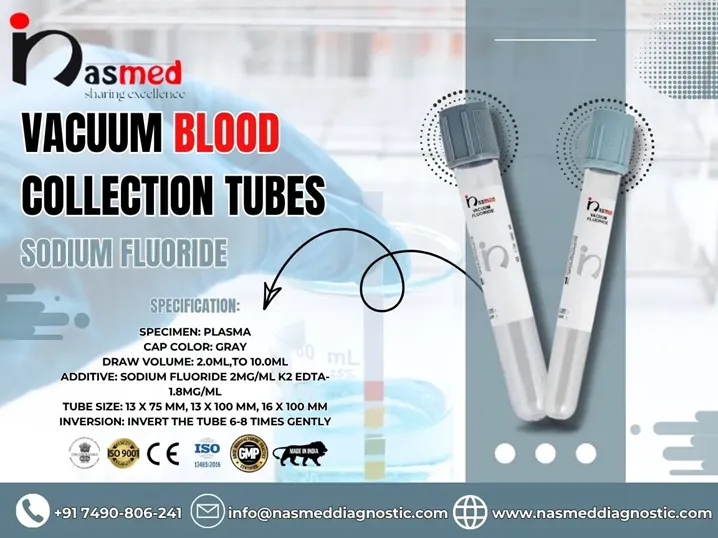
- Glucose/fluoride tubes – contain sodium fluoride and an anticoagulant to stop glycolysis, which keeps glucose levels stable until testing. Both vacuum and non-vacuum versions exist, including sodium fluoride vacuum blood collection tubes in Karnataka and sodium fluoride non-vacuum blood collection tubes for labs that prefer manual draws.
- Serum Separator Tubes (SST) – combine a clot activator with a gel that separates serum from clotted cells during centrifugation. Many labs pick these for routine biochemistry panels.
- Specialised tubes – such as cell-free DNA tubes for genetic and prenatal testing. Nasmed’s cell-free DNA blood collection tube in Delhi stabilises DNA fragments for accurate downstream analysis.
Blood Collection Tube Colors and What They Mean
Phlebotomists use cap color as a universal shorthand to identify a tube at a glance:
| Cap Color | Additive | Common Use |
|---|---|---|
| Red / Plain | Clot activator (or none) | Serum chemistry, serology |
| Gold / Yellow (SST) | Clot activator + gel | Biochemistry, hormone panels |
| Lavender / Purple | EDTA | CBC, blood typing |
| Light Blue | Sodium citrate | Coagulation (PT/INR, APTT) |
| Grey | Sodium fluoride + oxalate | Glucose, lactate testing |
| Green | Heparin | Plasma chemistry, STAT tests |
| Pearl / White | Cell-free DNA stabiliser | Genetic and prenatal screening |
Cap colors stay fairly consistent across manufacturers, but always double-check the tube insert or the manufacturer’s chart. Minor variations do exist between brands and regions.
EDTA Tubes, Serum Tubes, and SST Tubes Explained
These three names come up constantly in any discussion of blood collection tubes, so let’s break down the difference.
EDTA tubes contain ethylenediaminetetraacetic acid, an anticoagulant that binds calcium in the blood so it can’t clot. This keeps red cells, white cells, and platelets intact and countable. That’s exactly why labs use EDTA tubes as the standard choice for a complete blood count (CBC). Nasmed also manufactures a K3 EDTA non-vacuum blood collection tube for facilities that still rely on manual, non-vacuum draws.
Serum tubes (plain, red-top) let the blood clot naturally. The lab then separates out the liquid serum, free of cells and clotting factors, and uses it for chemistry and serology testing.
SST (Serum Separator Tubes) combine a clot activator with a gel of intermediate density. After centrifugation, the gel forms a physical barrier between the clot and the serum. This keeps the sample stable for longer and makes it easier for lab staff to pipette serum without disturbing the cells below.
In short: EDTA tubes suit whole blood work, serum tubes suit basic serum work, and SST tubes are the more advanced, gel-based version of a serum tube.
Which Blood Collection Tube Is Used for Which Test?
Here’s a quick, practical reference that lab technicians and hospital staff often keep close by:
- Complete Blood Count (CBC): EDTA (lavender) tube
- Blood Sugar / Glucose (FBS, PPBS, HbA1c prep): Sodium fluoride (grey) tube
- Liver Function, Kidney Function, Lipid Profile: SST (gold) or plain (red) tube
- Coagulation Studies (PT, APTT): Sodium citrate (light blue) tube
- Blood Grouping / Crossmatch: EDTA tube
- STAT electrolyte panels: Heparin (green) tube
- NIPT / Genetic screening: Cell-free DNA stabiliser tube
Getting this match right isn’t just a formality. It directly affects whether the sample is even usable. A glucose sample drawn into a plain tube, for instance, can show falsely low readings within an hour, because red blood cells keep consuming glucose without a stabiliser present.
How to Choose the Right Vacuum Blood Collection Tube
For hospitals, diagnostic labs, and clinics, choosing a blood collection tube supplier isn’t only about the cap color chart. It’s about consistency, safety, and compliance. Check these points before you commit to a supplier:
- Manufacturing environment – tubes made in a certified clean room reduce the risk of contamination reaching the sample.
- Regulatory certification – look for CDSCO-certified products if you’re sourcing within India, so you know the tubes meet national medical device standards.
- Consistent vacuum draw volume – batch-to-batch consistency matters for coagulation and other volume-sensitive tests.
- Range of tube types – a single supplier offering EDTA, SST, fluoride, and specialised tubes like cell-free DNA collection tubes simplifies procurement and cuts vendor management overhead.
- After-sales support – responsive support matters when you need to reorder in bulk or troubleshoot a batch issue quickly.
Working with an established blood collection tube manufacturer in India also helps here, since local manufacturing usually means shorter lead times and easier compliance with Indian regulatory norms.
A Quick Word About Nasmed Diagnostics
Nasmed Diagnostics Pvt. Ltd., based in Gandhinagar, Gujarat, manufactures a full range of vacuum and non-vacuum blood collection tubes. This includes EDTA, SST, sodium fluoride, gel lithium heparin, and cell-free DNA tubes, along with micro/paediatric tubes and urine containers. Directors Kush Patel and Suril Shah lead the company, and its team manufactures every product in a CDSCO-certified, ISO 7 clean room facility (Class 10,000) to keep contamination risk to a minimum.
Hospitals, clinics, and diagnostic labs across India use Nasmed’s tubes, and the team focuses on affordable pricing without cutting corners on quality or international material guidelines. If your lab is evaluating suppliers for vacuum blood collection tubes, you can reach the Nasmed team at +91 79908 01393, on WhatsApp at +91 74908 06241, or by email at info@nasmeddiagnostic.com.
Frequently Asked Questions About Blood Collection Tubes
1. What is the difference between vacuum and non-vacuum blood collection tubes?
- Vacuum tubes have a built-in vacuum that automatically draws a fixed volume of blood once the needle pierces the stopper. Non-vacuum tubes need the phlebotomist to manually draw blood with a syringe and then transfer it into the tube. Some smaller clinics still prefer this method for cost or workflow reasons.
2. How long can blood stay in a collection tube before testing?
- This depends entirely on the test and the additive in the tube. EDTA samples for a CBC typically stay stable for up to 24 hours if refrigerated. Glucose or coagulation samples, on the other hand, need processing much sooner, often within one to two hours.
3. Can one vacuum blood collection tube be used for multiple tests?
- Sometimes, if the tests share the same additive requirement, several chemistry tests can share one SST tube. But tests that need different additives, like a CBC and a coagulation panel, always need separate, dedicated tubes.
4. Why do some tubes need inversion after collection?
- Gentle inversion mixes the blood with the additive inside the tube. Skipping this step, especially for EDTA or citrate tubes, can cause micro-clots that make the sample unusable.
5. Are all blood collection tube brands interchangeable?
- Cap colors stay broadly standardised, but additive concentrations and tube quality can vary between manufacturers. It’s best to stick with tubes validated for your lab’s specific analyzers and protocols.
For authoritative technical guidance on venous blood specimen collection order and handling, laboratories can also refer to the WHO guidelines on drawing blood.
Whether you’re a hospital procurement team, a diagnostic lab, or a clinic setting up a new sample collection process, understanding your vacuum blood collection tubes, from cap color to additive to shelf handling, is one of the simplest ways to cut down on rejected samples and repeat draws.