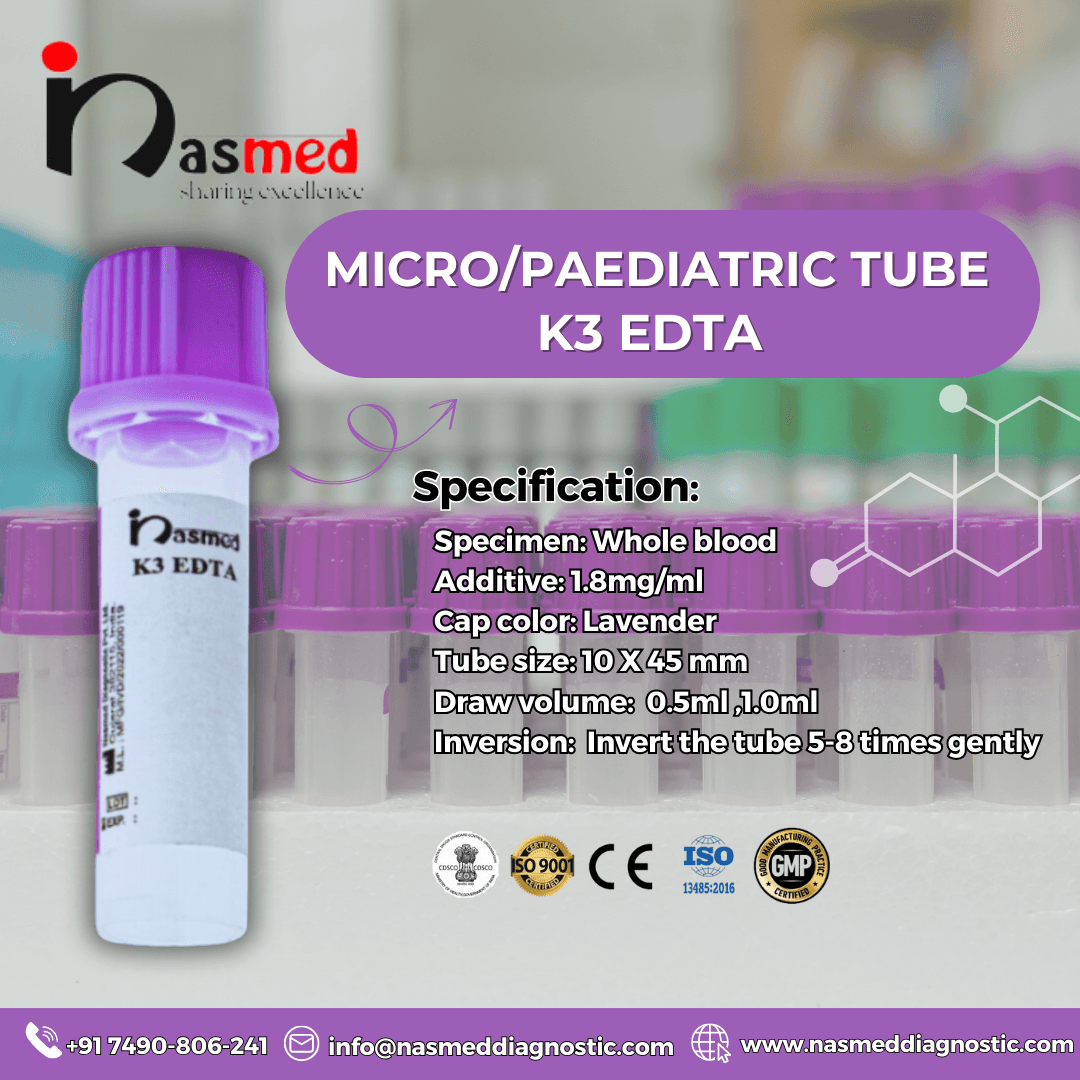
Advanced K3 EDTA Pediatric Tubes for Safe & Accurate Diagnostics: Nasmed Diagnostic
K3 EDTA Pediatric Tubes Ensuring Accurate Results are central to today’s rapidly evolving diagnostics and pathology testing environment. Over the last two decades, increased automation, centralized laboratory models, and digital reporting have raised expectations for accuracy and faster turnaround times across healthcare systems in India, United States, United Kingdom, and other global markets.
Seasoned lab personnel recognize that dependable test results start long before a specimen hits the instrument. Patient well-being, sample condition, and correct pre-analysis handling directly impact assay quality. Within this process, K3 EDTA Pediatric Blood Collection Tubes are vital—particularly for younger patients and small-volume draws—where precision, consistency, and reliable anticoagulation are crucial for accurate results.
Evolving Requirements of Contemporary Diagnostic & Healthcare Facilities
Labs currently face numerous operational pressures:
- Increased test volumes due to wellness screenings and ongoing condition monitoring
- Quicker turnaround time expectations from medical staff and patients
- Adherence to international quality benchmarks for certification and reviews
- Export and regulatory demands for labs supporting studies or reference testing across borders
In medical center and pathology lab settings, even minor hindrances—such as sample rejection due to clotting or improper tube use—can result in delayed reports, redraws, and system strain. These issues are shared by diagnostic chains in the UAE and expanding lab networks across Europe, where consistent processes are anticipated across different locations.
What Are K3 EDTA Pediatric Blood Collection Tubes?
In standard blood-drawing procedures, this tube is used to collect small amounts of venous or capillary blood, primarily for blood counts. Instead of focusing on official definitions, it’s helpful to grasp its function at the workbench level:
- The included anticoagulant prevents clotting during transit and holding.
- The tube’s dimensions and draw capacity are suitable for children and instances where blood volume must be minimal.
- The construction promotes even mixing, lowering pre-analytical differences.
In everyday use, phlebotomists choose this tube when preparing complete blood counts or similar panels, ensuring samples stay viable from the patient to the analyzer.
Why Are Blood Collection Tubes Necessary for Correct Blood Sample Collection?
Accurate diagnoses rely on maintaining sample quality from collection through analysis. Collection tubes help achieve this by supporting:
- Avoiding contamination: Proper seals and materials limit exposure to the outside.
- Uniformity across test results: Consistent tube performance minimizes variation between batches and drawing sites.
- Export-grade diagnostics: Reference labs handling specimens for global partners need reliable consumables to meet acceptance criteria.
In worldwide diagnostic supply networks, reliable tubes help maintain result comparability across facilities in Canada and lab centers in Australia.
The Part Blood Collection Tubes Play in Trustworthy Test Results
Mishandling tube selection or compromised tube quality can introduce unnecessary errors:
- Test precision: Inappropriate anticoagulant ratios might affect cell appearance.
- Repeat testing frequencies: Clotted or ruptured samples necessitate repeat collections.
- Patient confidence: Repeated blood draws, especially in pediatric cases, impact the patient experience and trust.
In hospital and pathology lab settings, skilled teams closely monitor rejection explanations. Pre-analytical errors frequently account for a large share of corrective work, underscoring the practical value of consistent tube performance.
Concerns Regarding Safety, Cleanliness & Patient Care
Procedures involving patients necessitate supplies that enable safe handling:
- Sterilization: Tubes must be made and packed to stay sterile until needed.
- Leak-proof construction: Secure caps lower exposure risks during movement.
- Safe handling for phlebotomists: User-friendly tops and sturdy materials support regular work without raising occupational hazards.
In the daily operations of diagnostic labs, these features minimize handling incidents and support adherence to established safety guidelines.
Suitability with Current Diagnostic Instruments
Modern labs rely on seamless integration across different equipment types:
- Automated blood count analyzers
- Benchtop and floor centrifuges
- Specimen transport and pneumatic systems in large hospitals
Uniformity in supplies helps labs operating across multiple locations in Singapore and Malaysia to streamline processes without repeated qualification.
Manufacturing Quality, Components & Tube Uniformity
Consistency in manufacturing isn’t abstract—it directly impacts daily dependability. Simply put, uniform tube measurements, consistent material quality, and consistent additive amounts reduce variation in sample management.
Standard components added to blood collection tubes include:
- EDTA for blood counts
- Gel separators for serum/plasma division
- Heparin for specific chemistry tests
- Fluoride for sugar stabilization
Each added substance has a specific function. Experienced lab experts know that swapping tube types without updating procedures can jeopardize test comparability, particularly in multi-site studies across South Africa and Kenya.
Storage, Shelf Life & Shipping Considerations
Environmental conditions affect consumable stability:
- Indian climate: Heat and high humidity require stable packaging and controlled storage.
- Export shipping: Extended transit paths to labs in Saudi Arabia and Qatar demand durable outer packaging.
- Long-haul logistics: Predictable shelf life supports reliable inventory planning for distributors.
In the regular work of diagnostic labs, expired or poorly stored tubes are a preventable source of deviations.
Cost Effectiveness for Labs & Healthcare Providers
Operational economy in diagnostics is tied to process reliability more than the cost per unit:
- Fewer rejected samples reduce the expense of repeat collections.
- Reduced retesting saves analyzer time and reduces chemical use.
- Stable supply quality supports predictable purchasing strategies.
In hospital buying cycles, these aspects lead to tangible operational savings without sacrificing patient care standards.
Adherence, Benchmarks & Export Readiness
International acceptance of diagnostic supplies hinges on:
- Alignment with recognized quality criteria
- Preparedness for buyer assessments and document checks
- Meeting hospital purchasing expectations for tracking and consistency
Labs and distributors supporting testing programs across borders in Kuwait and Thailand depend on supplies that fit smoothly into compliance structures. This isn’t legal counsel, but a practical operational observation across purchasing cycles.
Fitting into Hospital & Lab Processes
The tube fits into regular regimens across:
- Outpatient and ward draws
- Inpatient blood collection rounds
- Centralized diagnostic chains and reference labs
In hospital and pathology lab settings, standardization simplifies instruction, lowers selection mistakes, and promotes consistent pre-analytical quality across all departments.
Instruction, Handling & Waste Procedures
Effective utilization relies on simple training and responsible disposal:
- Easy instructions: Clear color coding and labels speed up onboarding for new team members.
- Safe disposal: Compatibility with needle/sharp and bio-medical waste streams supports regulatory compliance.
- Bio-medical waste awareness: Correct separation protects cleaning and transport staff.
- Seasoned lab experts know that consumables should simplify, not complicate, routine adherence.
Why Selecting the Right Producer Matters?
Choosing a manufacturer is a quality-based choice:
- Manufacturing background supports process stability.
- Quality checks ensure batch-to-batch uniformity.
- Export knowledge minimizes documentation gaps.
- Steady supply supports long-term strategies for distributors in Nigeria and diagnostic networks in Latin America.
This viewpoint mirrors operational realities rather than marketing claims.
About Nasmed Diagnostic Pvt Ltd
Nasmed Diagnostic Pvt Ltd is a manufacturer serving the Indian and global diagnostic sectors, focusing on high-quality blood collection supplies for standard lab tasks. In the day-to-day operations of diagnostic labs, collaborators value producers who understand pre-analytical processes, logistical constraints, and documentation requirements. Further details are available at 👉 https://www.nasmeddiagnostic.com/
Summary:
Blood collection tubes are a fundamental component of dependable diagnostics. From pediatric draws to high-volume hospital testing, consistent tube performance supports sample integrity, workflow efficiency, and patient-focused care. For labs and distributors operating globally, careful selection of supplies contributes to stable workflows and reliable diagnostic results. A thoughtful procurement strategy—based on quality, compatibility, and supply assurance—supports long-term lab performance.
Main Points to Remember
- Diagnostic Precision: Steady tube performance lessens pre-analytical variation
- Sample Safety & Sterility: Proper design aids safe handling
- Process Efficiency: Standardization simplifies learning and handling
- Cost Management for Labs: Fewer rejections and retries boost operational effectiveness
- Growing Worldwide Demand: Harmonized supplies support multi-site diagnostics
FAQs
1. How are blood collection tubes used in everyday lab routines?
- They are chosen based on the required test panel, filled to the marked level, mixed gently, labeled, and moved according to lab guidelines.
2. Can using the incorrect tube affect the accuracy of a blood sample?
- Yes. Choosing the wrong tube or having compromised additives can cause clotting or change test measurements, increasing the need for repeat testing.
3. What holding conditions help maintain a tube’s usable period?
- Storage in a cool, dry place, away from direct sunlight and heat sources, helps preserve packaging integrity and component stability.
4. Are these tubes compatible with automated analyzers and transport systems?
- Compatibility depends on standardized dimensions and materials. Most modern labs rely on consumables designed to work with standard analyzers and centrifuges.
5. What are common lab mistakes with blood collection tubes?
- Underfilling, inadequate mixing, using expired tubes, and improper storage are frequent pre-analytical issues.
#BloodCollectionTube #DiagnosticConsumables #PathologyLab #MedicalDiagnostics #NasmedDiagnostic #IVDProducts #HealthcareManufactufacturing #GlobalDiagnostics #SodiumFluorideBloodCollectionTubes