
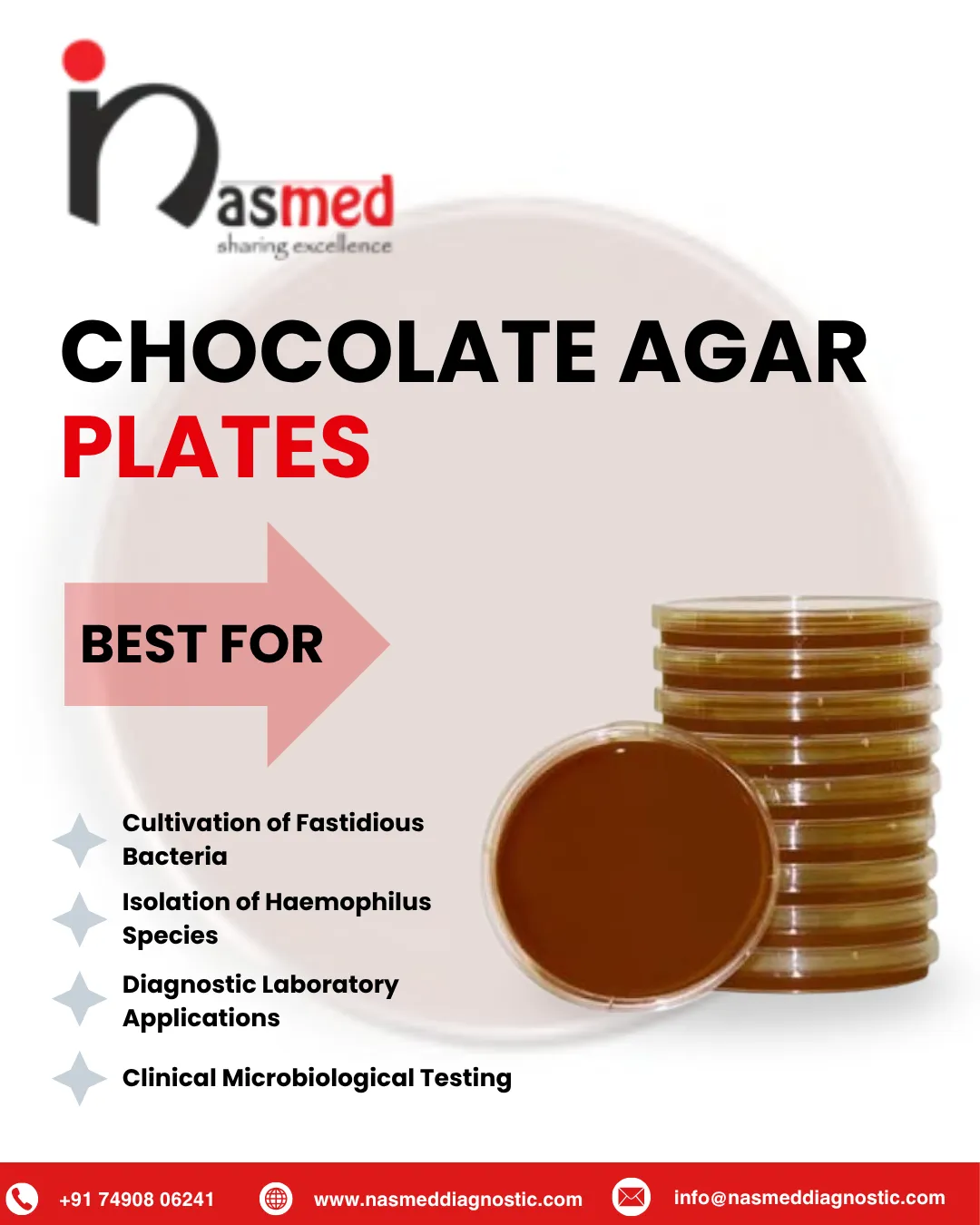
What Are Chocolate Agar Plates Used For?
Microbiology laboratories rely on dozens of culture media every single day. But few matter as much as chocolate agar plates. Diagnostic microbiologists, medical students, and lab technicians often ask the same question: what exactly do these reddish-brown plates do, and why can’t ordinary blood agar handle the same job? This guide answers that question in detail. It walks through the composition, the science behind it, and the practical steps for using it correctly in a diagnostic setting.
A person preparing for a microbiology exam or setting up a hospital laboratory needs to understand chocolate agar plate uses. This guide on the uses and benefits of chocolate agar plates covers this topic in even more depth. Below, we explain every major aspect of this culture medium in a simple, structured way, along with two reference tables and a detailed FAQ section at the end.
What Are Chocolate Agar Plates?
Chocolate agar is an enriched, non-selective culture medium. Labs prepare it by heating blood agar until the red blood cells lyse completely. This process gives the plate its distinctive brown colour. It also makes the medium far more effective at supporting bacteria that cannot survive on simpler media.
Selective media suppress the growth of unwanted organisms. Chocolate agar does the opposite — it encourages growth. It shares the same base ingredients as blood agar plates: peptones, starch, and sodium chloride. But one key difference sets it apart. The nutrients trapped inside red blood cells release directly into the medium. As a result, the plate becomes far more nutritious for fastidious organisms.
Labs typically store chocolate agar plates at 2–8°C. Technicians should bring the plates to room temperature before inoculation. A shelf life of four to six weeks is standard when plates are stored correctly. Any plate showing excessive moisture, cracking, or contamination should be discarded before use.
Why Are Chocolate Agar Plates Used?
Laboratories keep chocolate agar plates on hand mainly to grow fastidious organisms — bacteria with specific nutritional needs that ordinary agar cannot meet. Two organisms depend heavily on this medium:
- Haemophilus influenzae, which needs both X factor (hemin) and V factor (NAD) to grow
- Neisseria species, including Neisseria meningitidis and Neisseria gonorrhoeae, which are capnophilic and grow best in a carbon-dioxide-enriched atmosphere
These organisms cause serious clinical conditions such as bacterial meningitis, pneumonia, otitis media, and gonococcal infections. Blood agar does not release these growth factors in a usable form. Because of this, chocolate agar becomes the medium of choice whenever such pathogens are suspected.
Common specimen types plated on chocolate agar include:
- Cerebrospinal fluid (CSF), especially in suspected meningitis cases
- Sputum and other respiratory tract samples
- Genital swabs, when gonococcal infection is suspected
- Eye and ear discharge samples
- Blood culture subcultures
The Wikipedia entry on chocolate agar confirms that the medium exists specifically to grow fastidious respiratory bacteria that fail to grow on standard nutrient or blood agar. It is worth noting that chocolate agar serves a very different purpose from MacConkey agar plates. Labs use MacConkey agar, a selective and differential medium, mainly to isolate and identify Gram-negative enteric bacteria rather than fastidious respiratory pathogens.

What Is the Composition of Chocolate Agar?
The chocolate agar plate composition closely resembles blood agar, with one addition: heat-lysed red blood cells. A standard formulation includes the following components per litre of medium.
| Ingredient | Approximate Quantity | Function |
|---|---|---|
| Casein/animal tissue digest (peptones) | 15.0 g | Supplies amino acids and nitrogen for bacterial growth |
| Cornstarch | 1.0 g | Provides a carbohydrate energy source and detoxifies metabolic by-products |
| Sodium chloride | 5.0 g | Maintains osmotic balance within the medium |
| Agar | 15.0 g | Acts as the solidifying agent |
| Defibrinated sheep or horse blood | 5–10% v/v | Source of hemoglobin, hemin (X factor), and NAD (V factor) after lysis |
| Distilled water | Up to 1000 ml | Solvent base for all components |
Technicians boil or heat this blend at a controlled temperature of 70–80°C. This heat ruptures the red blood cells without destroying the essential nutrients they release. Some manufacturers now use processed blood powder instead of fresh defibrinated blood. This shift reduces cost and improves shelf stability without compromising bacterial growth, a trend that recent laboratory research on PMC/NCBI documents clearly.
The final pH of the prepared medium generally stays between 6.8 and 7.4. This range supports optimal recovery of most clinically relevant fastidious organisms.
What Is the Principle of Chocolate Agar?
The working principle behind chocolate agar is simple once you understand the biology. Technicians add red blood cells to molten agar base. Instead of keeping the cells intact, as blood agar does, they heat the mixture slowly until the cells lyse. This controlled heating step:
- Ruptures the red blood cell membrane, releasing intracellular contents into the surrounding medium
- Frees hemoglobin, which converts into hemin, supplying the essential X factor
- Releases NAD, supplying the V factor that organisms such as H. influenzae require
- Inactivates enzymes that would otherwise break down NAD before bacteria can use it
Both growth factors become freely available in the medium itself. As a result, fastidious bacteria no longer need to lyse red cells on their own — a task many of them simply cannot perform. This explains why chocolate agar succeeds where blood agar fails for organisms like Haemophilus and Neisseria.
Incubation conditions matter just as much as the medium itself. Labs generally incubate plates at 35–37°C in a 5–10% CO₂ atmosphere for 24–48 hours. Resource-limited laboratories sometimes use a candle jar as a low-cost alternative to generate the required carbon dioxide levels.
Why Is It Called Chocolate Agar?
The name has nothing to do with the ingredient chocolate. Manufacturers never add cocoa, sugar, or flavouring to the medium. The chocolate-brown appearance comes entirely from the controlled heating and lysis of red blood cells — a process that denatures hemoglobin and gives the agar its characteristic dark colour. It remains a purely descriptive, colour-based name, one that microbiology laboratories have used for decades. It also stays one of the most recognisable culture media by appearance alone.
How to Interpret Chocolate Agar Plate Results?
Chocolate agar is a non-selective, enriched medium, so many types of bacteria can grow on it — not just the fastidious organisms it targets. Interpretation therefore depends heavily on colony morphology, growth pattern, and correlation with the clinical specimen source.
| Organism | Typical Colony Appearance | Clinical Relevance |
|---|---|---|
| Haemophilus influenzae | Small, smooth, grey-white, glistening colonies | Meningitis, otitis media, respiratory infections |
| Neisseria meningitidis | Grey, moist, non-hemolytic, mucoid colonies | Bacterial meningitis, septicaemia |
| Neisseria gonorrhoeae | Small, grey, translucent colonies | Gonococcal infections |
| Streptococcus pneumoniae | Mucoid, alpha-hemolytic (if visible on adjacent blood agar) | Pneumonia, meningitis |
| Non-pathogenic flora | Variable, often overgrowing the plate | Considered contamination in most cases |
Keep these points in mind while reading a chocolate agar plate:
- Precipitated hemoglobin may sometimes appear as small dark spots on the medium; this does not affect its performance and should not be mistaken for contamination
- Because the medium is enriched rather than selective, overgrowth by normal flora can mask the pathogen of interest
- Technicians should always confirm results with additional biochemical or serological tests before finalising an identification
- Labs usually run a parallel blood agar plate alongside chocolate agar so they can compare hemolytic patterns
What Is Chocolate Agar Plate With Bacitracin Used For?
Chocolate agar with bacitracin is a specialised variant. Technicians prepare it by adding a low concentration of the antibiotic bacitracin to the standard formulation. Bacitracin suppresses the growth of most normal respiratory flora, while Haemophilus species grow largely undisturbed, since this genus resists bacitracin at the concentrations used.
Labs use this selective version mainly when processing:
- Sputum samples heavily contaminated with upper respiratory tract flora
- Throat and nasopharyngeal swabs
- Any specimen where isolating Haemophilus influenzae specifically is the diagnostic goal
By narrowing down the competing organisms, this variant helps laboratories identify Haemophilus far more reliably than plain chocolate agar alone. On a standard plate, overgrowth by other bacteria often hides small, slow-growing colonies.
How to Use Chocolate Agar Plates?
Correct handling directly affects how reliable the results turn out to be. Most diagnostic laboratories follow this general workflow:
- Bring the plate to room temperature before opening it, since inoculating a cold plate can reduce recovery of delicate organisms
- Label the plate with patient details, specimen type, and date
- Inoculate the specimen using a sterile loop and the standard streak method to achieve isolated colonies
- Incubate at 35–37°C in a 5–10% CO₂ atmosphere (or a candle jar, where CO₂ incubators are unavailable) for 24–48 hours
- Examine the plate daily, since some fastidious organisms grow slowly and may only appear after the second day
- Compare growth with a parallel blood agar plate to check for hemolysis and confirm whether the organism truly needs the enriched medium
- Subculture suspicious colonies onto appropriate media for further biochemical, serological, or antimicrobial susceptibility testing
Extended incubation beyond 48 hours is occasionally necessary, particularly for slow-growing Neisseria strains. Technicians should also subculture N. gonorrhoeae within 18–24 hours of initial isolation to maintain viability.
The quality of the underlying disposable also matters. The base plate, its sterility, and its manufacturing consistency directly affect how reliably a culture medium performs. Diagnostic disposable manufacturers that follow strict quality frameworks, such as Nasmed Diagnostics Pvt. Ltd., produce their range in a CDSCO-certified, ISO 7 clean room facility. This focus on contamination-free production gives laboratories the consistent, reproducible culture results they depend on.
Conclusion
Chocolate agar plates remain one of the most valuable tools in a diagnostic microbiology laboratory. They support the growth of fastidious, clinically significant organisms such as Haemophilus influenzae and Neisseria species. This makes them indispensable for diagnosing conditions ranging from bacterial meningitis to gonococcal infections. Once you understand the composition, the underlying principle, and the correct handling procedure, you can extract accurate, dependable results from every plate you use. Correct storage, careful inoculation, and proper incubation conditions ultimately determine whether a plate performs as intended. Laboratories exploring other specialised formulations can also check this guide on advanced agar plates for accurate diagnostics, which covers several additional media types worth knowing about.
Frequently Asked Questions
Q1.What is chocolate agar used for?
- Labs use chocolate agar to grow fastidious bacteria, primarily Haemophilus influenzae and Neisseria species, from clinical specimens such as CSF, sputum, and genital swabs.
Q2.Is chocolate agar selective or differential?
- No. Chocolate agar is a non-selective, non-differential, enriched medium. It supports the growth of many organisms rather than restricting or distinguishing between them.
Q3.What grows on chocolate agar plates?
- Haemophilus influenzae, Neisseria meningitidis, Neisseria gonorrhoeae, and Streptococcus pneumoniae rank among the most clinically important organisms recovered on this medium, alongside many other bacteria.
Q4.Why does chocolate agar appear brown in colour?
- The brown colour comes from heating and lysing red blood cells during preparation. The medium contains no actual chocolate or cocoa product.
Q5.What is the ideal pH of chocolate agar?
- The final prepared medium typically holds a pH between 6.8 and 7.4, which supports optimal recovery of fastidious pathogens.
Q6.How is chocolate agar different from blood agar?
- Blood agar contains intact red blood cells and shows hemolytic patterns. Chocolate agar contains lysed red blood cells, which release X and V growth factors but lose the ability to show hemolysis.
Q7.How long can chocolate agar plates be stored?
- When refrigerated at 2–8°C, chocolate agar plates generally stay usable for four to six weeks, provided no visible contamination or drying occurs.