
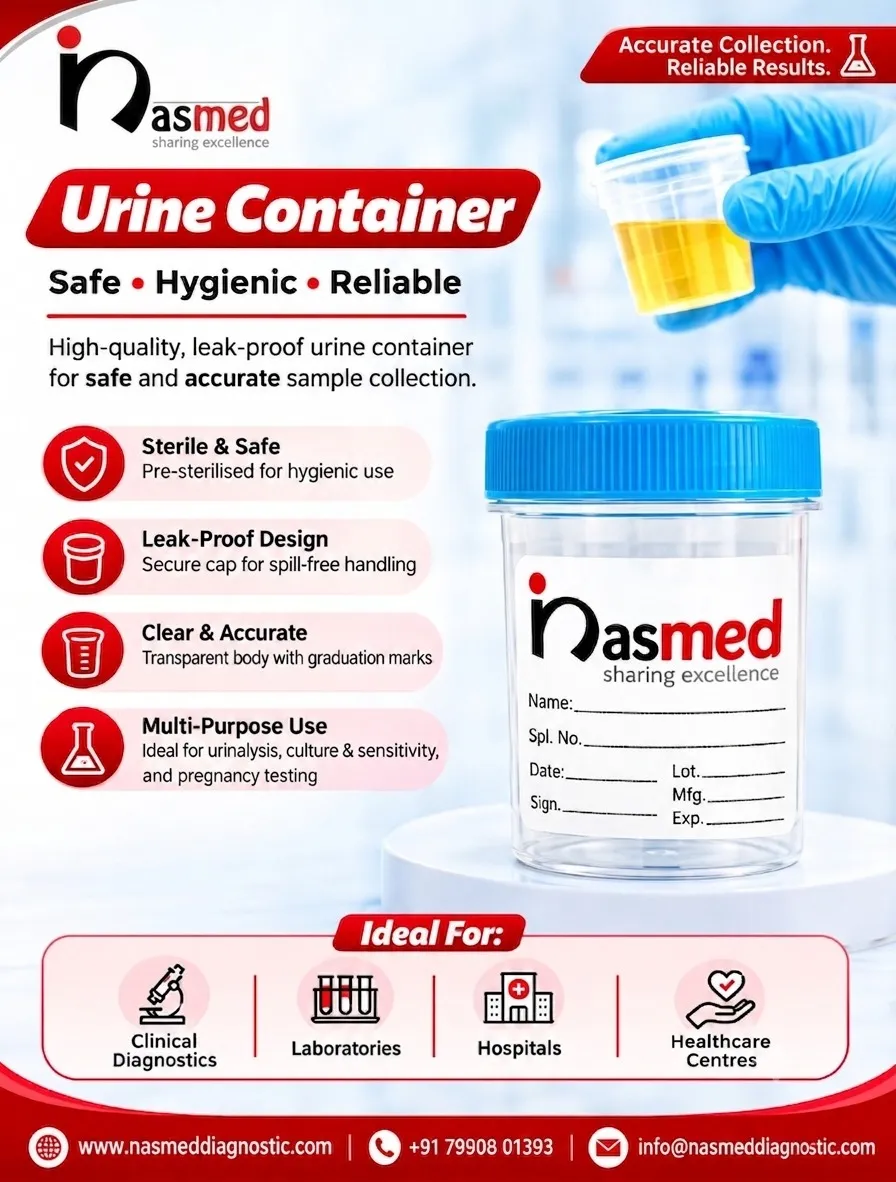
Safe Urine Collection For More Reliable Diagnostics
Why Choose Reliable Urine Containers For Diagnostic Laboratories?
Reliable urine containers help diagnostic laboratories maintain Safe Urine Collection For More Reliable Diagnostics by supporting hygienic handling, secure closure, and sample integrity. Properly designed containers reduce contamination risks and help preserve specimens during transportation and testing.
Nasmed Diagnostic Pvt Ltd provides quality urine containers designed for dependable laboratory workflows, supporting hospitals, diagnostic centres, and healthcare facilities with consistent sample collection solutions. Choosing reliable containers can improve testing efficiency, minimize handling concerns, and contribute to more dependable diagnostic outcomes.
Safe Urine Collection For More Reliable Diagnostics: A Practical Guide from Gandhinagar’s Manufacturing Floor
Urine analysis sounds simple until a contaminated sample throws off an entire diagnostic report and a doctor ends up chasing the wrong lead. After spending over 15 years around clean rooms, tube assembly lines, and QC labs in Gujarat, I can tell you that most “unreliable” urine test results trace back to one overlooked factor — the quality of the collection container itself.
Getting this right isn’t just about compliance paperwork; it directly affects patient outcomes, lab turnaround time, and a diagnostic center’s reputation. This article walks through what actually goes into building dependable urine containers, and why sourcing decisions matter more than most procurement teams realize.
Why Choose Nasmed Diagnostics for Safe Urine Collection For More Reliable Diagnostics
Nasmed Diagnostics operates out of an ISO 7 clean room facility in Nandoli, Gandhinagar, where every container batch goes through leak testing, sterility checks, and dimensional accuracy verification before it ships. The best urine containers aren’t the ones with the fanciest packaging — they’re the ones that hold sample integrity from collection point to lab bench, without leaching, leakage, or cross-contamination risk.
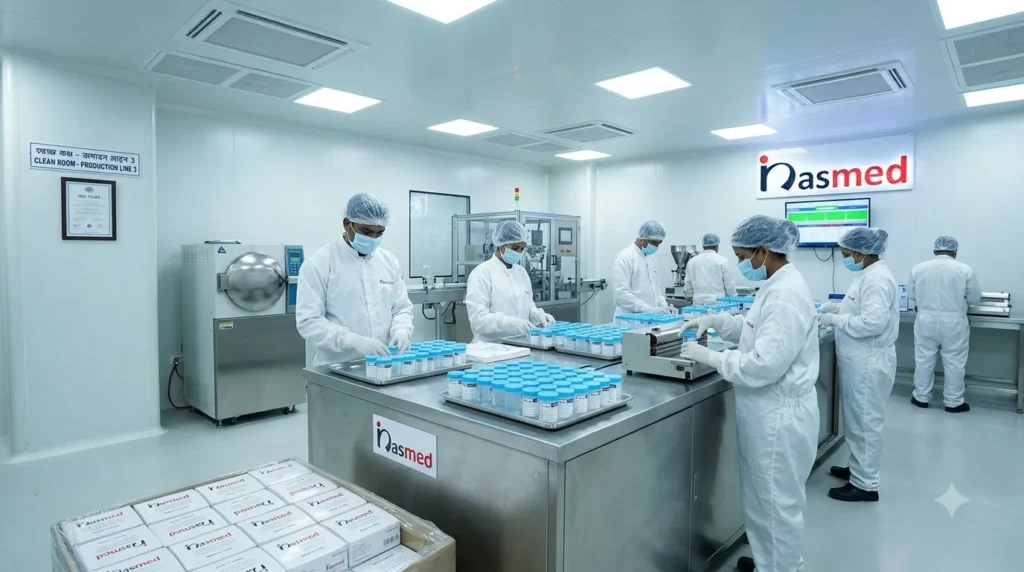
Led by Directors Kush Patel and Suril Shah, the team focuses on contamination-free manufacturing that hospitals in Ahmedabad, Surat, and Vadodara have relied on for years now. Labs sourcing a full range of urine container options typically appreciate wide-mouth designs, secure leak-proof caps, and graduated markings for accurate volume reading.
Our Safe Urine Collection For More Reliable Diagnostics Manufacturing Capabilities
Here’s how Nasmed Diagnostics builds a urine container that actually performs under real-world lab conditions. Raw polypropylene resin is sourced against international material guidelines, moulded in-house, and cured under controlled humidity — a step many smaller regional suppliers skip to cut costs, which later shows up as brittle caps or hazy walls during transport from Jaipur to Chandigarh or Kolkata.
Every container batch undergoes:
- Leak-proof cap torque testing
- Sterility validation under ISO 7 clean room protocols
- Clear volume graduation printing checks
- Random sampling for CDSCO documentation
The same production discipline carries over to Nasmed’s broader blood collection tubes range, including vacuum blood collection tubes, non-vacuum blood collection tubes, gel lithium heparin tubes, micro paediatric tubes, and cell-free DNA tubes — all manufactured under one roof, which keeps quality consistent across a lab’s entire disposables order.
Navigating Regulatory Compliance & CDSCO Certification
Yes, we provide fully CDSCO certified urine containers, and this matters more than most first-time buyers realize. CDSCO’s Class A medical device classification for sample containers still requires manufacturing site registration, labelling compliance, and batch traceability — details that get missed when labs source from unregistered local vendors just to save a few rupees per unit.
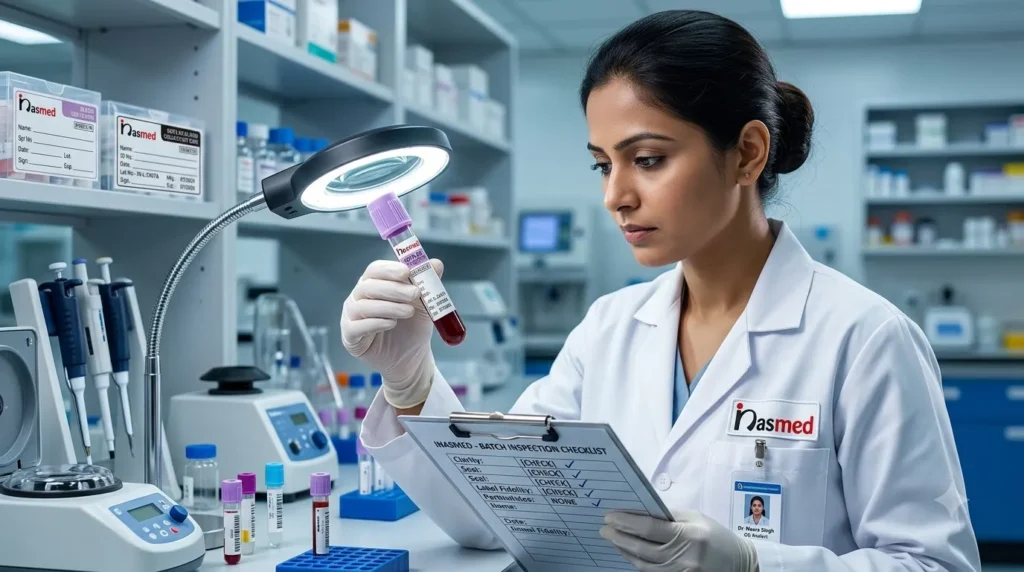
International material guidelines (such as ISO 10993 biocompatibility references) also apply, since urine containers come into direct contact with biological samples and, occasionally, patient skin during collection. Labs handling both blood and urine sampling often standardize on K2 EDTA blood collection tubes alongside their urine container stock, simply to keep one certified vendor accountable for compliance documentation. A diagnostic center in Hyderabad once mentioned to our team that switching to properly certified diagnostic lab disposables cut their sample rejection rate noticeably within two months — not a dramatic transformation, just steady, measurable improvement from consistent container quality.
Local Suppliers vs Nasmed Diagnostics (Comparison Table)
| Parameter | Typical Local Supplier | Nasmed Diagnostics |
|---|---|---|
| Manufacturing Environment | Basic assembly setup | ISO 7 Clean Room (Class 10,000) |
| Certification | Often unverified | CDSCO Certified |
| Leak-Proof Testing | Inconsistent | 100% batch verified |
| Custom Orders | Limited | Available (custom diagnostic solutions) |
| Pan-India Delivery | Regional only | Mumbai, Delhi, Bangalore, Chennai, Pune, Indore & more |
Step-by-Step Process – How We Deliver Safe Urine Collection For More Reliable Diagnostics
- Requirement discussion – volume, cap type, labelling needs specific to your lab workflow
- Sample dispatch – for approval before bulk production begins
- Clean room manufacturing – under monitored temperature and humidity
- Quality checks – leak testing, graduation accuracy, sterility validation
- Sterile packaging – tamper-evident sealing before dispatch
- Pan-India logistics – reaching diagnostic centers from Chennai to Chandigarh within committed timelines
Labs that combine urine containers with K3 EDTA blood collection tubes in a single order usually see this process consolidate into one dispatch and one invoice, which smaller diagnostic centers in Indore and Surat find easier to manage during month-end stock reviews.
Real Client Case Study
A mid-sized diagnostic chain in Pune (referred to here as “Client A” for confidentiality) had been sourcing urine containers from three different regional vendors to manage cost — a common practice, but one that created inconsistent cap quality across batches. After consolidating their lab consumables India sourcing with Nasmed Diagnostics, their lab operations head reported fewer sample leakage complaints from phlebotomy staff and simpler inventory management, since containers, sterile blood collection tubes, and paediatric tubes now arrive from a single, CDSCO certified source.
It wasn’t an overnight fix — proper vendor transitions rarely are — but the consistency improved within their first two restocking cycles, especially after they added lithium heparin blood collection tubes to the same monthly order for their biochemistry panels.
For labs comparing options, working with an established vacuum blood collection tubes manufacturer in Gandhinagar alongside a urine container supplier under one roof genuinely reduces coordination overhead — something procurement heads have mentioned appreciating during festive-season stock planning when logistics get tight. Diagnostic centers running molecular testing panels have also started asking about our cell-free DNA tube range as part of the same conversation.