Urine Containers for Diagnostic Labs: Quality, Compliance & Bulk Supply Across India
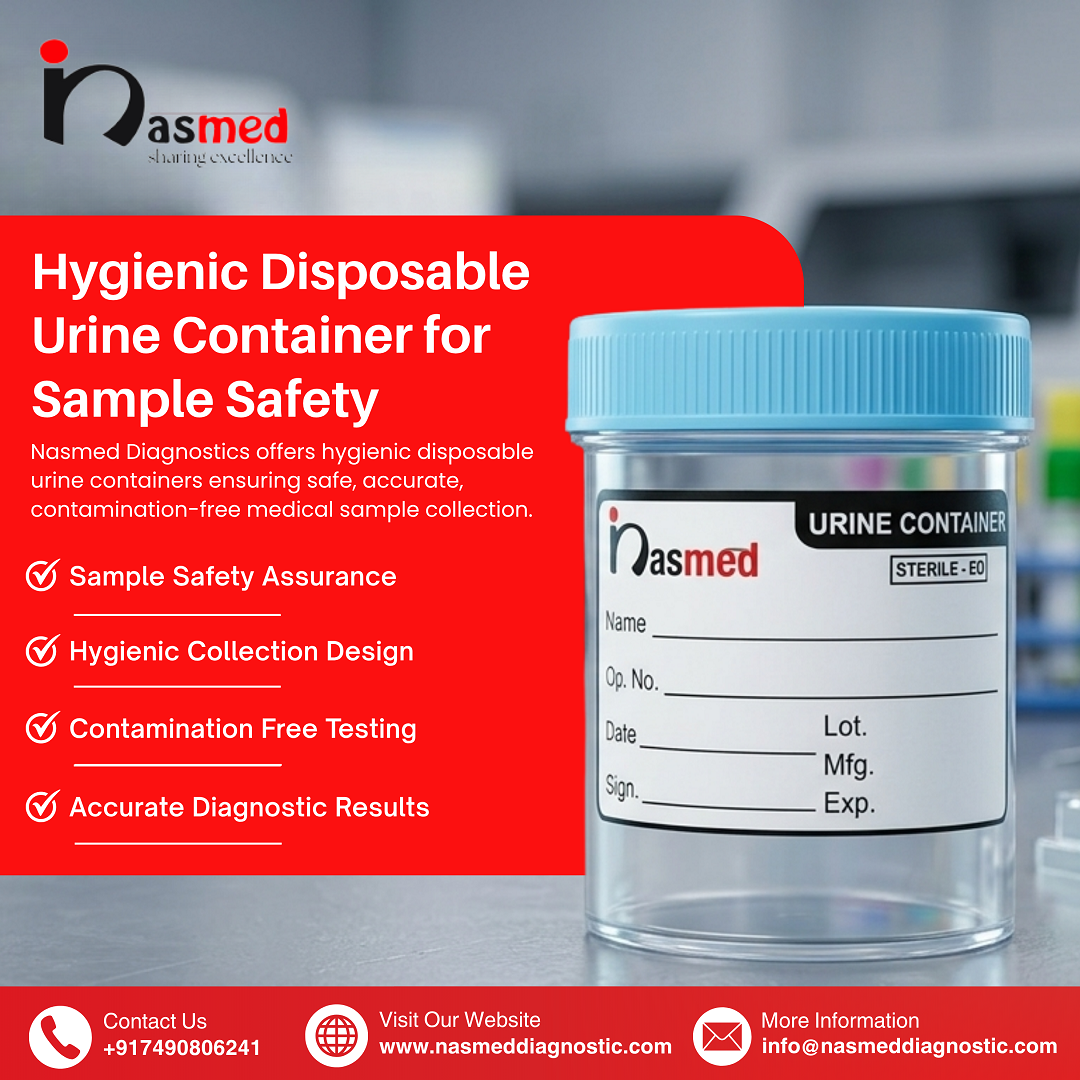
Every diagnostic result begins at collection—before analyzers, reagents, or centrifuges. In urine testing, the urine container determines whether a sample is protected or compromised. A leaking lid, contamination, or unstable preservative leads to repeat testing and delayed diagnosis, impacting NABL quality metrics. Hygienic Urine Containers Ensuring Accurate Sample Results are essential. Nasmed Diagnostic Pvt Ltd designs urine sample collection containers, sterile urine containers, and leak-proof urine containers around real lab needs, delivering reliable, consistent quality that matches the standards of modern diagnostic laboratories across India.
The demand for bulk urine containers for diagnostic labs in India has grown steadily over the last five years. This growth is driven by the expansion of standalone collection centres, franchise lab chains, and government health screening programmes. A single NABL-accredited lab in Ahmedabad can consume anywhere between 3,000 to 12,000 urine collection containers per month. That figure depends on patient load and test menu. At that volume, the container is not a minor consumable. It is a procurement decision that directly affects cost per sample, retest rate, and compliance documentation. Nasmed Diagnostic Pvt Ltd supplies at this scale without compromising on medical-grade polypropylene quality, seal integrity, or sterilization certification. This applies to labs in Gujarat, Maharashtra, Rajasthan, and across pan-India.
What Makes a Urine Container Clinically Reliable: Not Just Physically Intact
Most procurement conversations stop at price per unit and lead time. Those matter, but they do not determine sample integrity. A sterile urine collection bottle that meets clinical requirements must satisfy a specific set of material and design criteria. Generic suppliers routinely cut corners on these. Medical-grade PP must not leach trace chemicals into the sample. Graduation markings must be printed and permanent — not embossed lines that fade with handling and cause volume measurement errors. A screw cap or snap-lock closure must allow a patient to seal the container with one hand in a hospital toilet. A container that requires force to seal is a container that arrives unsealed. For culture testing, EO sterilized urine containers with batch certification ensure documented sterility required during audits and compliance.
Nasmed Diagnostic Pvt Ltd manufactures its urine container range to satisfy each of these criteria. The 80 ml wide-mouth container used in routine urine examination carries the same PP grade as the sterile variant used for urine culture collection with boric acid preservative. The difference between the two is sterilization status and preservative integration — not a downgrade in base material quality. This consistency across product variants allows NABL-accredited diagnostic laboratories to use a single supplier for their entire urine sample collection product line. It also eliminates a documentation patchwork at audit time.
In India’s diagnostic sector, labs rarely struggle to find urine containers. The real challenge is sourcing sterile urine containers reliably at volume with compliance, preservation, and proper documentation support. Why urine containers matter in diagnostic testing — the answer begins at material grade and ends at audit documentation.
Key Features of Nasmed Diagnostic Urine Containers
The clinical value of a urine container depends entirely on its construction. Every feature in Nasmed Diagnostic Pvt Ltd’s range targets lab-grade performance, not just basic functionality.
Medical-Grade Polypropylene (PP) Body: Non-reactive, chemically inert material that does not leach trace compounds into the urine sample. This ensures analyte stability from collection point to analyzer.
Wide-Mouth Opening: A minimum 40 mm diameter opening across routine and sterile variants. This enables easier mid-stream collection for patients and reduces spillage during sample transfer in the lab.
Leak-Proof Screw Cap with Inner Seal: A double-seal closure design prevents leakage during transit. This is critical when samples move from peripheral collection centres in Rajkot, Vadodara, or Jodhpur to central processing labs.
Printed Graduation Markings: Permanent ink-printed volume markings from 10 ml to maximum capacity, resistant to handling abrasion. No embossed lines that fade and cause volume measurement errors in 24-hour urine assays.
EO Sterilization with Batch Certificate: Sterile variants undergo ethylene oxide sterilization and come with batch-level sterilization certificates. These satisfy ISO 15189 documentation requirements for NABL-accredited labs.
Boric Acid Preservative Integration: Sterile culture containers carry 1.8% boric acid pre-loaded. This prevents bacterial overgrowth for up to 48 hours at room temperature without refrigeration.
Transparent Body: Full-length clarity for visual sample assessment. Colour, turbidity, and sediment remain visible before processing begins.
For broader healthcare perspectives and industry updates, refer to trusted sources like nytimes.com.
Applications: Where Each Urine Container Type Is Used
Choosing the correct container for each clinical application separates reliable sample integrity from avoidable pre-analytical error. Nasmed Diagnostic Pvt Ltd’s urine container range covers every diagnostic workflow a full-service lab encounters.
Routine Urine Examination (Urinalysis) The standard 60 ml to 120 ml wide-mouth urine container handles dipstick testing, microscopic sediment examination, and physical urine assessment. This is the highest-volume application in any diagnostic lab — the container that moves through a collection centre in the thousands every month.
Urine Culture and Sensitivity Testing Labs must use a sterile urine container with 1.8% boric acid preservative. Boric acid holds the bacterial count stable for up to 48 hours at room temperature. This allows samples from Rajkot or Jaipur to reach a central microbiology lab in Ahmedabad or Pune without transit-driven bacterial overgrowth invalidating the result. Non-sterile containers in this application cause direct misdiagnosis of urinary tract infections.
24-Hour Urine Collection Labs use this for creatinine clearance, protein quantification, urinary cortisol, VMA, aldosterone, and hormonal assays that require a complete 24-hour urine output volume. The 2.5 litre to 3 litre container with the correct additive — hydrochloric acid, thymol, or no-additive depending on the analyte — is the only clinically valid collection vessel for these tests.
Paediatric and Neonatal Urine Collection Labs, paediatric wards, and NICU settings use the paediatric urine collection bag with hypoallergenic adhesive for infants and neonates where standard container-based collection is not possible. It is compatible with dipstick, urinalysis, and culture workflows.
Home-Based Sample Collection For outpatient and home-collection workflows, safe urine collection solutions that ensure accurate testing include bilingual-labelled 24-hour containers and sealed routine urine containers that patients self-collect and deposit at a collection point without supervision.
Sterile, Preserved & Routine: Three Product Needs, One Supplier
A full-service diagnostic lab consumable supplier in India must cover the entire urine collection requirement without forcing labs to source from multiple vendors. Nasmed Diagnostic Pvt Ltd covers this range in full.
The routine urine container — 60 ml to 120 ml, transparent body, wide mouth, screw cap — handles urinalysis, dipstick testing, and microscopic sediment examination for standard patient flow. The sterile urine container with boric acid preservative handles urine cultures and sensitivity testing. Its 1.8% boric acid concentration prevents bacterial overgrowth during transit for up to 48 hours at room temperature. This is critical when samples travel from a peripheral collection point in Rajkot or Jaipur to a central processing lab in Ahmedabad or Mumbai.
The 24-hour urine collection container with preservative — 2.5 litre to 3 litre capacity — covers creatinine clearance, protein quantification, urinary cortisol, and hormonal assays. These containers come with patient instruction labels in English and Hindi. This detail sounds minor, but it demonstrably improves home-collection compliance and reduces invalid sample submissions. Additive variants — hydrochloric acid, thymol, and no-additive — are available depending on the analyte. A single additive type does not serve the full spectrum of 24-hour urine testing.
The paediatric urine collection bag — hypoallergenic adhesive, neonatal and infant sizes, compatible with standard dipstick workflows — covers the segment that most diagnostic consumable distributors in India treat as an afterthought.
For global healthcare insights and updates, refer to trusted sources like theguardian.com.
Bulk Supply Across Gujarat, Maharashtra & Rajasthan: Regional Reach That Matters for Labs
Labs in Ahmedabad, Surat, Pune, Nagpur, and Jaipur are not looking for occasional deliveries. They need an affordable urine container manufacturer for clinics and labs with distributor infrastructure already operating in their state — one that turns around orders in days, not weeks, and maintains consistent batch quality across repeat orders. Nasmed Diagnostic Pvt Ltd’s regional distribution model across Gujarat, Maharashtra, and Rajasthan meets exactly this requirement. Their distributor partners operate within the local diagnostic ecosystem. They know the labs, understand the procurement cycle, and carry stock of the full urine container range — not just the routine variant.
For a procurement manager in Ahmedabad evaluating where to buy urine containers in bulk for a diagnostic lab in India, the combination of regional presence, documented product quality, and full-range availability from a single supplier answers the three questions that drive the purchasing decision: reliability of supply, compliance readiness, and total cost of ownership when retest rates and audit non-conformances are factored in. Across tier-2 cities where diagnostic collection centres are expanding fastest — Rajkot, Vadodara, Nashik, Aurangabad, Jodhpur — Nasmed Diagnostic Pvt Ltd’s state distributor network ensures labs do not depend on pan-India shipping timelines for a product they need every single working day.
Documentation, Compliance & NABL Audit Readiness: Why the Paper Trail Matters as Much as the Product
NABL-accredited diagnostic labs across India must now validate their consumable suppliers. A supplier who cannot produce batch sterilization certificates, material safety data sheets, shelf-life documentation, and leachability test reports on request is a compliance liability — not a supply partner. Most labs discover this gap during an internal audit, not at the point of purchase. Nasmed Diagnostic Pvt Ltd maintains complete documentation readiness for every product in their urine container range as standard — not as a premium service tier. Labs using their diagnostic lab consumables do not need to assemble a documentation file in the week before an audit. The records exist, they remain consistent across batches, and the team makes them accessible when needed.
For labs that are scaling — adding collection points, expanding their test menu into culture and sensitivity, or upgrading toward NABL accreditation — this documentation infrastructure from a trusted diagnostic consumable supplier in India often decides whether a vendor gets shortlisted or finalised. Finding a urine sample container that passes a visual quality check is easy. Finding one that comes with ISO 15189-ready documentation, supplied at bulk volume with consistent lead times from a regional distributor in Gujarat, Maharashtra, or Rajasthan — that is what Nasmed Diagnostic Pvt Ltd supplies. And that is the standard every diagnostic lab in India should source to. To place a bulk order or discuss your lab’s specific requirements, contact Nasmed Diagnostic Pvt Ltd directly and get a response from their regional team.
FAQs
Q.1 What type of urine container is required for urine culture and sensitivity testing in a diagnostic lab in India?
- For urine culture and sensitivity testing, labs require a sterile urine container with 1.8% boric acid preservative. The container must undergo EO sterilization and come with a batch certificate. Boric acid prevents bacterial overgrowth for up to 48 hours at room temperature. This is critical when samples travel from collection centres in Rajkot or Jaipur to central processing labs in Ahmedabad or Pune. An unpreserved or non-sterile urine collection container directly risks UTI misdiagnosis in any diagnostic lab in India.
Q.2 What is the standard volume for a sterile urine collection container used in routine urine examination?
- The standard sterile urine collection container for routine urine examination holds 60 ml to 120 ml. The 80 ml wide-mouth urine sample container is the most commonly used across diagnostic labs in India. These cover urinalysis, dipstick testing, and microscopic sediment examination. The urine container must have a leak-proof screw cap and printed graduation markings for accurate volume reading through transit and handling.
Q.3 Which preservative is used in a 24-hour urine collection container with preservative for diagnostic testing?
- The correct preservative depends on the test. Labs use hydrochloric acid for catecholamines and calcium. Thymol suits creatinine and glucose. Some protein quantification protocols require a no-additive urine collection container. Using the wrong preservative renders the entire 24-hour urine sample collection invalid. Diagnostic labs in India must confirm the exact additive variant before ordering bulk urine containers.
Q.4 How should a NABL-accredited diagnostic lab in India select a reliable bulk urine container supplier?
- A bulk urine container supplier for a NABL-accredited diagnostic lab must provide batch sterilization certificates, MSDS, shelf-life data, and leachability reports. ISO 15189 requires these for urine sample container validation. Consistent medical-grade PP quality across routine urine containers, sterile urine culture containers, 24-hour urine collection containers, and paediatric urine collection bags is essential. Nasmed Diagnostic Pvt Ltd supplies all of this as standard practice, making them a verified audit-ready diagnostic consumable supplier across India.
Q.5 Where can diagnostic labs in Gujarat, Maharashtra, and Rajasthan buy urine containers in bulk?
- Diagnostic labs across Gujarat, Maharashtra, and Rajasthan can source through Nasmed Diagnostic Pvt Ltd’s regional distributor network. This covers Ahmedabad, Surat, Vadodara, Pune, Nagpur, Jaipur, and Rajkot. Distributors carry the full urine container range — including sterile urine collection containers, 24-hour urine collection containers with preservative, and paediatric urine collection bags — with consistent documentation and reliable lead times. For bulk enquiries, contact Nasmed Diagnostic Pvt Ltd to connect with the nearest regional distributor.
Q.6 What is a paediatric urine collection bag and when is it used in diagnostic labs across India?
- Labs use a paediatric urine collection bag for urine sample collection from infants and neonates who cannot use a standard urine container. It has a hypoallergenic adhesive backing, comes in infant and neonatal sizes, and is compatible with dipstick testing, routine urine examination, and urine culture workflows. Poor adhesive quality causes urine sample loss and forces repeat collection. This makes adhesive grade the most critical specification in any paediatric urine collection bag.
Q.7 Why do printed graduation markings on a urine sample container matter for diagnostic accuracy in Indian labs?
- Printed graduation markings stay clearly readable through the full handling cycle — collection, transit, and lab processing. Embossed markings fade with handling and cause volume measurement errors in tests like protein quantification, creatinine clearance, and 24-hour urine assays. For high-volume labs across India, graduated urine containers with printed markings ensure clinically reliable, accurate urine sample collection and measurement. To explore the full range, visit the urine container product page.
