
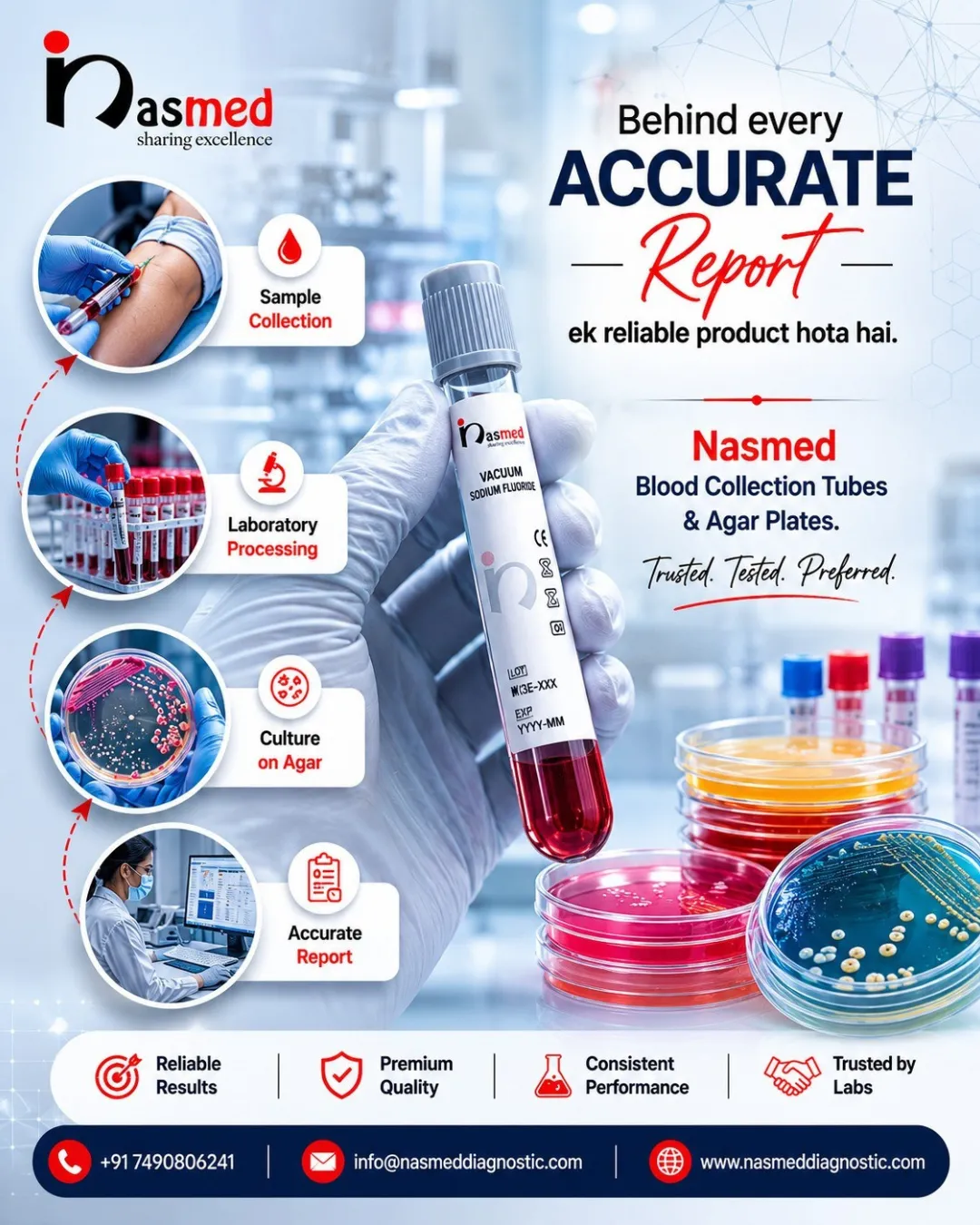
How Quality Blood Collection Tubes Improve Results
How quality blood collection tubes improve results is not just a technical question — it is the operational backbone of every reliable diagnostic report produced in India’s growing healthcare network. From a small pathology centre in Rajkot to a multi-speciality hospital in Pune, the integrity of every blood sample depends entirely on the tube in which it is collected, stored, and transported. When a tube is substandard — whether it uses an incorrect anticoagulant, has a compromised vacuum, or is manufactured without consistent sterilization standards — the resulting test values can deviate significantly from the patient’s actual clinical picture. This makes blood collection tube quality a non-negotiable parameter for any NABL-accredited lab, procurement manager, or hospital purchase committee serious about diagnostic accuracy.
How Quality Blood Collection Tubes Improve Results in Routine Haematology and Biochemistry Testing?
In day-to-day laboratory operations across Gujarat, Maharashtra, and Rajasthan, the most frequent errors traced back to pre-analytical stages involve the blood collection tube itself — wrong additive, incorrect fill volume, or inadequate mixing. For routine haematology, EDTA-coated blood collection tubes must contain precisely 1.8 mg of EDTA per mL of blood. Any deviation — even ±10% — can cause red cell shrinkage or plasma dilution effects that distort CBC parameters, including haemoglobin, platelet count, and MCV. For biochemistry panels, serum separator tubes (SST) with inert gel barriers must activate properly at 1000–1200 g centrifugation force to ensure clean serum without cellular contamination. Nasmed Diagnostic Pvt Ltd, a specialized manufacturer and supplier of diagnostic consumables across India, formulates each tube with validated additive concentrations, consistent vacuum calibration (typically ±10% of draw volume), and lot-wise quality control documentation that aligns directly with ISO 15189 pre-analytical requirements.
Understanding types of blood collection tubes — their colour codes, additives, and clinical applications — is fundamental to preventing these pre-analytical errors before they reach the analyzer.
Why Sterilization Standards and Closure Design Directly Affect Sample Integrity?
When procurement managers in Ahmedabad, Nagpur, or Vadodara evaluate suppliers, tube sterility and closure design are often underweighted compared to price. This is a costly oversight. Evacuated blood collection tubes manufactured without validated EO (ethylene oxide) sterilization can carry microbial load that interferes with culture-grade samples or inflammatory marker panels sensitive to endotoxin contamination. The rubber stopper closure — made from natural rubber or bromobutyl compounds depending on the tube variant — must form an airtight seal that maintains vacuum integrity for a minimum shelf life of 18 to 24 months from the date of manufacture. Stopper penetrability must allow smooth needle entry without coring, which can introduce rubber fragments into the sample.
Nasmed Diagnostic Pvt Ltd sources medical-grade raw materials compliant with BIS standards for rubber closures and uses EO sterilization cycles validated to achieve a sterility assurance level (SAL) of 10⁻⁶, meeting the requirements that NABL-accredited diagnostic laboratories must demonstrate during technical assessments. This level of manufacturing documentation directly supports labs during NABL audits and CAP inspections, removing a frequently cited non-conformance related to consumable traceability.
For labs managing specimen transport across long distances — common in states like Rajasthan and interior Maharashtra — tube integrity under temperature variation becomes equally critical. Properly sealed, high-vacuum tubes maintain sample viability far better than loosely manufactured alternatives during the 2–6 hour transit window typical of hub-and-spoke collection models.
Buy Blood Collection Tubes in Bulk for Diagnostic Labs in India — What to Verify Before Placing Orders
Buying blood collection tubes in bulk for diagnostic labs in India is a volume-sensitive procurement decision where a wrong batch can affect thousands of patient samples before the error is caught. Labs in Surat, Jaipur, and Pune running 500 to 2,000 samples per day cannot afford mid-month supply disruption or batch-wise additive inconsistency. The key verification parameters before bulk procurement should include: vacuum draw volume tolerance (stated vs. actual), anticoagulant/additive type and concentration per mL, tube material (PET vs. glass), expiry date and storage condition requirements, and lot-specific Certificate of Analysis (CoA) availability.
Nasmed Diagnostic Pvt Ltd offers bulk supply programmes with CoA documentation for every dispatched lot, enabling labs to maintain their internal incoming quality control records as required under ISO 15189 clause 6.6. Their blood collection tube product range includes EDTA, SST, citrate, fluoride oxalate, heparin, and specialty tubes, allowing procurement managers to consolidate sourcing under a single validated diagnostic consumables supplier — reducing the vendor qualification burden significantly.
External validation from organisations like the Clinical and Laboratory Standards Institute (CLSI) through their GP34 guideline for venous blood collection provides the international framework against which Indian lab consumables, including blood collection tubes, should be benchmarked.
Blood Collection Tubes with Preservative in India — Applications in Paediatric, Oncology, and Molecular Testing
Blood collection tubes with preservative in India serve a growing clinical need, particularly in oncology centres in Pune and Ahmedabad, molecular diagnostics facilities, and neonatal units across tier-2 cities that are expanding their high-complexity testing menus. Micro-paediatric tubes, designed for 0.5 mL to 2 mL draw volumes, are essential in neonatal ICUs and paediatric wards where blood conservation is critical and repeated venepuncture is clinically unacceptable. For liquid biopsy and genetic testing, cell-free DNA blood collection tubes use specific stabilizing preservatives — such as formaldehyde-releasing agents at 0.5–1.0% effective concentration — that prevent white blood cell lysis for up to 14 days at 4–25°C, protecting circulating tumour DNA integrity during transport to reference laboratories.
Nasmed Diagnostic Pvt Ltd supplies micro-paediatric tubes engineered for low-draw volumes with proportional additive concentrations, and cell-free DNA tubes validated for cfDNA stabilization applications. For labs building molecular diagnostics capabilities across Gujarat and Maharashtra, having a domestic supplier with reliable pan-India logistics reduces the dependency on import-dependent supply chains that proved fragile during recent global disruptions.
The WHO Laboratory Biosafety Manual — an authoritative reference for specimen handling standards globally — reinforces that pre-analytical tube quality is inseparable from downstream laboratory biosafety and result accuracy.
Explore Nasmed Diagnostic Pvt Ltd’s full range of sample collection products or reach the team directly through the contact page for bulk quotations, CoA requests, and distributor enquiries across India.
Frequently Asked Questions
Q1. How do quality blood collection tubes improve diagnostic results in NABL-accredited labs in India?
- Quality blood collection tubes improve diagnostic results by ensuring additive concentrations are precisely calibrated — for example, EDTA tubes must contain exactly 1.8 mg per mL of blood for accurate CBC values. Consistent vacuum draw volume, proper EO sterilization, and validated rubber closure integrity prevent pre-analytical errors that distort clinical data. For NABL-accredited diagnostic laboratories in India, using verified tubes directly supports pre-analytical compliance under ISO 15189 clause 5.4 requirements.
Q2. What is the correct EDTA concentration in blood collection tubes for haematology testing in Indian diagnostic labs?
- The correct EDTA concentration in blood collection tubes for haematology testing is 1.8 mg of EDTA per mL of blood, as specified by CLSI GP34 and ISO 15189 pre-analytical standards. Deviation beyond ±10% causes measurable errors in platelet count, MCV, and haemoglobin values. Labs in Ahmedabad, Pune, and Jaipur procuring from verified suppliers like Nasmed Diagnostic Pvt Ltd receive lot-wise Certificate of Analysis confirming additive concentration within validated limits.
Q3. How to buy blood collection tubes in bulk for diagnostic labs in India without compromising quality?
- To buy blood collection tubes in bulk for diagnostic labs in India, verify the supplier’s Certificate of Analysis for each lot, confirm vacuum draw tolerance (±10% of stated volume), and check EO sterilization validation documents. Ensure tube material (PET or glass), additive type, and expiry date meet your lab’s testing menu. Nasmed Diagnostic Pvt Ltd provides complete bulk supply documentation including CoA and regulatory compliance records, serving labs across Gujarat, Maharashtra, and Rajasthan.
Q4. What are cell-free DNA blood collection tubes, and which labs in India need them?
- Cell-free DNA blood collection tubes contain stabilizing preservatives — typically formaldehyde-releasing agents at 0.5–1.0% effective concentration — that prevent white blood cell lysis for up to 14 days at 4–25°C, protecting circulating tumour DNA (ctDNA) integrity. They are essential for liquid biopsy, prenatal genetic testing, and oncology reference labs across Pune, Ahmedabad, and Mumbai. Nasmed Diagnostic Pvt Ltd’s cell-free DNA tubes are validated for molecular diagnostics applications with domestic pan-India supply.
Q5. Why do blood collection tube closures matter for sample integrity during transport in India?
- Blood collection tube closures — made from bromobutyl or natural rubber — must form an airtight seal maintaining vacuum integrity for 18–24 months. During specimen transport across hub-and-spoke collection networks in Rajasthan, Gujarat, and Maharashtra, poorly sealed tubes lose vacuum, causing haemolysis, evaporation, or microbial contamination within the 2–6 hour transit window. EO-sterilized closures meeting BIS material standards and penetrable without coring are critical for ensuring sample viability before analysis at reference labs.
Q6. Which types of blood collection tubes are required for a complete diagnostic lab setup in India?
- A complete diagnostic lab in India requires EDTA tubes for haematology, SST (serum separator tubes) for biochemistry, sodium citrate tubes for coagulation, fluoride oxalate tubes for glucose, heparin tubes for plasma chemistry, and specialty tubes for molecular diagnostics and culture testing. Refer to Nasmed Diagnostic’s blood tube guide for colour-coded additive details. Labs in Surat, Nagpur, and Vadodara can consolidate all tube types from a single NABL-compliant supplier for audit-ready consumable traceability.
Q7. What sterilization standard should blood collection tubes meet for use in NABL-accredited labs and hospitals in India?
- Blood collection tubes used in NABL-accredited labs and hospitals across India must be sterilized using validated EO (ethylene oxide) sterilization achieving a Sterility Assurance Level (SAL) of 10⁻⁶, as required under ISO 15189 and BIS standards for medical consumables. Suppliers should provide sterilization validation certificates per batch. This is especially important for sterile blood collection tubes used in culture testing, immunology panels, and molecular diagnostics where microbial or endotoxin contamination directly compromises result validity across procurement in Ahmedabad, Jaipur, and Pune.