

How Premium Tubes Improve Test Results
How Premium Blood Collection Tubes Improve Test Results: A Manufacturing Insider’s Perspective
Every year, thousands of Indian labs — from a small diagnostic center in Surat to a large corporate hospital in Mumbai — receive inaccurate test results that are not caused by the diagnostic machine or the technician’s skill. They are caused by the tube. If a blood sample is collected in a poorly manufactured tube — one with incorrect additive fill ratios, inadequate vacuum, or a non-sterile interior — the damage is done before the sample ever reaches the analyser. Premium blood collection tubes solve this problem at the source, and understanding how they do it is genuinely important for anyone responsible for lab quality in India today.
At Nasmed Diagnostics Pvt. Ltd., based in Gandhinagar, Gujarat, we manufacture diagnostic lab disposables inside an ISO 7 clean room (Class 10,000) and hold CDSCO certification — because we have seen, firsthand, what happens when these standards are compromised. This article breaks down the science, the process, and the real-world difference that tube quality makes.
Why Tube Quality Directly Affects Diagnostic Accuracy?
Let me share something I have observed repeatedly over the years working in this industry. A diagnostic lab in Hyderabad was reporting inconsistent serum glucose readings for the same patients. After weeks of troubleshooting the analyser and reagents, the root cause turned out to be gel lithium heparin tubes that had incorrect gel density — the gel barrier was not forming properly after centrifugation, allowing cellular contamination of the serum layer. One tube change resolved weeks of frustration.
This is not an isolated story. Sample integrity is determined almost entirely by what happens in the first 60 seconds of collection, and the tube is the primary variable. Here is how each tube type directly impacts result quality:
Vacuum blood collection tubes must maintain a precise internal vacuum to draw exactly the right volume of blood. Too little vacuum means an under-filled tube, which alters the blood-to-additive ratio. Too much, and you risk haemolysis. At Nasmed Diagnostics, every vacuum tube is manufactured with calibrated vacuum levels — tested batch by batch — to ensure the ratio is always within acceptable CLSI and international material guideline tolerances.
Gel lithium heparin tubes are among the most sensitive. The gel must be exactly the right viscosity to migrate cleanly between red cells and plasma during centrifugation. Impure or inconsistently formulated gel leads to fibrin strands crossing the barrier — a silent error that skews chemistry panels. Our gel formulations are sourced and tested against verified international benchmarks before use in production.
Cell-free DNA tubes — increasingly used in Delhi, Bangalore, and Chennai for liquid biopsy and NIPT — require the preservation agent to halt white blood cell lysis for up to 14 days at room temperature. A substandard preservative that degrades within 3–4 days will cause cfDNA contamination by genomic DNA, giving completely unreliable NGS results. This is a category where there is no margin for manufacturing error.
Micro paediatric tubes are another area of real clinical impact. Children have limited blood draw volumes, so a small tube with incorrect EDTA coating can cause platelet clumping or partial coagulation — leading to a retest that puts the child through another puncture. Correct manufacturing here is not just about data quality; it is about patient comfort and clinical ethics.
Why Choose Nasmed Diagnostics for Premium Blood Collection Tubes?
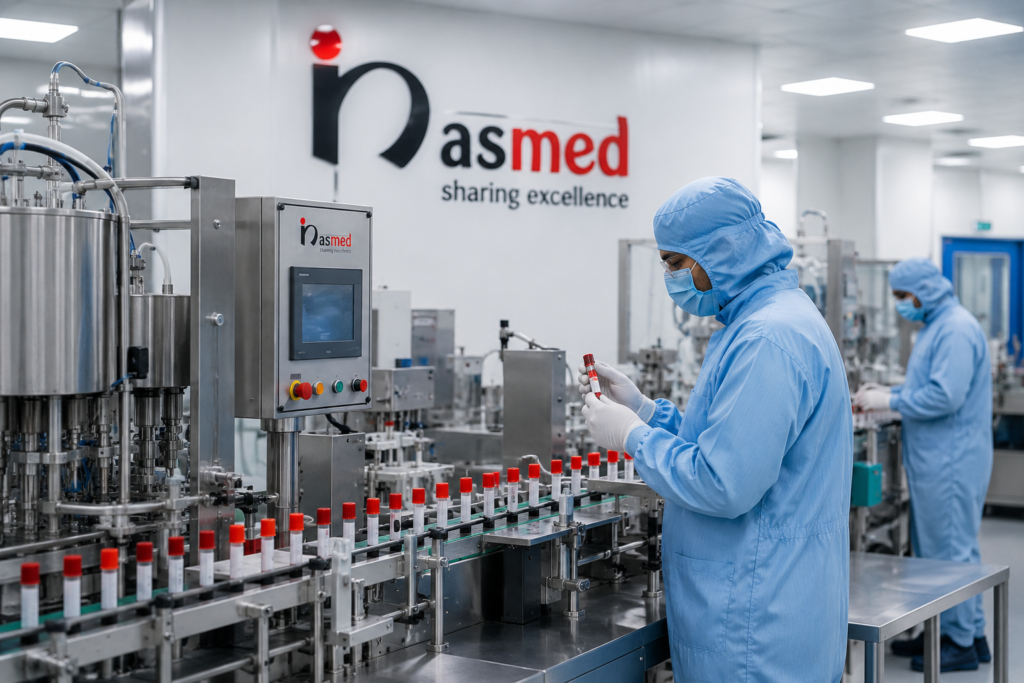
The honest answer is not about marketing — it is about what the manufacturing environment actually makes possible. When you walk into our facility in Nandoli, Gandhinagar, the first thing you notice is that it does not feel like a typical small-manufacturer setup. The ISO 7 clean room maintains air particle counts below Class 10,000 levels at all times, with positive pressure differentials, HEPA filtration, and gowning protocols that most visitors find surprisingly rigorous for a diagnostic consumables plant.
Why does this matter? Because a blood collection tube is essentially a sterile, chemically precise container. Any particulate contamination in the manufacturing environment can compromise the inner surface coating. humidity variation can affect vacuum stability. Any cross-contamination between tube types — say, EDTA residue in a plain serum tube — can cause catastrophic analytical interference.
Our facility is led by Directors Kush Patel and Suril Shah, both of whom have hands-on involvement in quality systems. This is not a company where quality is managed only by a department — it is part of the operational culture.
We supply hospitals and diagnostic labs in Ahmedabad, Vadodara, Pune, Jaipur, Chandigarh, and Kolkata, among others. Procurement heads in these cities consistently tell us two things: our tubes perform consistently batch to batch, and our turnaround on bulk orders is reliable — both of which are genuinely rare combinations in the Indian diagnostic consumables market.
As a vacuum blood collection tubes manufacturer in Gandhinagar, we also offer custom labelling and tube configurations for hospital-branded procurement, which has been useful for large hospital groups running centralized procurement out of Indore and Bangalore.
Our Blood Collection Tube Manufacturing Capabilities
Here is an overview of the tube types we manufacture and what makes each one relevant to diagnostic accuracy:
Non-vacuum blood collection tubes remain important in rural healthcare settings and point-of-care collection where venipuncture devices are simpler. We manufacture these with the same coating precision as vacuum variants — correct EDTA or sodium citrate fill lines are clearly marked, and tube interiors are treated to prevent cell adhesion.
Micro paediatric tubes are available in 0.5 mL to 2 mL volumes with colour-coded caps matching global conventions. The EDTA K2/K3 coating is spray-dried and verified for uniform distribution — an important detail that many smaller manufacturers skip.
Our cell-free DNA tubes use a formaldehyde-free preservation chemistry and are validated for extended stability, supporting labs in Mumbai and Delhi that run high-volume oncology panels where sample transport time is a real variable.
We also manufacture urine containers in standard and sterile variants, which are increasingly in demand as urine culture, metabolomics, and drug monitoring panels expand in urban diagnostic chains across India.
Custom diagnostic solutions — special fill volumes, private-label branding, or specific additive concentrations requested by hospital laboratory directors — are something we handle regularly. A research hospital group in Pune approached us with a request for a modified citrate ratio for a coagulation research protocol, and we developed a small custom batch within their required timeline.
All our sterile blood collection tubes and diagnostic lab disposables are manufactured under CDSCO-compliant quality systems, with batch traceability records available on request — important for lab accreditation audits under NABL and CAP requirements.
Navigating Regulatory Compliance & CDSCO Certification
Since blood collection tubes fall under the Medical Devices Rules, 2017 in India, any serious procurement head should be verifying CDSCO registration before placing orders. The Central Drugs Standard Control Organisation (CDSCO) under the Ministry of Health & Family Welfare has detailed device-specific requirements for in-vitro diagnostic products, including blood collection tubes.
Nasmed Diagnostics holds valid CDSCO certification for our tube range. We maintain documented technical files that include material specifications, shelf-life validation data, sterility test reports, and performance testing against international material guidelines — including references to ISO 6710 (single-use containers for venous blood specimen collection) and CLSI H3 guidelines for tube additive performance.
Practically speaking, when a diagnostic tubes supplier India holds these certifications and can produce them on demand, it eliminates a significant compliance risk for the buying lab or hospital. NABL-accredited labs, in particular, face scrutiny during reassessment audits on the traceability of consumables. Having a CDSCO-certified supplier with batch records simplifies this considerably.
Labs in Chennai and Jaipur that we supply have told us that during NABL audits, the auditors specifically checked manufacturer certification for blood collection tubes — something that was not as rigorously enforced five years ago but is now a standard checkpoint.
Local Suppliers vs. Nasmed Diagnostics — What the Difference Looks Like in Practice
Before the comparison table, a quick note: the goal here is not to dismiss local suppliers wholesale. Some are perfectly adequate for basic serum tubes. The difference shows up most in speciality tubes — gel tubes, cfDNA, paediatric, or custom additive variants — where manufacturing precision is the whole point.
| Parameter | Typical Unverified Local Supplier | Nasmed Diagnostics Pvt. Ltd. |
|---|---|---|
| Manufacturing Environment | Standard facility, no clean room certification | ISO 7 Clean Room (Class 10,000), HEPA filtered |
| CDSCO Registration | Often absent or unverifiable | Fully CDSCO certified, documentation available |
| Vacuum Calibration | Batch-level variance common | Calibrated vacuum per tube type, batch tested |
| Gel Tube Formulation | Variable gel density, inconsistent barrier | Formulated and tested to international standards |
| Cell-Free DNA Tubes | Typically unavailable | Available, validated for cfDNA preservation |
| Micro Paediatric Tubes | Limited sizes, inconsistent EDTA coating | Multiple volumes, spray-dried EDTA, colour-coded |
| Custom Solutions | Rarely offered | Available — additive variants, private labelling |
| Batch Traceability | Often unavailable | Full batch records provided on request |
| Shelf Life Validation | Self-declared, usually undocumented | Validated and documented per CDSCO requirements |
| Urine Containers | Basic only, no sterility data | Standard and sterile variants, certified |
A Quick Story from Indore: A mid-size diagnostic chain with 6 collection centers in Indore had been facing a 4–6% haemolysis rate on their serum samples — well above the industry benchmark of under 2%. After switching to our vacuum blood collection tubes, their haemolysis rate dropped to 1.1% within the first month. Their lab director attributed it to the consistent vacuum calibration, which prevented turbulent blood draw — the primary mechanical cause of haemolysis in venipuncture.

Real Client Case Study: Reducing Pre-Analytical Errors in a Multi-Branch Diagnostic Lab
Client: MedPrecise Diagnostics Pvt. Ltd. (Name Anonymized) — 12 Branches Across Gujarat & Rajasthan
Background: MedPrecise is a growing regional diagnostic chain with collection centers in Ahmedabad, Vadodara, Jaipur, and Surat. In early 2024, they began experiencing a pattern of inconsistent CBC (Complete Blood Count) results — particularly platelet counts — across branches, despite using the same haematology analyser brand at all locations.
Problem Identified: After internal quality review, the lab quality manager identified that the issue was pre-analytical — specifically with EDTA K3 tubes from their then-supplier. The EDTA coating in the tubes was uneven, causing partial platelet activation and clumping in some samples before analysis. The issue was inconsistent across batches, making it especially difficult to track.
Solution with Nasmed Diagnostics: MedPrecise contacted us for a trial batch of 5,000 EDTA K3 tubes. We supplied our standard EDTA K3 vacuum tubes manufactured in our ISO 7 clean room, with spray-dried EDTA coating and vacuum calibrated for a 3 mL draw volume. Their internal QC team ran parallel testing over three weeks.
Results:
- Platelet count CV (coefficient of variation) across branches dropped from 8.3% to under 2.1%
- Zero clotted sample rejections in the first 30-day period after switch
- NABL re-assessment audit passed without a single pre-analytical non-conformance
- Annual rejection rate for haematology samples reduced by approximately 76%
MedPrecise’s procurement manager noted: “The difference was visible immediately in our QC charts. We had been spending more time troubleshooting results than actually reporting them. Switching tube suppliers — which seemed like a minor change — turned out to be the highest-impact decision we made that year.”
MedPrecise now sources their full range of lab consumables India requirements — EDTA, gel-serum, sodium citrate, and paediatric tubes — from Nasmed Diagnostics, along with urine containers for their culture testing panels.

FAQs: How Premium Tubes Improve Test Results
1. How do premium blood collection tubes improve test results?
- Premium blood collection tubes maintain sample integrity through accurate vacuum levels, high-quality additives, and contamination-free materials. This helps laboratories achieve more reliable and reproducible test results.
2. Why are blood collection tubes important in diagnostic testing?
- Blood collection tubes are the first step in the diagnostic process. The right tube preserves the sample, prevents clotting or contamination, and ensures accurate laboratory analysis.
3. Can low-quality tubes affect laboratory results?
- Yes. Low-quality tubes may cause hemolysis, clot formation, sample leakage, or additive inconsistencies, which can lead to inaccurate reports and repeat testing.
4. What features should laboratories look for in premium blood collection tubes?
- Labs should look for consistent vacuum pressure, medical-grade materials, accurate additive concentration, leak-proof design, and regulatory certifications such as CDSCO compliance.
5. Premium blood collection tubes se test accuracy kaise improve hoti hai?
- Premium tubes sample ko contamination aur degradation se bachati hain. Isse blood sample ki quality maintain rehti hai aur laboratory ko zyada accurate test results milte hain.
6. Kya high-quality blood collection tubes repeat testing ko kam karti hain?
- Haan. Quality tubes sample errors, clotting aur hemolysis ko reduce karti hain, jisse repeat sample collection aur retesting ki zarurat kam ho jaati hai.
7. Bharat ki diagnostic labs ke liye premium tubes kyon zaroori hain?
- India mein samples ko aksar long-distance transport kiya jata hai. Premium blood collection tubes transportation ke dauran sample stability maintain karti hain, jisse reliable diagnostic reports milti hain.