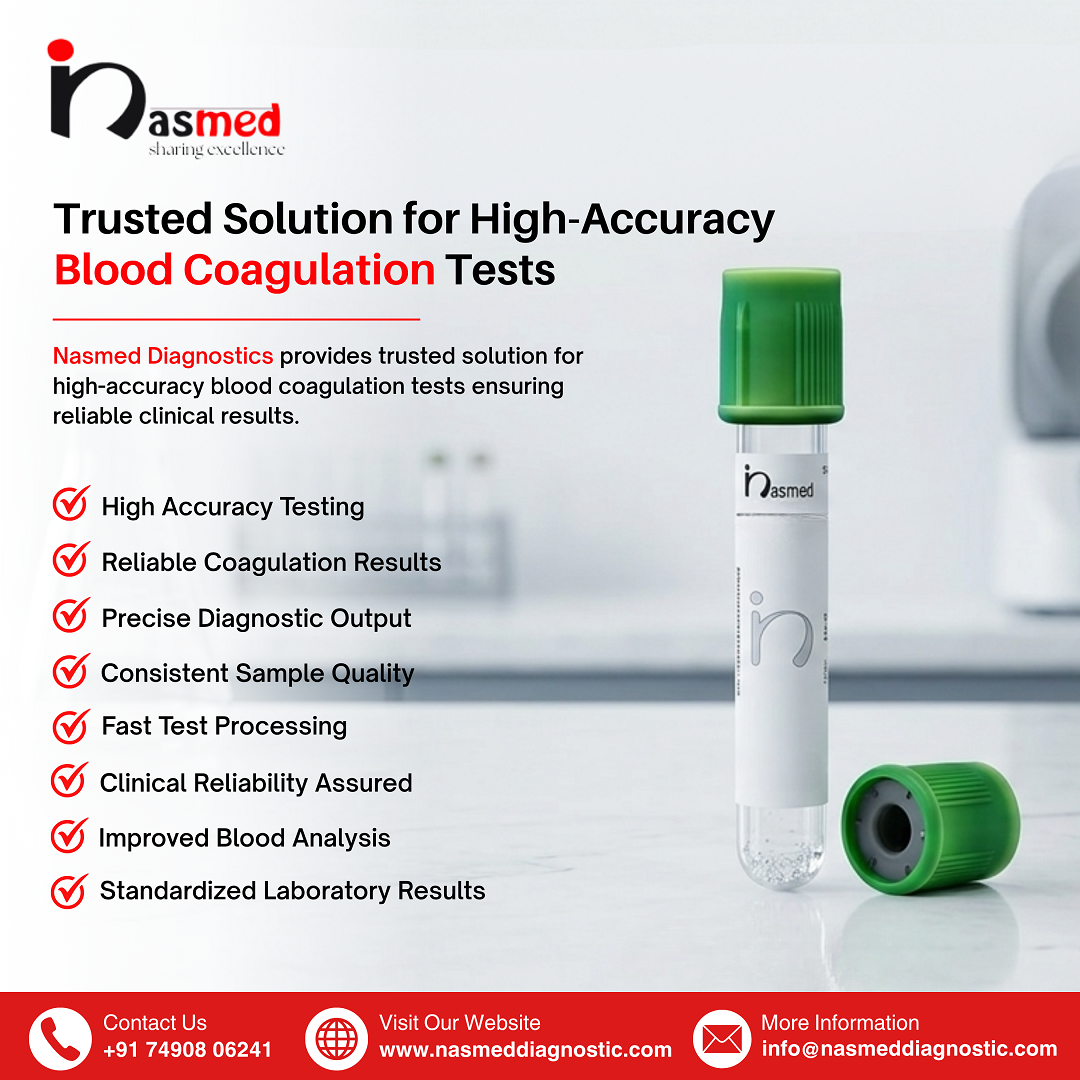
Gel Lithium Heparin Tubes: What Every Diagnostic Lab Needs to Know About Sample Integrity and Reliable Results
Over the past decade, diagnostic laboratories have evolved significantly, managing higher test volumes and stricter quality standards across global healthcare systems. From Mumbai to Manchester, labs now require reliable tools that ensure precision and efficiency. Even something as basic as a blood collection tube plays a critical role in test accuracy and patient safety. This is where High-Performance Solutions for Reliable Coagulation Test Results become essential, with Nasmed Diagnostic Pvt Ltd delivering dependable quality and consistent laboratory performance.
The Gel Lithium Heparin Tube plays a key role, as lab professionals rely on blood collection tubes from sample collection to analyzer for accurate decisions.
The Changing Needs of Modern Diagnostic and Healthcare Labs
In daily diagnostic lab operations, the pressure to deliver faster, more accurate results has never been greater. Turnaround time expectations have shortened. Patients and clinicians expect results within hours, not days. Hospital administrators, accreditation bodies, and international buyers rigorously audit labs, ensuring compliance with ISO 13485, CE marking, and global standards.
Labs and manufacturers serving global markets must maintain consistent quality at every sample collection step. One weak link—such as a poorly manufactured tube, inconsistent additives, or inadequate sterility—can compromise an entire sample batch.
Experienced lab professionals understand that cutting costs on consumables is often a false economy. The downstream costs of sample rejection, re-collection, and re-testing almost always outweigh any savings made at the point of purchase.
What Is a Gel Lithium Heparin Tube?
A Gel Lithium Heparin Tube is a vacuum blood collection tube used primarily for plasma-based biochemistry testing. It contains lithium heparin, an anticoagulant that prevents clotting, and a separation gel that forms a barrier between plasma and cellular components after centrifugation.
Technicians draw blood into the tube, heparin prevents coagulation, and after centrifugation, the gel forms a stable layer between plasma and red cells. This gives you a clean, stable plasma sample that is ready for analysis.
Labs identify the tube by its green cap (or green-grey cap) and use it for biochemistry panels, including liver tests, renal tests, electrolytes, lipid profiles, and drug monitoring. You can explore our full range of blood collection tubes to find the right tube for every diagnostic need.
Why Gel Lithium Heparin Tubes Are Essential for Accurate Blood Sample Collection
Sample integrity is the foundation of every reliable test result. Errors at sample collection—such as using an incorrect tube, improper mixing, low fill volume, or poor-quality additive—compromise results, making even advanced analyzers unreliable.
The Gel Lithium Heparin Tube addresses several of the most common causes of sample integrity failure:
- Anticoagulant activity: Lithium heparin works rapidly and effectively, preventing clot formation without interfering with most biochemistry analytes. Unlike EDTA, which chelates calcium and is unsuitable for most biochemistry panels, lithium heparin is compatible with a broad range of tests.
- Gel barrier stability: The separation gel creates a physical barrier that remains stable for up to 48–72 hours post-centrifugation under correct storage conditions. This is particularly important for labs with batched testing schedules or where samples are transported to central processing facilities.
- Reduced contamination risk: By separating plasma from cells, the gel prevents continued cellular metabolism that could alter analyte values — particularly for glucose, lactate, and electrolytes — during storage and transport.
For export-quality diagnostics, consistency in these properties across every tube in a batch is essential. A single inconsistent lot can lead to a supplier audit failure or, worse, clinically unreliable results.
Role of the Gel Lithium Heparin Tube in Reliable Test Results
In hospital and pathology lab environments, incorrect tube selection is one of the most underappreciated causes of analytical error. Using a Clot Activator Tube (typically red or gold cap) when a plasma sample is needed, or forgetting to invert a heparin tube adequately, introduces variability that the analyzer cannot detect or correct for.
Practical scenarios where tube choice directly affects results:
- Potassium levels: Red cell breakdown (haemolysis) in a poorly mixed or low-quality heparin tube will falsely elevate potassium readings — a clinically significant error.
- Troponin assays: Some labs use Lithium Heparin Tubes for urgent cardiac panels where plasma results are needed faster than serum (which requires clotting time). The gel layer ensures sample stability during rapid centrifugation cycles.
- Therapeutic drug monitoring: For drugs like cyclosporine or tacrolimus, the type and quality of the anticoagulant and the efficiency of plasma separation directly affect measured drug concentrations.
Experienced lab directors often trace high re-test rates to pre-analytical variables and first evaluate the quality of the collection tube.
Safety, Sterility, and Patient Care Considerations
From a patient care standpoint, the blood collection tube must be sterile, non-pyrogenic, and free from any substances that could cause harm or interfere with the sample at the point of collection. This is not merely a regulatory checkbox — it is a fundamental requirement for patient safety.
For phlebotomists and lab technicians handling large volumes of tubes daily, practical design features matter as well:
- Leak-proof closure: Tubes must seal reliably to prevent exposure to blood during handling and transport.
- Vacuum consistency: Accurate vacuum levels ensure correct fill volumes, which are critical for maintaining the correct blood-to-additive ratio.
- Label clarity: Colour-coding and clear labelling reduce the risk of tube mix-ups, particularly in high-volume OPD and emergency settings.
Safe disposal of used blood collection tubes is part of bio-medical waste management protocols in India (under BMW Rules 2016) and equivalent regulations in the UK, Australia, and across the Middle East. Training staff on proper segregation and disposal is as important as any other part of lab safety.
For additional insights on blood coagulation testing standards, you can explore resources on Google.
Compatibility with Modern Diagnostic Equipment
Today’s diagnostic labs — whether in a corporate hospital chain in India or a reference laboratory in Canada — rely on automated biochemistry analyzers from manufacturers like Roche, Abbott, Beckman Coulter, and Siemens. These instruments are calibrated and validated with specific tube types in mind.
A well-manufactured Gel Lithium Heparin Tube should be compatible with:
- Automated pre-analytical systems: Tube sorters and sample handlers require consistent tube dimensions and cap types.
- Centrifuge protocols: The gel must separate cleanly within standard centrifugation protocols (typically 1,500–2,000 × g for 10 minutes).
- Closed-system sampling: Many modern analyzers draw samples directly through the cap. A piercing-compatible closure is essential for this workflow.
Manufacturers who understand global lab environments design tubes to meet these compatibility expectations, not just local ones.
Manufacturing Quality, Additives & Tube Consistency
Labs assess a Gel Lithium Heparin Tube by its hidden factors: additive coating precision, gel stability, vacuum integrity, and sterile manufacturing quality.
Lithium heparin is spray-coated or lyophilized onto the inner wall of the tube. The uniformity of this coating directly affects how quickly and completely anticoagulation occurs after blood draw. Similarly, the rheological properties of the gel — its density and viscosity — must be tightly controlled to ensure that it migrates correctly during centrifugation and remains stable thereafter.
Batch-to-batch consistency is a quality issue that experienced procurement managers increasingly focus on. A tube that performs well in one lot but is inconsistent in the next creates analytical variability that is difficult to track and costly to investigate. As a trusted manufacturer of blood collection tubes, maintaining this consistency is a core manufacturing priority.
Storage, Shelf Life & Transportation Considerations
Labs across India must manage storage conditions for blood collection tubes due to climate variations. Most tubes require storage between 4°C and 25°C, away from direct sunlight and humidity. Gel integrity and vacuum stability can both be compromised by improper storage.
Protect export shipments with packaging that prevents temperature fluctuations and physical damage during long-distance logistics. Clearly display shelf life (18–24 months) on packaging to meet import regulations in the EU, UK, and Gulf countries.
Cost Efficiency for Labs and Healthcare Providers
The cost conversation in diagnostic consumables is rarely straightforward. A low-cost tube can increase overall costs due to sample rejections, re-collection, patient inconvenience, and staff time.
Reliable Gel Lithium Heparin Tubes contribute to cost efficiency by:
- Reducing pre-analytical errors that lead to sample rejection
- Minimizing repeat collections, which consume staff time and patient goodwill
- Maintaining consistent quality that prevents calibration drift caused by variable sample quality
For high-volume labs, even marginal improvements in first-pass sample acceptance rates translate into meaningful operational savings over time.
To improve your website’s search visibility and ranking, refer to industry-leading guides available on Moz.
Compliance, Standards & Export Readiness
Define CE marked and ISO certified products as those built under a quality management system, validated for use, and tested against performance criteria.
Diagnostic labs and international buyers now treat documentation from domestic manufacturers as a baseline requirement. Accreditation bodies (NABL, JCI, CAP) and agencies like the NHS and UAE Ministry of Health require technical documentation, lot traceability, and continuous quality monitoring.
Choosing a blood collection tube manufacturer in India who understands these requirements — not just for their home market but for multiple international regulatory environments — is a practical necessity for any serious procurement decision.
Integration into Hospital & Lab Workflow
Use the Gel Lithium Heparin Tube across OPD collection, inpatient rounds, emergency draws, and central lab processing. Ensure the tube delivers consistent performance across all collection centers, regardless of collector or location.
Train phlebotomists in correct inversion (8–10 gentle turns), proper order of draw, and accurate labelling. These are standard competencies that any experienced phlebotomy team can adopt without disruption to existing workflows.
Why Choosing the Right Manufacturer Matters
In any market, from Ahmedabad to Riyadh, the manufacturer matters as much as the tube quality. Evaluate manufacturing experience, process validation, cold-chain capability, export documentation, and supply continuity to ensure product reliability.
Labs that also require Sodium Heparin Vacuum Blood Collection Tubes or other specialized tube types benefit from working with a single manufacturer who can supply a complete, validated product range under one quality system.
Choose a manufacturer with advanced infrastructure, global quality standards, and export experience to ensure better long-term lab performance than price-focused options.
About Nasmed Diagnostic Pvt Ltd
Nasmed Diagnostic Pvt Ltd manufactures diagnostic consumables, including blood collection tubes like EDTA, Gel Lithium Heparin, Clot Activator, Sodium Citrate, Fluoride, Heparin, K2EDTA/K3EDTA, Serum, Micro/Pediatric, Cell Free DNA tubes, and urine containers.
Nasmed Diagnostic Pvt Ltd serves Indian and global markets, combining strong manufacturing capability with regulatory compliance and quality documentation expertise. For labs and distributors looking for a reliable supply partner, more information is available at 👉 https://www.nasmeddiagnostic.com/
Conclusion
The Gel Lithium Heparin Tube is not a commodity item — it is a precision diagnostic tool that affects the quality of every test result it touches. Lab directors, hospital administrators, and procurement teams must understand tube manufacturing to ensure patient safety, diagnostic accuracy, and operational efficiency.
Run any lab or network with strict focus on blood collection tube quality, just like analyzers and reagents.
If you are evaluating suppliers or looking to review your current consumable standards, feel free to contact us — our team is available to assist labs and distributors with product information, documentation, and supply queries.
Key Takeaways
- Diagnostic Accuracy: Gel Lithium Heparin Tubes prevent coagulation and provide stable plasma, supporting reliable biochemistry results across a wide test menu.
- Sample Safety & Sterility: Sterile, leak-proof design protects both the sample and the healthcare worker handling it.
- Workflow Efficiency: Gel separation reduces processing time and supports stable sample storage for batched or centralized testing models.
- Cost Control for Labs: Fewer sample rejections and repeat collections mean measurable reductions in operational cost over time.
- Growing Global Demand: International quality expectations and rising test volumes are driving demand for consistently manufactured, export-ready diagnostic consumables.
Frequently Asked Questions
Q1. What tests are Gel Lithium Heparin Tubes most commonly used for?
- Labs use Gel Lithium Heparin Tubes for biochemistry panels, including liver function tests, renal function tests, lipid profiles, electrolytes, and therapeutic drug monitoring. They provide plasma, which labs prefer over serum for faster availability after collection.
Q2. How should Gel Lithium Heparin Tubes be stored to maintain quality?
- Tubes should be stored at 4°C to 25°C, away from direct sunlight and excessive humidity. In regions with high ambient temperatures — common across India and the Middle East — climate-controlled storage is advisable to maintain vacuum integrity and gel stability throughout the stated shelf life. Nasmed Diagnostic Pvt Ltd ensures all tubes include clear storage instructions and validated shelf life stability across varied climatic conditions.
Q3. What is the correct technique for mixing a Gel Lithium Heparin Tube after blood collection?
- Immediately after filling, the tube should be gently inverted 8 to 10 times. This ensures thorough mixing of blood with the heparin coating without causing haemolysis. Vigorous shaking should be avoided as it can damage red cells and compromise sample quality.
Q4. Can Gel Lithium Heparin Tubes be used with all automated biochemistry analyzers?
- Most modern biochemistry analyzers are compatible with lithium heparin plasma. However, it is important to verify compatibility with your specific analyzer and assay panels, as some immunoassays or specialized tests may require serum rather than plasma. Always refer to the analyzer manufacturer’s specifications. Nasmed Diagnostic Pvt Ltd designs its Gel Lithium Heparin Tubes to meet dimensional and performance standards compatible with leading global analyzer platforms.
Q5. What should labs look for when evaluating a Gel Lithium Heparin Tube manufacturer for export or bulk procurement?
- Key evaluation criteria include: ISO 13485 certification and CE marking, documented batch-to-batch consistency data, sterility testing records, evidence of compatibility testing with major analyzers, shelf life documentation, and the manufacturer’s experience with export logistics and international regulatory requirements. You are welcome to contact us directly for any product or compliance documentation queries.
#BloodCollectionTube #DiagnosticConsumables #PathologyLab #MedicalDiagnostics #NasmedDiagnostic #IVDProducts #HealthcareManufacturing #GlobalDiagnostics
