

Grow Healthcare With Premium Blood Collection Tubes
Grow Healthcare With Premium Blood Collection Tubes: A Manufacturer’s Perspective from Gandhinagar
Every diagnostic result — whether it’s a routine CBC in a neighbourhood clinic in Surat or a complex cell-free DNA test at a tertiary hospital in Mumbai — starts with one critical step: collecting a clean, uncontaminated blood sample. That step depends entirely on the quality of the tube in the technician’s hand. Over the years, working closely with procurement teams, pathology heads, and lab managers across India, the same concern comes up again and again: tube failures, haemolysis issues, additive inconsistencies, and last-minute supply breakdowns. Nasmed Diagnostics Pvt. Ltd., manufactured out of Gandhinagar, Gujarat, was built precisely to address these pain points — with verified quality, regulatory clarity, and dependable supply.
Why Choose Nasmed Diagnostics for Premium Blood Collection Tubes?
Here’s a practical truth that most lab managers in Chennai, Hyderabad, and Kolkata already know: not all diagnostic tubes perform the same way on the bench. A tube with an inconsistent vacuum level can give you short draws; an additive that hasn’t been precisely coated can compromise your coagulation studies. When you’re running 500 samples a day, even a 2% failure rate translates into real re-draws, patient discomfort, and wasted reagent costs.
Nasmed Diagnostics manufactures its complete range of blood collection products inside a Class 10,000 ISO 7 clean room facility — one of the most stringent controlled environments available in Indian medical device manufacturing. Every batch goes through defined QC checkpoints covering vacuum integrity, additive fill accuracy, stopper seal strength, and sterility verification before it leaves the floor.
The company is led by Directors Kush Patel and Suril Shah, both of whom bring hands-on understanding of the Indian diagnostic supply chain. The manufacturing team includes trained technicians and quality specialists who work under documented SOPs aligned with CDSCO (Central Drugs Standard Control Organisation) guidelines for medical devices. This isn’t a paper certification — it reflects actual process discipline on the floor.
Hospitals and diagnostic labs in Bangalore, Ahmedabad, Pune, and Delhi trust these tubes not just because of the certification documents, but because the tubes work — batch after batch, month after month. For procurement teams evaluating blood collection tubes manufacturers near me, that consistency is what matters most.
For further information on our quality range, explore our complete diagnostic lab disposables product catalogue.
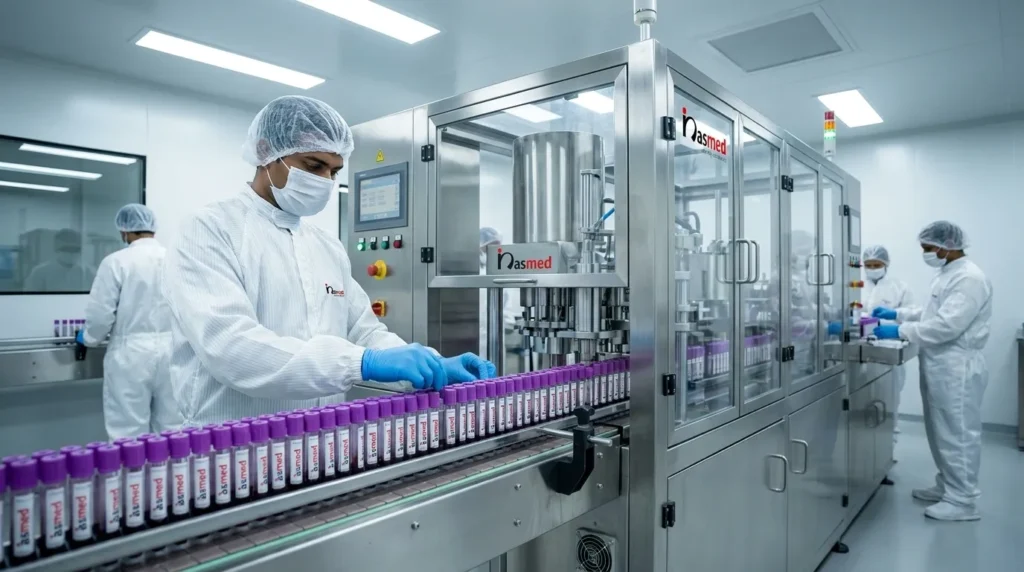
Our Blood Collection Tubes Manufacturing Capabilities
The product range at Nasmed Diagnostics has been developed keeping in mind the actual workflow inside Indian labs — from large hospital networks in Delhi and Mumbai to standalone diagnostic centres in Jaipur, Chandigarh, and Indore.
Here is what the manufacturing line covers:
- Vacuum Blood Collection Tubes — Available in multiple additive configurations (EDTA K2/K3, Sodium Citrate, Serum Separator, Fluoride Oxalate, Heparin). Precise vacuum levels ensure accurate fill volumes every time.
- Non-vacuum blood collection tubes — Designed for settings where a vacuum draw isn’t feasible or preferred, while maintaining the same sterility and additive standards.
- Gel lithium heparin tubes — Particularly useful in chemistry and therapeutic drug monitoring panels. The gel separator ensures clean serum separation with minimal centrifuge cycles.
- Micro paediatric tubes — Developed for neonatal and paediatric wards where sample volumes are critically limited. These tubes allow accurate testing with as little as 0.5 mL of blood.
- Cell-free DNA tubes — Engineered for liquid biopsy, NIPT (Non-Invasive Prenatal Testing), and oncology applications. These preserve cfDNA integrity during transport, which is non-negotiable for molecular diagnostics.
- Urine containers — Sterile, leak-proof containers suitable for routine urinalysis, culture, and sensitivity testing.
All products comply with international material guidelines including ISO 6710 for single-use blood collection containers and relevant WHO guidelines for phlebotomy. For labs in Vadodara and Hyderabad that have international accreditation requirements (NABL, CAP), this compliance alignment is directly relevant to their audit documentation.
Custom labelling, additive concentrations, and pack sizes are also available for hospitals and diagnostic chains running high volumes. To discuss specific requirements, visit our custom diagnostic solutions page.
Navigating Regulatory Compliance & CDSCO Certification
One question that comes up frequently from procurement managers — especially those working with government hospitals in Kolkata and Chennai — is about CDSCO registration status. It’s a fair question. Since the Medical Devices Rules 2017 came into effect and Schedule M was progressively enforced, a significant number of smaller manufacturers found themselves without proper registration, creating supply chain risk for buyers.
Nasmed Diagnostics holds valid CDSCO certification for its blood collection tube range. This means the products have been evaluated and registered under the applicable device classification, and the manufacturing site has been assessed for compliance. For procurement teams maintaining vendor qualification documents, this removes a major compliance risk.
The ISO 7 clean room manufacturing environment adds another layer of verifiability. Class 10,000 environments are defined by particulate control standards — the number of particles ≥0.5 µm per cubic metre of air is controlled below 352,000. In a blood collection tube manufacturing context, this directly impacts tube sterility, which affects patient safety downstream.
It’s also worth noting that CDSCO-certified tubes are now a requirement under many hospital empanelment criteria and state government procurement tenders — particularly in states like Gujarat, Maharashtra, and Rajasthan. Sourcing from a verified, registered vacuum blood collection tubes manufacturer in Gandhinagar simplifies your compliance documentation considerably.
For labs preparing for NABL accreditation or upgrading their vendor list, our CDSCO compliance documentation page provides certificate copies and relevant regulatory references.
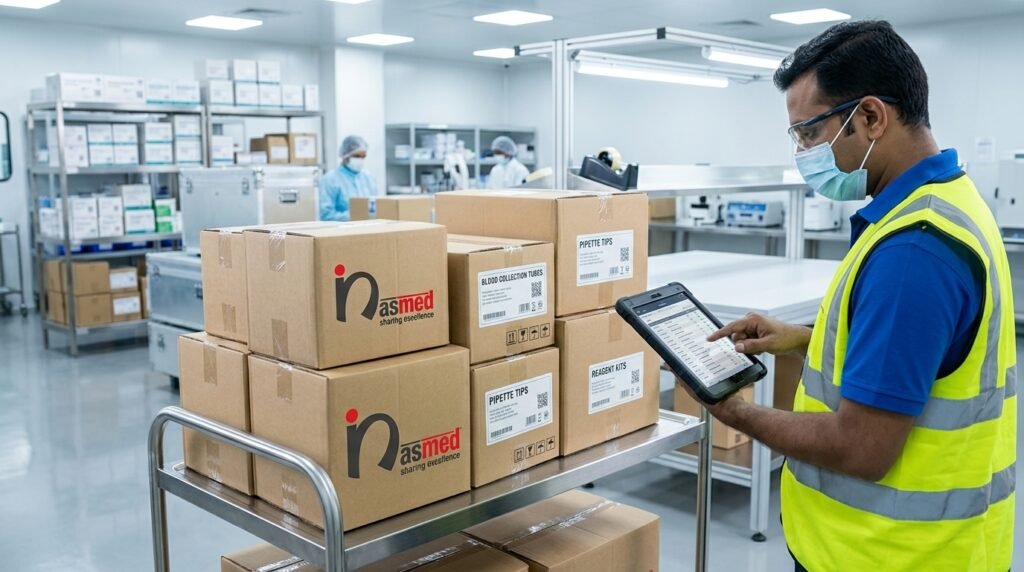
Local Suppliers vs Nasmed Diagnostics: What the Comparison Actually Shows?
A procurement head in Pune once told me that they had switched suppliers three times in two years — each time because of either quality inconsistency or supply unreliability. When evaluating diagnostic tubes suppliers India, the decision isn’t just about unit price. Here’s a practical comparison:
| Parameter | Typical Local/Unregistered Supplier | Nasmed Diagnostics Pvt. Ltd. |
|---|---|---|
| CDSCO Registration | Often absent or pending | ✔ Valid CDSCO Certified |
| Manufacturing Environment | Standard or uncontrolled | ✔ ISO 7 Clean Room (Class 10,000) |
| Product Range | Limited (1–3 tube types) | ✔ Full range incl. cfDNA, Micro Paediatric, Gel Lithium Heparin |
| Vacuum Consistency | Variable (batch-to-batch issues) | ✔ Validated vacuum levels per batch QC |
| Custom Solutions | Rarely available | ✔ Custom additive, labelling, pack size |
| Pan-India Supply | Local/regional only | ✔ Supplies to Mumbai, Delhi, Bangalore, Chennai, Hyderabad & more |
| Technical Support | Limited post-sale support | ✔ Dedicated technical & after-sales team |
| Regulatory Audit Support | Certificate copies often unavailable | ✔ Full documentation provided for NABL/ISO audits |
Step-by-Step Process: How Nasmed Diagnostics Delivers Premium Blood Collection Tubes
Understanding how your tubes are manufactured and delivered isn’t just an academic exercise — it directly affects your confidence in the product you’re putting into a patient’s arm. Here’s the actual process flow:
- Raw Material Verification — All incoming materials (PET tubes, rubber stoppers, additives) are tested against defined specifications before entering the clean room. Non-conforming material is quarantined and returned.
- Clean Room Processing — Tube assembly, additive filling, and vacuum sealing happen inside the ISO 7 environment. Personnel access is controlled; gowning protocols are strictly followed.
- In-Process Quality Checks — Vacuum levels, fill volumes, and stopper integrity are checked at defined intervals during production runs. Any deviation triggers a line stoppage and investigation.
- Finished Product QC — Each batch is sampled for sterility testing, labelling accuracy, and dimensional verification before release to warehouse.
- Packaging & Dispatch — Products are packed in tamper-evident, moisture-resistant packaging. Cold-chain requirements (where applicable for cfDNA tubes) are managed during dispatch to cities like Mumbai, Bangalore, and Delhi.
- Post-Delivery Support — Our technical team remains accessible for any lot-specific queries, complaint investigations, or documentation requests from your QA team.
For labs in Ahmedabad and Surat looking to evaluate a trial order before committing to volume, we offer a Free Product Consultation and sample dispatch. Reach us on WhatsApp at +91 74908 06241 to get started.
You can also browse our complete sterile blood collection tubes range with additive references and tube colour coding guide.
Real Client Case Study: Resolving Sample Quality Issues for a Multi-Branch Diagnostic Chain
Client: Anonymised as “Shree Pathology & Diagnostics” — a 9-branch diagnostic chain operating across Ahmedabad, Vadodara, and Surat.
In early 2024, the quality manager at this chain approached us with a recurring problem: haemolysed samples on their biochemistry analyser, particularly in EDTA tubes during peak morning collection hours. Their rejection rate had climbed to nearly 4.8% — directly impacting patient TAT (turnaround time) and creating rework costs of approximately ₹18,000–22,000 per month across branches.
Root cause identified: After reviewing their existing tube supplier’s batch records and running our own vacuum integrity check on samples from their inventory, we found vacuum levels were running 8–12% below specification — causing inconsistent draw volumes and increased haemolysis risk during transport.
Solution implemented: We transitioned all 9 branches to our vacuum blood collection tubes — EDTA K2 and K3 variants — with validated vacuum levels. We also supplied micro paediatric tubes for their paediatric sampling stations in Vadodara. A brief orientation was conducted with their phlebotomy supervisors on tube handling and transport protocols.
Result after 90 days: Sample rejection rate dropped from 4.8% to under 0.9%. The biochemistry rejection incidents specifically reduced by 81%. The QA manager noted in a feedback call that the consistency across branches had improved their morning collection workflow measurably.
This case isn’t exceptional — it’s representative of what reliable lab consumables India-wide procurement can actually achieve when quality is verified, not assumed.
📥 Download the Blood Collection Tubes Cost Guide — available on request. Email us at info@nasmeddiagnostic.com or WhatsApp +91 74908 06241.
Quick Win — Jaipur Hospital Network: A 3-hospital group in Jaipur switched to our gel lithium heparin tubes for their chemistry panels. Within two months, their serum separator-related repeat centrifugation requests dropped by 65%. Lab director’s comment: “The gel separation is clean and consistent — exactly what we needed.”

FAQs: Grow Healthcare With Premium Blood Collection Tubes
1. Why are premium blood collection tubes important for accurate diagnostics?
- Premium blood collection tubes help preserve sample integrity, reduce contamination, and ensure accurate laboratory results. They improve diagnostic reliability and support better patient care in hospitals, clinics, and diagnostic laboratories.
2. How do premium blood collection tubes improve healthcare services?
- High-quality tubes minimize pre-analytical errors, protect blood samples during transportation, and enhance testing efficiency. This enables healthcare providers to deliver faster and more reliable diagnostic reports.
3. What should laboratories look for when choosing a blood collection tube supplier?
- Laboratories should choose a supplier offering certified manufacturing standards, consistent product quality, reliable delivery, multiple tube options, and responsive technical support to ensure uninterrupted diagnostic operations.
4. Premium Blood Collection Tubes kyun choose karne chahiye?
- Premium blood collection tubes blood sample ki quality maintain karte hain, contamination ko kam karte hain aur laboratory reports ko zyada accurate banate hain. Isse doctors ko reliable diagnostic results milte hain aur patients ko better treatment milta hai.
5. Blood Collection Tube supplier select karte waqt kya check karna chahiye?
- Supplier ki manufacturing quality, certifications, product consistency, timely delivery aur customer support zaroor check karein. Ek trusted supplier laboratory ki efficiency aur patient satisfaction dono improve karta hai.
6. Healthcare business grow karne ke liye premium blood collection tubes kaise help karte hain?
- Quality blood collection tubes laboratory workflow ko smooth banate hain, sample rejection ko reduce karte hain aur doctors ka trust badhate hain. Isse hospitals, pathology labs aur distributors apna healthcare business confidently expand kar sakte hain.
7. How can partnering with a trusted blood collection tube manufacturer support long-term business growth?
- A trusted manufacturer provides consistent product quality, regulatory compliance, dependable supply, and scalable production. These advantages help distributors, hospitals, and diagnostic laboratories build long-term partnerships while delivering reliable healthcare solutions.