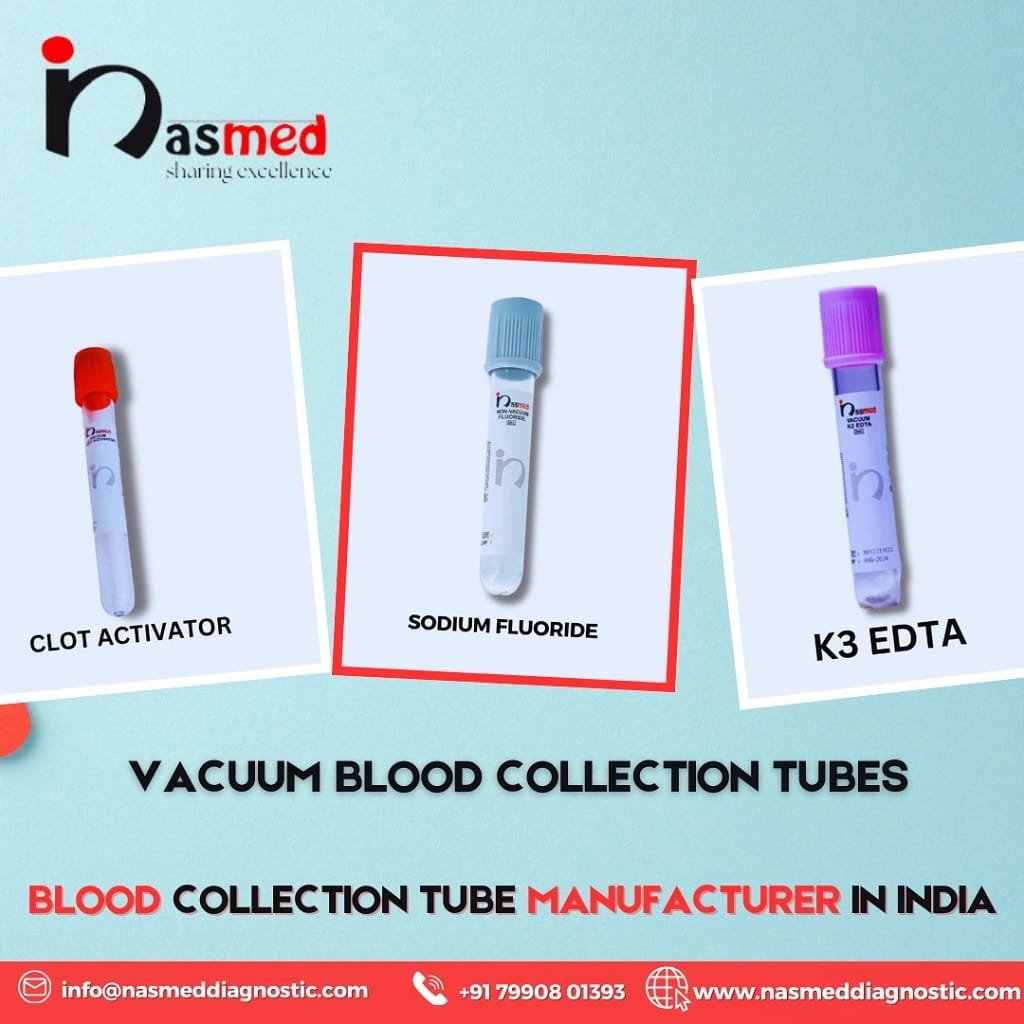
Nasmed Diagnostics: Trusted Manufacturer of High-Quality Blood Collection Tubes for Modern Laboratories
Modern diagnostics and pathology testing have advanced rapidly over the past two decades. Laboratories have shifted from manual workflows to highly automated systems, where accuracy, speed, and patient safety drive every diagnostic decision. Across hospitals and pathology labs in India, the USA, the UK, and other advanced healthcare markets, dependable pre-analytical processes are now viewed as the backbone of reliable results—making the role of a high-quality blood collection tubes manufacturer for laboratories more critical than ever in ensuring precise and consistent diagnostic outcomes.
Of all the preliminary procedures, drawing a blood sample is among the most delicate. Even the most sophisticated analytical device cannot make up for a compromised specimen. In day-to-day diagnostic lab work, seasoned experts recognise that accurate sample acquisition directly influences the reliability of results, completion time, and clinician trust.
Blood Collection Tubes hold a vital place in this process. Although often viewed as a basic disposable item, the standard, consistency, and appropriateness of the tube noticeably affect diagnostic precision and patient treatment results.
Evolving Requirements of Contemporary Diagnostic & Healthcare Facilities
Diagnostic labs today operate under increasing strain from several fronts. Increasing test volumes, particularly in metropolitan diagnostic chains and hospital systems, mandate efficiency without sacrificing accuracy. Simultaneously, medical practitioners anticipate faster turnaround times to enable prompt health decisions.
Global quality benchmarks and accreditation mandates have also grown stricter. Facilities serving worldwide markets or participating in cross-boundary research must adhere to accepted diagnostic methods. Diagnostic providers focused on exports face additional regulatory and paperwork requirements from purchasers in regions such as Europe, the Middle East, and Southeast Asia.
Actual difficulties encountered by labs internationally include:
- Managing substantial daily specimen loads with minimal error tolerance
- Decreasing specimen rejection and the need to redraw
- Sustaining uniform consumable quality across different sites
- Guaranteeing staff security during collection and handling
These changing demands underscore the importance of dependable Blood Collection Tubes that seamlessly integrate into contemporary lab operations.
What Constitutes a Blood Collection Tube?
A Blood Collection Tube is a sterile receptacle formulated to receive, maintain, and move a blood specimen from the patient to the lab for examination. Operationally, it functions as the initial touchpoint between the patient and the diagnostic sequence.
In standard procedures, the venipuncture professional immediately uses the tube after drawing blood, seals it, and then sends it for testing. The tube’s interior environment helps keep the sample in a state suitable for particular diagnostic assessments.
Instead of merely being a passive vessel, the tube actively supports sample stability throughout the handling, storage, and processing phases.
Why Are Blood Collection Tubes Crucial for Accurate Blood Sampling?
Precise blood sample acquisition hinges on preserving specimen integrity from the moment of the draw. Low-quality tubes can introduce variation, impurity, or decay that impacts test findings.
Blood Collection Tubes are essential as they:
- Aid in retaining the blood sample’s original makeup
- Lessen external contamination dangers
- Guarantee a consistent sample volume for trustworthy testing
For diagnostics intended for export, uniformity across production batches is paramount. Laboratories processing specimens for international trials or referral testing depend on standard consumables to maintain comparability of results.
The Role of Blood Collection Tubes in Dependable Test Outcomes
Improper or irregular tubes can directly compromise test accuracy. In settings such as hospitals and pathology labs, frequent issues include clotting in unsuitable tubes, sample breakdown (hemolysis), or interference from incompatible agents.
These complications can result in:
- An increase in re-testing requirements
- Reporting delays
- Added patient inconvenience from having to repeat the collection
Seasoned lab personnel understand that using the appropriate Blood Collection Tubes for each test reduces pre-analytical errors and ensures consistent diagnostic results.
Considerations for Safety, Sterility, and Patient Welfare
Safety is a mutual obligation shared between manufacturers and healthcare providers. Blood collection items must meet strict sterility expectations to safeguard both patients and staff.
Key points to consider involve:
- Appropriate sterilisation to prevent microbial contamination
- Leak-proof tube design to avoid exposure during handling
- A smooth exterior dimension to facilitate safe needle insertion
From a patient comfort perspective, reliable tubes facilitate easier collections and fewer repeat procedures, enhancing the overall patient experience without making clinical guarantees.
Compatibility with Current Diagnostic Apparatus
Labs today rely heavily on automated analysers, centrifuges, and specimen transport systems. Blood Collection Tubes must work with this machinery to ensure workflows remain uninterrupted.
Compatibility aspects include:
- Standardised tube sizing for analyser racks
- A balanced tube structure for effective centrifugation
- Secure seals for pneumatic conveyance systems
Global lab settings, whether in large medical centres or reference labs, depend on consumables that integrate smoothly with their established systems.
Manufacturing Excellence, Additives, and Tube Uniformity
Consistency in manufacturing is one of the foremost determinants of Blood Collection Tube performance. Fluctuations in tube material, internal lining, or the amount of additive can affect sample longevity.
Typical agents introduced into diagnostic tubes consist of:
- EDTA for blood cell analysis
- Gel barriers for serum or plasma segregation
- Heparin for chemical testing
- Fluoride for sugar assessment
Each additive must be precisely quantified and uniformly applied. Irregular production can lead to variable test results, something laboratories strive to prevent.
Storage, Usable Life, and Shipping Requirements
Storage and supply chain management play a vital role in preserving tube quality. In nations with varied climates, such as India, regulating temperature and moisture is crucial.
For international shipment, extra elements apply:
- The duration of long-distance travel
- Multiple transfer points
- Inconsistent storage settings
Suitable packaging and a defined expiration date help ensure that Blood Collection Tubes reach labs in a usable state, irrespective of whether they are sent locally or internationally.
Economic Effectiveness for Labs and Care Providers
While disposable supplies constitute a regular cost, long-term financial prudence relies more on reliability than on cost per unit. Uniform tube quality supports operational savings by:
- Decreasing specimen rejection rates
- Minimising the necessity for re-testing
- Enabling more predictable inventory management
In the day-to-day operations of diagnostic labs, stable consumables help facilities maintain process efficiency and manage indirect expenditures.
Adherence, Benchmarks, and Export Readiness
Conformity with recognised norms is vital for gaining laboratory acceptance and for compliance with procurement procedures. Buyers frequently evaluate manufacturers based on their documentation, quality control systems, and export-readiness.
International acceptance is essential for:
- Hospital purchasing departments
- In Vitro Diagnostic (IVD) resellers and importers
- Facilities serving clientele globally
While not offering legal guidance, it is evident that diagnostic items intended for export must align with the purchaser’s expectations and audit requirements.
Incorporation into Hospital and Lab Operations
Blood Collection Tubes are utilised across various collection settings, including:
- Outpatient blood collection areas
- Inpatient wards
- Central diagnostic labs
Their design and labelling must facilitate quick recognition, straightforward transit, and streamlined processing. Integration into the operational flow shortens handling time and promotes consistent reporting.
Instruction, Handling, and Waste Disposal Methods
Ease of training is another practical aspect to consider. Standardised tube design enables new personnel and trainees to master collection techniques quickly.
Appropriate handling and disposal support:
- Safe phlebotomy practices
- A lower risk of exposure
- Compliance with biomedical waste regulations
Clear tube labelling also helps lab technicians prevent procedural mistakes during busy periods.
Why the Selection of the Correct Manufacturer is Significant?
From a worldwide viewpoint, the manufacturer’s background and quality assurance mechanisms directly affect laboratory outcomes. Dependable suppliers comprehend the practical demands of diagnostic labs and export sectors.
Important aspects include:
- Demonstrated production expertise
- Consistency from one batch to the next
- Awareness of international supply chains
- The capacity to sustain a steady supply
Selecting the appropriate manufacturer is a protracted commitment that bolsters diagnostic accuracy and operational assurance.
About Nasmed Diagnostic Pvt Ltd
Nasmed Diagnostic Pvt Ltd is a specialised manufacturer of Blood Collection Tubes serving the Indian and global diagnostic sectors. By prioritising manufacturing uniformity, safety, and laboratory compatibility, the firm supports pathology labs, medical centres, and distributors across varied healthcare settings.
Nasmed Diagnostic Pvt Ltd collaborates closely with diagnostic experts to grasp real-world lab necessities and evolving international benchmarks. Further details about the company and its diagnostic supplies are accessible at 👉 https://www.nasmeddiagnostic.com/
Summary:
Blood Collection Tubes might appear uncomplicated, yet their contribution to diagnostic accuracy and patient well-being is considerable. From maintaining sample integrity to optimising workflow effectiveness, the right tube underpins reliable testing and medical assurance.
For facilities and care providers, investing in reliable Blood Collection Tubes is a component of maintaining quality-focused diagnostics. For distributors and purchasing bodies, partnering with experienced manufacturers guarantees uniformity, compliance, and enduring operational value.
Primary Takeaways
- Diagnostic Precision: Reliable tubes lead to consistent test findings
- Specimen Safety & Sterility: Correct design reduces contamination risks
- Workflow Effectiveness: Compatibility with modern lab systems is key
- Cost Management for Labs: Fewer instances of re-testing and re-collection
- Rising Worldwide Requirements: High-quality consumables are essential everywhere
FAQs
1. How do Blood Collection Tubes influence the accuracy of a blood sample?
- The tube’s material, added agents, and sterility all play a part in sample stability, w
2. Can incorrect tubes lead to repeated blood collection?
- Yes. Using unsuitable tubes can cause clotting or sample degradation, leading to re-tests.
3. What is the typical shelf life of Blood Collection Tubes?
- Shelf life varies by tube type and storage conditions and should always be checked before use.
4. Are these tubes compatible with automated laboratory analysers?
- Quality tubes are designed to fit standardised analysers and centrifuges used globally.
#BloodCollectionTube #DiagnosticConsumables #PathologyLab #MedicalDiagnostics #NasmedDiagnostic #IVDProducts #HealthcareManufacturing #GlobalDiagnostics #SodiumFluorideBloodCollectionTubes