
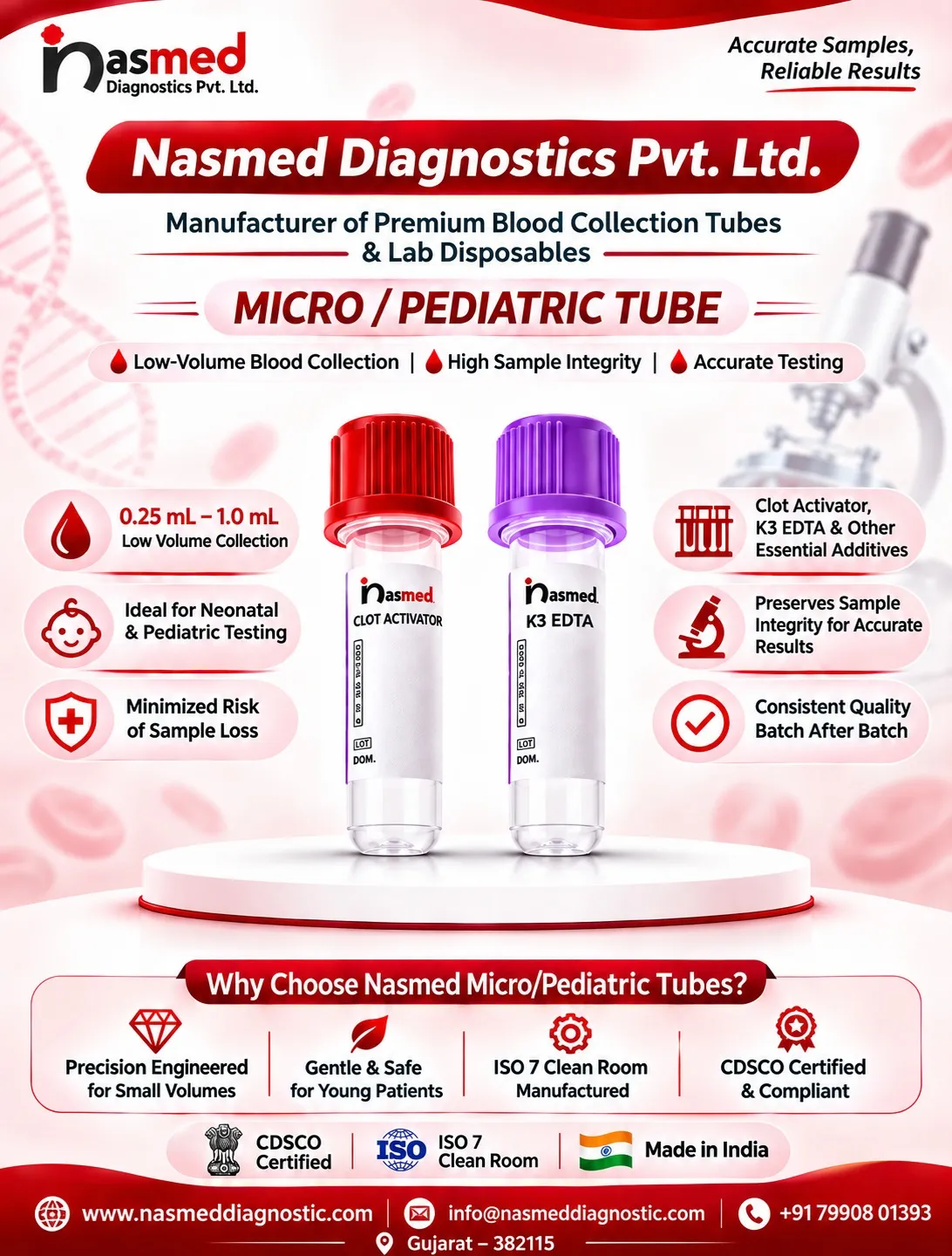
Innovative Blood Collection Tubes Healthcare Solutions
How Do Innovative Blood Collection Tubes Reduce Sample Errors?
Innovative Blood Collection Tubes Healthcare Solutions from Nasmed Diagnostics Pvt. Ltd. are designed to reduce sample errors by ensuring accurate blood collection, secure additives, and consistent vacuum performance. Manufactured in an ISO 7 clean room with strict quality control, these tubes help prevent contamination, clotting issues, and sample loss. Their precision engineering preserves specimen integrity, enabling laboratories and healthcare professionals to achieve reliable diagnostic results while improving workflow efficiency and patient care.
Blood Collection Tubes Manufacturers in Gandhinagar: A Practical Guide for Indian Labs and Hospitals
Choosing a reliable partner for diagnostic lab disposables is not just a procurement decision — it directly affects sample integrity, patient safety, and lab turnaround time. For hospital administrators, pathology lab owners, and diagnostic center managers across India, the search for consistent, contamination-free vacuum blood collection tubes often comes down to one question: can the manufacturer be trusted, batch after batch? Nasmed Diagnostics has spent years answering that question for labs in Gujarat and beyond, manufacturing tubes and containers in a controlled clean room environment designed specifically for diagnostic accuracy.
This article walks through how modern blood collection tube manufacturing works, what regulatory compliance actually looks like in practice, and how procurement teams can evaluate suppliers without getting lost in marketing claims.
Why Choose Nasmed Diagnostics for Blood Collection Tube Manufacturing
Sample quality starts at the tube, not at the testing bench. A tube with inconsistent vacuum draw, poor additive coating, or contamination risk can compromise results before the sample even reaches the analyzer — something every experienced lab technician in Mumbai or Chennai has encountered at least once with a poorly manufactured batch.
Nasmed Diagnostics, based in Gandhinagar, Gujarat, manufactures its range in an ISO 7 clean room facility (Class 10,000), which limits airborne particle contamination during production. The facility is led by Directors Kush Patel and Suril Shah, along with a technical team focused on additive precision and vacuum consistency. This matters practically: a lab in Pune ordering gel lithium heparin tubes needs the anticoagulant ratio to be exact every single time, not just on the first few batches.
The company’s product range includes non-vacuum blood collection tubes, micro paediatric tubes for pediatric and neonatal draws, and cell-free DNA tubes used in oncology and prenatal diagnostics — all manufactured under CDSCO oversight, which is the baseline regulatory expectation for any medical device sold in India.
Manufacturing Capabilities: What Goes Into Every Batch
Here’s how Nasmed Diagnostics approaches production quality control. Every batch of sterile blood collection tubes goes through additive dosing checks, vacuum calibration, and visual inspection before packaging. For labs handling high patient volumes — think diagnostic chains in Bangalore or Hyderabad running hundreds of draws a day — even a small variance in vacuum fill volume can throw off sample-to-additive ratios, which is why batch consistency is treated as a manufacturing priority rather than an afterthought.
The product line covers several draw types used across Indian healthcare settings:
- Vacuum tubes for standard venous draws in hospitals and diagnostic labs
- Non-vacuum tubes, often preferred by smaller clinics for manual draw procedures — see the K3 EDTA Non Vacuum Blood Collection Tubes range for hematology applications
- Sodium fluoride tubes for glucose and lactate testing, detailed on the Sodium Fluoride Non Vacuum Blood Collection Tubes page
- Micro and paediatric formats for low-volume draws, particularly relevant for NICU and pediatric wards — browse the Micro/Pediatric Tube category for specifications
- Urine containers manufactured under the same clean room protocols for consistent sample collection integrity
Custom diagnostic solutions are also available for labs with specific volume, additive, or labeling requirements — a common request from mid-sized labs in Indore and Vadodara scaling up their sample collection processes.
Navigating Regulatory Compliance and CDSCO Certification
The best starting point for any procurement team is verifying regulatory compliance before evaluating price or delivery timelines. In India, blood collection tubes fall under CDSCO’s medical device regulations, and manufacturers are expected to follow material safety and labeling standards aligned with international guidelines for in-vitro diagnostic devices.
CDSCO certified tubes are manufactured with documented traceability — batch numbers, material certificates, and quality test records that a hospital’s procurement or quality assurance team can audit if needed. This is particularly relevant for NABL-accredited labs, where auditors routinely check consumable sourcing documentation during accreditation renewals. Labs in Delhi and Kolkata undergoing NABL audits have increasingly asked suppliers for this kind of documentation upfront, rather than requesting it reactively.
Nasmed Diagnostics maintains CDSCO certification alongside its ISO 7 clean room manufacturing environment, giving procurement teams a documented basis for compliance checks rather than relying on verbal assurances.
Local Suppliers vs Nasmed Diagnostics: A Comparison
Yes, we understand procurement teams often compare local trading suppliers against direct manufacturers before finalizing a vendor. Here’s a practical breakdown of what typically differs:
| Parameter | Local Traders/Resellers | Nasmed Diagnostics (Direct Manufacturer) |
|---|---|---|
| Manufacturing Transparency | Often limited or unclear origin | ISO 7 clean room, documented process |
| Batch Consistency | Varies by third-party source | Controlled additive & vacuum calibration |
| Regulatory Documentation | May require follow-up requests | CDSCO certification available on request |
| Customization | Limited, fixed catalog only | Custom diagnostic solutions available |
| Pricing Structure | Reseller margin added | Direct manufacturer pricing |
Step-by-Step: How Nasmed Diagnostics Delivers Orders
- Requirement discussion — the team reviews draw type, volume, and additive requirements over a call or WhatsApp consultation
- Sample dispatch — sample tubes are sent for quality evaluation by the lab’s technical team
- Order confirmation and production scheduling — batch manufacturing is scheduled in the ISO 7 clean room facility
- Quality testing — each batch undergoes vacuum draw and additive dosing verification
- Sterile packaging and dispatch — tubes are packed under hygienic conditions and shipped to cities including Surat, Chandigarh, and Jaipur
Real Client Case Study: A Diagnostic Chain in Ahmedabad
A mid-sized diagnostic chain operating across three centers in Ahmedabad had been sourcing tubes from a regional reseller and started noticing inconsistent vacuum fill across batches — leading to occasional recollection requests, which frustrated both staff and patients. After switching to Nasmed Diagnostics for their vacuum and gel lithium heparin tube requirements, the lab’s quality team reported more predictable draw volumes and fewer sample rejection incidents over subsequent months. The lab’s procurement head specifically noted that having direct access to batch documentation simplified their internal quality audits.
A similar pattern played out with a smaller clinic in Rajkot that switched to non-vacuum tubes for manual draws — their main feedback was around simpler reordering once a stable supply relationship was established, rather than any dramatic before-after transformation. Sample quality improvements tend to be practical and incremental, not overnight.