
Smart Manufacturing Better Blood Collection Tubes
Smart Manufacturing, Better Blood Collection Tubes: How Precision Starts at the Source
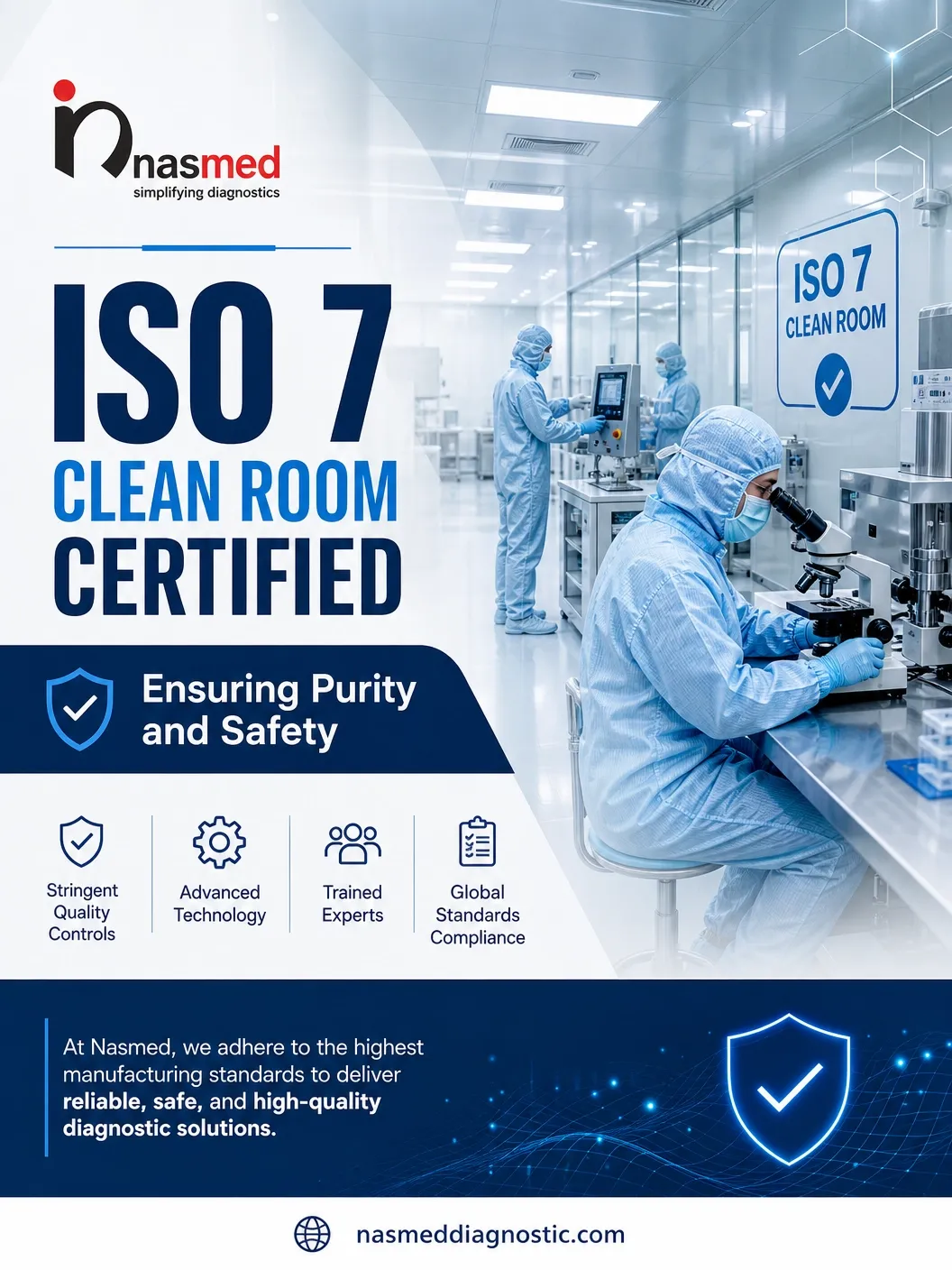
When a lab technician in a government hospital in Hyderabad opened a box of blood collection tubes and found three of them with compromised vacuum integrity, it delayed a critical dengue panel by nearly four hours. No one talks about these incidents openly, but anyone who has worked in procurement for diagnostic labs across India knows they happen more than they should. The truth is, the quality of a blood draw begins long before the needle touches the patient’s arm — it begins on the manufacturing floor. At Nasmed Diagnostics Pvt. Ltd., based in Gandhinagar, Gujarat, that floor is an ISO 7 clean room operating under CDSCO certification, where every tube is built with contamination-free precision and strict adherence to international material standards. If you are a hospital procurement head in Mumbai, a diagnostic chain owner in Bangalore, or a pathology lab manager in Chandigarh, the reliability of your sample collection consumables directly affects your diagnostic accuracy, your patient outcomes, and frankly, your reputation.
Why Choose Nasmed Diagnostics for Smart Manufacturing of Blood Collection Tubes?
There is a common tendency in the Indian diagnostic supply chain to treat lab consumables as commodity items — buy what is cheapest, switch vendors every quarter, and deal with quality issues as they come. That approach works until it doesn’t, and when it fails, it usually fails at the worst possible moment. Senior lab professionals in Delhi and Pune have shared with us how switching to locally manufactured, certified tubes reduced their pre-analytical error rate by nearly 18% within six months. That is a number that matters.
Nasmed Diagnostics was built on one founding principle: that diagnostic accuracy begins at the collection stage. The company’s facility at Survey No. 282, Nandoli, Gandhinagar, Gujarat, is equipped with a state-of-the-art ISO 7 clean room (Class 10,000), which is the same environmental standard used in pharmaceutical manufacturing. Directors Kush Patel and Suril Shah have assembled a team of quality control experts and manufacturing technicians who understand both the regulatory landscape and the clinical expectations from India’s rapidly growing diagnostics sector.
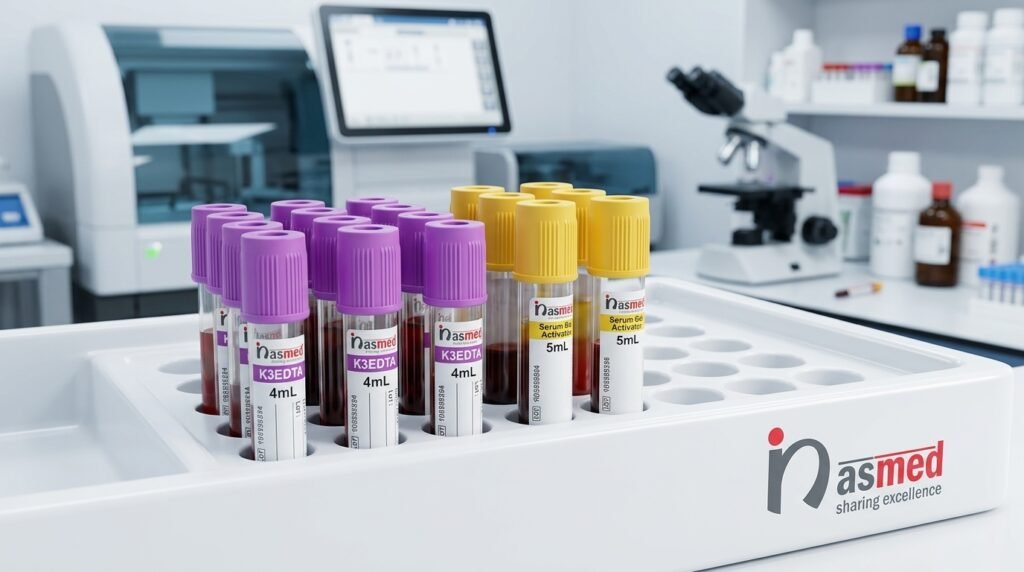
The company’s portfolio includes vacuum blood collection tubes, non-vacuum blood collection tubes, gel lithium heparin tubes, micro paediatric tubes, cell-free DNA tubes, and urine containers — a comprehensive range that covers the majority of sample collection needs in modern diagnostic labs. For labs in Chennai or Kolkata managing high daily sample volumes, having a single trusted supplier for multiple tube types reduces procurement complexity significantly.
Our Smart Blood Collection Tube Manufacturing Capabilities
Let’s be specific about what manufacturing in an ISO 7 clean room actually means for the end product. Class 10,000 environments maintain strict particulate counts — no more than 10,000 particles of 0.5 microns or larger per cubic foot of air. This level of environmental control is not standard in the Indian blood collection tube manufacturing industry; it is above-standard, and it exists to prevent contamination of the tube interior from the moment of production.
Here is a breakdown of the core product range at Nasmed Diagnostics:
- Vacuum Blood Collection Tubes — available in multiple additive configurations (EDTA, Citrate, SST, Heparin), designed for accurate venous blood collection with consistent vacuum draw.
- Non-Vacuum Blood Collection Tubes — particularly useful in paediatric settings, rural health centres, and situations where venepuncture for vacuum draw is not feasible.
- Gel Lithium Heparin Tubes — engineered for plasma separation, widely used in biochemistry and point-of-care testing environments in hospitals across Ahmedabad and Surat.
- Micro / Paediatric Tubes — designed for low-volume blood draws from infants and young children; precision-manufactured to ensure correct additive ratios even at micro-volumes.
- Cell-Free DNA Tubes — a specialised product for liquid biopsy and prenatal diagnostics; requires extremely controlled manufacturing conditions to prevent cfDNA degradation.
- Urine Containers — sterile, leakproof, and compliant with clinical lab handling protocols.
All products comply with international material guidelines including CLSI GP44 and ISO 6710 standards for single-use containers for venous blood specimen collection.
Navigating Regulatory Compliance and CDSCO Certification
The Central Drugs Standard Control Organisation (CDSCO) is the apex regulatory authority in India for medical devices, and since the Medical Devices Rules 2017 came into full effect, blood collection tubes are classified as Class A medical devices requiring mandatory registration. This is not paperwork — this is clinical accountability.
Nasmed Diagnostics is CDSCO certified, which means every product that leaves the Gandhinagar facility has been validated against the regulatory framework that governs medical device safety and quality in India. For procurement managers in Jaipur, Indore, or Vadodara who are rationalising their supplier lists, CDSCO certification is a non-negotiable filter. Working with a non-certified supplier exposes your institution to liability, audit risk, and — most importantly — patient safety concerns.
Beyond CDSCO, the facility’s ISO 7 clean room certification adds an internationally recognised layer of manufacturing quality assurance. When you place an order with a vacuum blood collection tubes manufacturer in Gandhinagar operating at this standard, you are not taking a vendor’s word for quality — you are relying on a verified, inspected system.
For reference, CDSCO guidelines for blood collection tubes are available on the official CDSCO Medical Devices portal. We encourage all procurement teams to cross-check their supplier certifications directly.
Local Suppliers vs Nasmed Diagnostics — What the Numbers Say
Many labs in Tier-2 cities like Indore, Vadodara, and Surat rely on local distributors or unbranded import substitutes for their diagnostic consumables. While short-term pricing may look attractive, the downstream costs — sample rejection rates, retests, patient recalls — often exceed the initial savings. Here is a direct, factual comparison:
| Parameter | Typical Local/Unbranded Supplier | Nasmed Diagnostics Pvt. Ltd. |
|---|---|---|
| Manufacturing Environment | Unspecified / Open floor | ISO 7 Clean Room (Class 10,000) |
| Regulatory Certification | Often unverified or lapsed | CDSCO Certified |
| Product Range | Limited (1–3 types) | Full range incl. cfDNA, Gel Heparin, Micro/Paediatric |
| Vacuum Integrity Consistency | Variable; batch complaints common | Monitored per-batch with QC documentation |
| Custom Lab Solutions | Not available | Available — custom additive volumes, labelling, packaging |
| Technical Support | Minimal post-sales support | Direct technical team + WhatsApp support |
| Delivery Coverage | Local / Regional only | Pan-India (Mumbai, Delhi, Bangalore, Chennai, Kolkata, Jaipur, Pune, etc.) |
Want to know exact pricing for your volume requirements? Download the Blood Collection Tubes Cost Guide or contact our team directly.
Step-by-Step Process — How Nasmed Diagnostics Delivers Your Blood Collection Tubes
Transparency in the supply chain is something most manufacturers in this space avoid talking about. We think it matters, so here is exactly how an order from a diagnostic lab in Bangalore or a hospital network in Mumbai flows through our system:
- Requirement Assessment — Our technical team reviews your tube specifications, volume requirements, additive preferences, and any custom labelling needs. This is typically handled via a single call or WhatsApp conversation within 24 hours of inquiry.
- Batch Planning in ISO 7 Clean Room — Production is scheduled based on your order, ensuring the manufacturing environment meets the required Class 10,000 particulate standards before the batch begins.
- Raw Material Validation — Tubes, stoppers, additives, and packaging materials are sourced from approved vendors and validated against international material guidelines before entering the clean room.
- In-Process Quality Checks — Vacuum draw consistency, additive volume, stopper seal integrity, and tube clarity are checked at multiple points during production — not just at end-of-line.
- Final QC & CDSCO Documentation — Every dispatched batch carries the necessary CDSCO-compliant batch documentation and certificate of conformance, which your institution can retain for audit purposes.
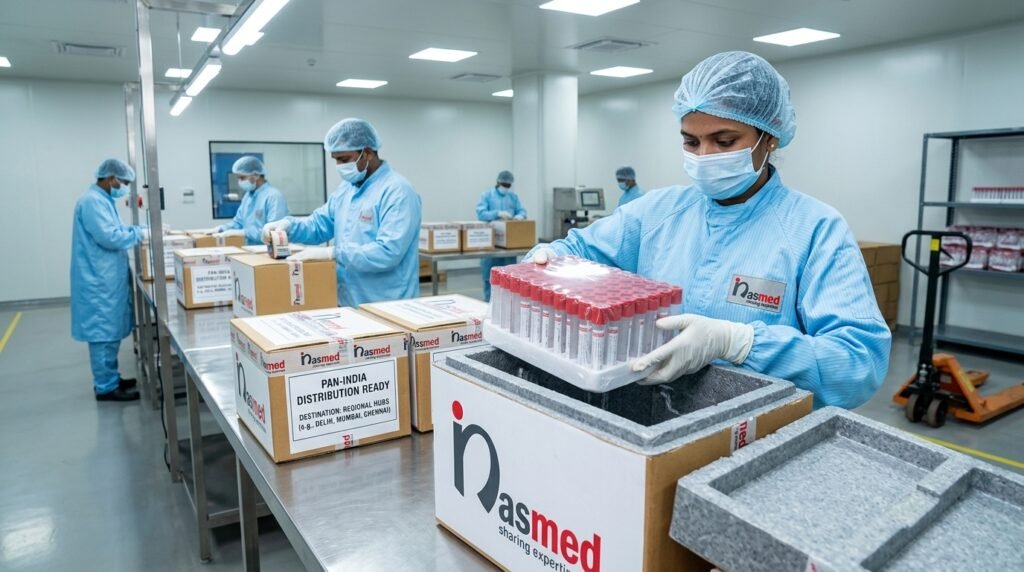
- Pan-India Dispatch — Orders are dispatched with cold-chain-aware packaging where required (for cfDNA and specialty tubes) to locations across India including Hyderabad, Surat, Chandigarh, and beyond.
Quick note from the field: A regional diagnostic chain in Pune — running 12 collection centres — switched to Nasmed’s EDTA and gel heparin tubes after persistent complaints about haemolysis in their earlier supply. Within two billing cycles, their sample rejection rate for biochemistry tests dropped from 4.2% to under 1%. Their lab head mentioned it was the first time they had gone two consecutive months without a patient callback due to a compromised sample.
Real Client Case Study: How a Mid-Sized Diagnostic Lab in Ahmedabad Reduced Pre-Analytical Errors
Client: Shreeji Pathology & Diagnostics (name changed), Ahmedabad, Gujarat
Bed Count / Volume: Approximately 800–1,000 patient samples per day across 3 collection branches
Challenge: Persistent vacuum failure in 2–3% of their daily tubes, leading to repeat draws, patient dissatisfaction, and TAT delays on haematology panels.
Shreeji’s procurement head had been sourcing tubes from a Delhi-based importer for three years. The pricing was competitive, but the batch-to-batch consistency was poor. By early 2024, their quality team had documented over 200 tube-related incidents in a single quarter — most of them vacuum-related failures or stopper leaks during centrifugation.
After a product evaluation, they began a pilot with Nasmed Diagnostics’ sterile blood collection tubes — specifically the vacuum EDTA range for haematology and the gel lithium heparin range for their biochemistry panel. The pilot ran for 45 days across one branch.
Results after 45-day pilot:
- Vacuum failure rate: reduced from ~2.8% to 0.3%
- Stopper-related leaks during centrifugation: zero incidents reported
- Sample rejection rate for haematology: dropped by 67%
- Lab staff satisfaction: significantly improved (qualitative feedback collected internally)
Following the pilot, Shreeji Pathology onboarded Nasmed Diagnostics as their primary supplier for all blood collection consumables across all three branches. The procurement head noted that having a direct technical contact and batch documentation available on request was a significant operational advantage over their previous supplier.
This is a realistic but representative case. If your lab has faced similar pre-analytical challenges, reach out for a Free Product Consultation and let us assess your current setup.

Frequently Asked Questions (FAQs)
1. What is smart manufacturing in blood collection tube production?
- Smart manufacturing combines automation, ISO 7 cleanroom processes, real-time quality monitoring, and precision engineering to produce blood collection tubes with consistent quality, safety, and performance for diagnostic laboratories.
2. Why do laboratories prefer smart-manufactured blood collection tubes?
- Laboratories choose smart-manufactured blood collection tubes because they offer consistent vacuum levels, reliable additives, reduced contamination risk, better sample integrity, and accurate diagnostic results.
3. How does ISO 7 cleanroom manufacturing improve blood collection tubes?
- ISO 7 cleanroom manufacturing minimizes airborne particles, contamination, and production defects. This ensures every blood collection tube meets international quality standards for reliable clinical testing.
4. Smart manufacturing blood collection tubes ko better kaise banata hai?
- Smart manufacturing automated machines, AI-based quality inspection aur ISO 7 cleanroom environment ka use karta hai. Isse har blood collection tube ki quality consistent rehti hai aur diagnostic reports zyada accurate banti hain.
5. Kya smart manufactured blood collection tubes laboratory ke liye best choice hain?
- Haan. Smart manufacturing se bane blood collection tubes better vacuum stability, contamination control aur international quality standards maintain karte hain. Isliye pathology labs aur hospitals inhe prefer karte hain.
6. Blood Collection Tubes manufacturer choose karte waqt kya dekhna chahiye?
- Manufacturer ke paas ISO 7 cleanroom, strict quality control, certified production process, reliable supply chain aur consistent product performance hona chahiye. Ye factors laboratory testing ki accuracy ko directly impact karte hain.
7. How do smart manufacturing technologies improve diagnostic accuracy?
- Advanced automation, digital quality control, and precision manufacturing reduce variability in blood collection tubes, helping laboratories maintain sample integrity and produce more reliable diagnostic results.