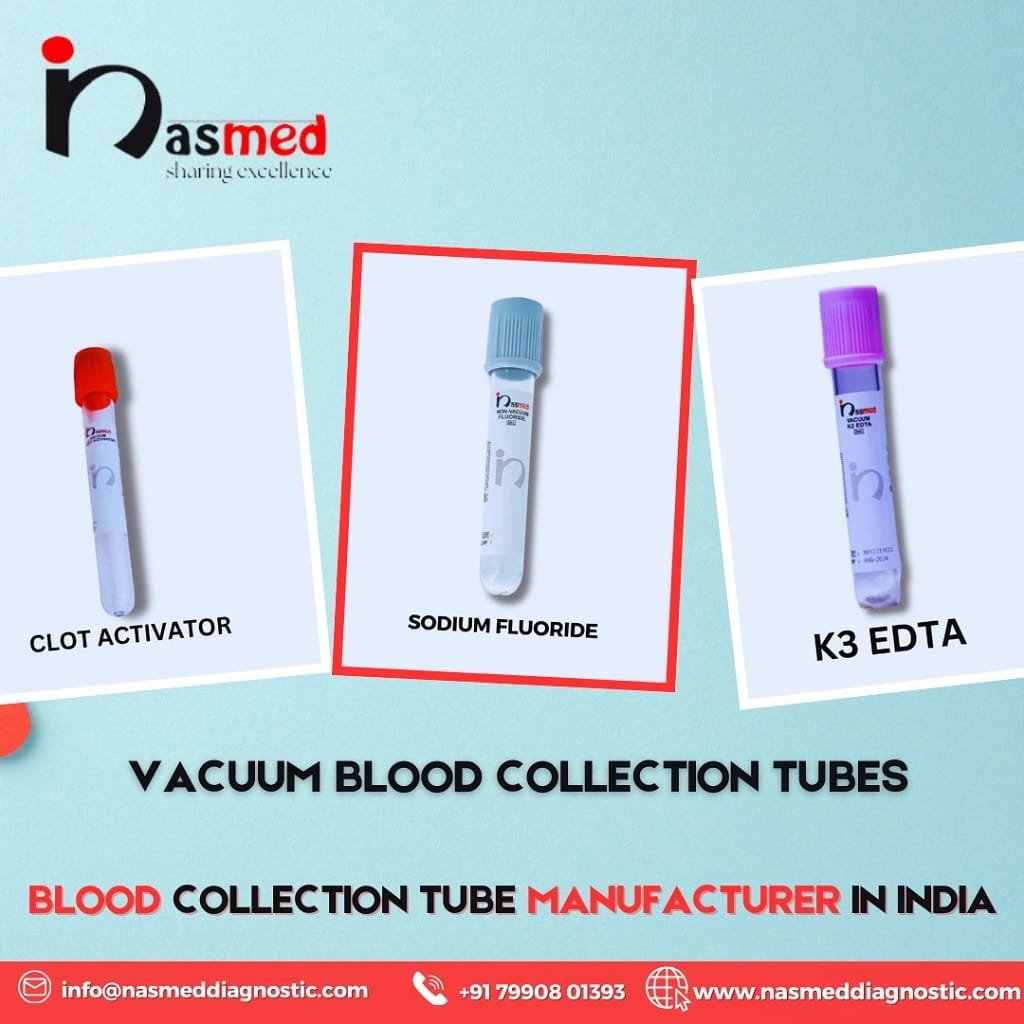
Leading Manufacturer & Supplier of Blood Collection Tubes: Nasmed Diagnostics Pvt. Ltd.
Modern diagnostics has evolved dramatically over the past two decades. From traditional manual microscopy-based testing to fully automated analyzers and integrated laboratory information systems, pathology and diagnostic services now operate with remarkable precision and efficiency. Across hospitals in India, reference laboratories in the USA and UK, and expanding healthcare systems in regions like the Middle East and Southeast Asia, accurate sample collection remains the cornerstone of reliable test results. Trusted for quality and consistency, Nasmed Diagnostics: India’s Leading Blood Collection Tubes Supplier ensures that every sample is handled safely and efficiently, supporting accurate and timely diagnostics worldwide.
Among all diagnostic supplies, Blood Collection Tubes hold a primary position. Regardless of how sophisticated the testing equipment or how seasoned the clinician, the quality of the outcome starts with the quality of the sample. Accurate blood drawing, maintenance, transport, and preparation directly impact patient assessment, treatment decisions, and ongoing care outcomes.
For those managing diagnostic facilities, hospital executives, and purchasing groups, selecting the appropriate blood collection tube vendor is more than just a purchasing decision— it affects clinical reliability.
Shifting Requirements of Contemporary Diagnostic & Healthcare Facilities
In daily lab functions, several developing demands shape consumable selection:
- Increasing test volumes due to wellness checks and ongoing condition monitoring
- Quicker turnaround time (TAT) desires
- Rigorous internal quality assurance methods
- Accreditation mandates (like NABL, ISO, CAP equivalents worldwide)
- Export and regulatory obligations for international arenas
Hospital and pathology settings today are more standardised and subject to review than ever before. Whether a diagnostic network in India is expanding into multiple metropolitan areas or a distributor in the UAE is supplying government medical centres, uniformity in supplies becomes crucial.
What Is a Blood Collection Tube?
A Blood Collection Tube is a sterile, specifically engineered medical container used to draw, preserve, and transport blood specimens from patients to testing centres.
In practical terms, throughout standard venipuncture:
- A healthcare provider withdraws blood using a needle setup.
- The blood flows straight into the vacuum or non-vacuum vessel.
- The tube holds specific agents (if needed) based on the required test.
- The specimen is lightly combined, marked, and forwarded for processing.
Why Blood Collection Tubes Are Vital for Precise Blood Sample Collection?
Reliable diagnosis hinges on the integrity of the specimen.
A correctly made blood collection tube guarantees:
- Accurate blood-to-additive proportion
- Prevention of coagulation (when necessary)
- Avoidance of pollution
- Stability of measurable components
In export-grade diagnostic setups, especially those serving markets such as Europe or Australia, maintaining consistency in specimen preservation is vital for comparisons across labs and standardised reporting.
In day-to-day lab tasks, even slight variations in additives can alter test findings. For instance, incorrect EDTA concentration might skew hematology measures. Thus, the tube is a managed element in the pre-analytical sequence.
Role of Blood Collection Tubes in Trustworthy Test Outcomes
Choosing the wrong tube or substandard quality can impact:
- Test precision
- Necessity for repeat testing
- Lab productivity
- Patient confidence
Consider a real instance: A glucose sample drawn into a tube lacking proper sodium fluoride stabilisation might yield lower glucose readings if processing is delayed. This could result in inexact reporting and potential misjudgment.
Likewise, using the wrong anticoagulant tube for clotting tests can render the results invalid.
In hospital and pathology lab settings, specimen rejection due to improper tubes increases the workload, delays reports, and negatively affects the patient experience. Dependable blood collection tubes lessen these dangers.
Safety, Sterility & Patient Care Aspects
Patient well-being starts at the point of collection.
Top-quality blood collection tubes are:
- Sterilised under regulated conditions
- Made to stop leakage
- Fabricated using medical-grade components
- Checked for vacuum completeness
For phlebotomists and lab personnel, ease of use and secure capping mechanisms decrease the risk of exposure. In high-throughput collection centres in India or major hospitals in the UK, a safe tube design aids smoother operations and reduces on-the-job risks.
Sterility is not a sales term — it is a fundamental prerequisite in clinical practice.
Compatibility with Modern Diagnostic Apparatus
Current laboratories employ:
- Automated blood cell counters
- Chemistry analyzers
- High-speed spinning machines
- Automated specimen handling setups
Blood collection tubes must have uniform dimensions and be compatible with these systems.
In international lab environments — from Singapore’s high-volume centres to reference labs in Canada — automation requires uniform tube sizes, cap rigidity, and legible labels.
Inconsistent tube manufacturing can cause analyser blockages, barcode reading errors, or centrifuge instability. Compatibility ensures smooth incorporation into automated processing lines.
Manufacturing Excellence, Agents & Tube Uniformity
From a production standpoint, consistency is achieved through controlled procedures and quality evaluations.
Typical agents utilised in blood collection tubes include:
- EDTA: for blood cell analysis
- Heparin: for plasma-based chemical tests
- Sodium Fluoride: for settling glucose levels
- Clot accelerator with gel: for serum segregation
Storage, Shelf Life & Shipping/Transit Concerns
India’s climate presents unique challenges, including high temperatures and humidity. Blood collection tubes must maintain physical soundness and agent stability even across prolonged storage.
For shipments abroad to destinations such as Saudi Arabia, Qatar, or Africa, extended logistics and temperature fluctuations must be factored in.
Properly manufactured tubes provide:
- Steady usability under suggested storage
- Robust packaging for transit
- Resistance to leaks during shipment
- In worldwide supply networks, sustaining quality from the factory to the lab shelf is essential.
Value Effectiveness for Labs & Healthcare Providers
Cost savings in diagnostics are not about choosing the cheapest option. It’s about minimising operational deficit.
Trustworthy blood collection tubes help minimise:
- Rates of specimen rejection
- Costs related to re-testing
- Extra venipuncture procedures
- Postponed reporting
In routine lab operations, fewer errors before analysis directly boost output. Purchasing managers and hospital executives frequently judge supplies based on long-term functional impact rather than initial outlay.
Stable supply and uniform quality contribute to predictable budgeting and smoother lab administration.
Adherence, Norms & Export Preparedness
Global purchasers, distributors, and hospital procurement teams anticipate:
- Documented quality supervision frameworks
- Traceability of product batches
- Consistent product specifications
- Transparency in audits
Export readiness requires understanding the paperwork, packaging, labelling, and compliance requirements across markets such as Europe, Southeast Asia, and parts of Africa.
For IVD distributors and importers, supplier dependability directly influences their standing in local arenas.
Fitting into Hospital & Lab Procedures
Blood collection tubes are used across several healthcare settings:
- Outpatient blood drawing stations
- Emergency units
- In-patient wards
- Main diagnostic labs
- Large diagnostic chains
In hospital and pathology settings, tubes need to fit naturally into standard routines — from the phlebotomy kit to centrifuge operation to analyser loading.
Clear colour coding, sturdy caps, and a dependable vacuum function simplify tasks and reduce the need for extensive training.
Instruction, Handling & Disposal Protocols
Medical pupils, lab personnel, and new phlebotomists are instructed on:
- Proper sequence of draw
- Accurate mixing technique
- Secure labeling
- Segregation of bio-medical waste
Blood collection tubes are single-use medical devices and must be discarded in accordance with biomedical waste control rules.
Clear marking and standardised style support simpler instruction and safe disposal methods.
Why is Selecting the Right Producer Important?
The manufacturer behind the tube plays a significant part in diagnostic reliability.
Key elements for consideration include:
- Prior experience in medical supply production
- Internal quality assurance systems
- Comprehension of export paperwork
- Uniform manufacturing capability
- Technical backup for distributors
Seasoned lab experts recognise that frequent changes in tube vendors can upset internal validation frameworks and quality assurance reference points.
Sustained collaborations with dependable manufacturers lead to operational steadiness.
About Nasmed Diagnostic Pvt Ltd
Nasmed Diagnostic Pvt Ltd is an expert manufacturer of Blood Collection Tubes, serving diagnostic facilities and medical organisations in India and global markets.
With a focus on quality-managed manufacturing, uniformity, and export-readiness, the company assists hospitals, pathology labs, and IVD distributors across diverse healthcare systems.
More details regarding product specs and manufacturing capacities are available at:
👉 https://www.nasmeddiagnostic.com/
Conclusion:
Modern diagnostics relies on correctness at every phase. While advanced testing equipment and expert clinicians are vital, the bedrock of every report lies in proper sample acquisition.
Blood Collection Tubes are not mere holders — they are controlled medical tools designed to maintain sample integrity, improve workflow efficiency, and ensure reliable outcomes.
For diagnostic centres, hospitals, and worldwide distributors, selecting the proper tube manufacturer directly contributes to patient safety, operational stability, and lasting clinical confidence.
Healthcare bodies seeking a reliable supply and consistent quality should assess manufacturing standards, compatibility, and export-readiness before finalising procurement decisions.
Main Points
- Diagnostic Precision: Retains specimen integrity for trustworthy findings
- Specimen Security & Sterility: Guarantees safe handling and pollution defence
- Workflow Speed: Compatible with automated lab setups
- Expense Management for Labs: Cuts down specimen rejection and repeat testing
- Increasing Worldwide Need: Crucial for expanding healthcare structures
Frequently Asked Questions (FAQs)
1. How do Blood Collection Tubes affect test accuracy?
- They maintain correct blood-to-additive ratios and prevent clotting or degradation, which directly impacts analytical reliability.
2. Can incorrect tube selection lead to sample rejection?
- Yes. Using the wrong additive or tube type can invalidate test results, requiring recollection.
3. What is the typical shelf life of Blood Collection Tubes?
- Shelf life depends on manufacturing standards and storage conditions. Tubes should be stored according to the manufacturer’s recommendations to maintain additive stability.
4. Are Blood Collection Tubes compatible with automated analysers?
- Quality tubes are designed for compatibility with modern analysers, centrifuges, and robotic systems used in hospital and reference laboratories.
#BloodCollectionTube #DiagnosticConsumables #PathologyLab #MedicalDiagnostics #NasmedDiagnostic #IVDProducts #HealthcareManufacturing #GlobalDiagnostics #SodiumFluorideBloodCollectionTubes